
Top Alawite cleric urges mass protest after Homs mosque bombing
 3 Min Read
Sheikh Ghazal Ghazal urges a peaceful mass protest, calls for political federalism, and warns of worsening violence if fundamental changes aren’t made.
-
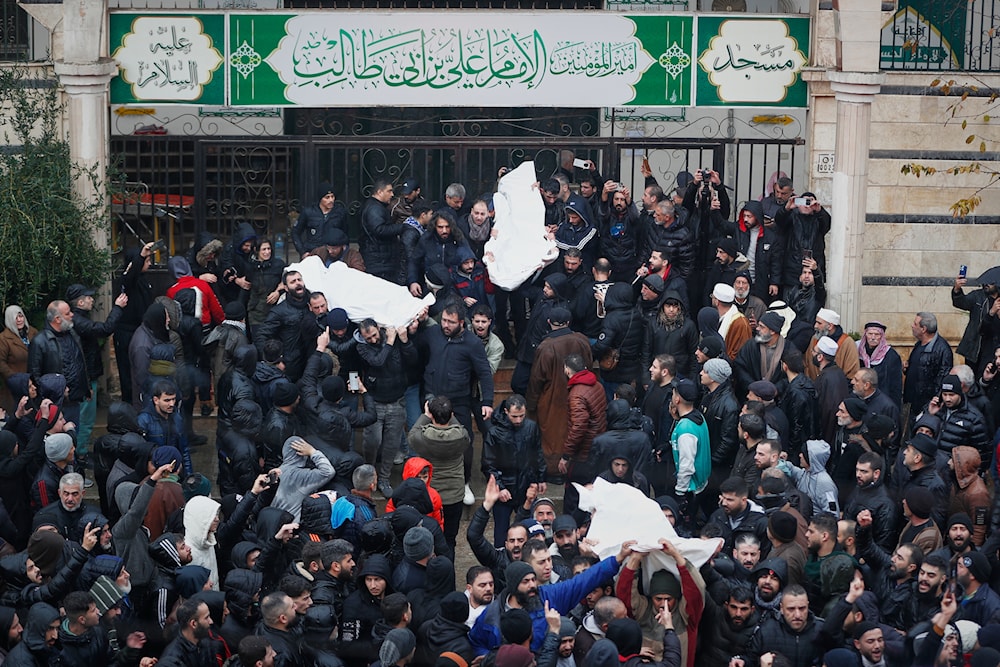
The bodies of victims of an attack a day earlier at the Imam Ali bin Abi Talib Mosque in the predominantly Alawite Wadi al-Dhahab neighborhood are carried outside the mosque for burial in Homs, Syria, Saturday, Dec. 27, 2025 (AP)
The head of the Supreme Alawite Islamic Council in Syria and the diaspora, Sheikh Ghazal Ghazal, announced plans for a peaceful mass demonstration on Sunday, calling on supporters to gather from noon until 5 pm in what he described as a “human flood” that would fill public squares.
In a statement, Sheikh Ghazal urged members of other Syrian communities to stand in solidarity with the Alawites and support their demands, stressing that the movement seeks political solutions rather than violence. “We do not want a civil war, but political federalism,” he stated.
He rejected characterizations of the current situation as a conflict between rival parties, arguing instead that it amounts to identity-based killings aimed at breaking people’s will and forcing submission.
Sheikh Ghazal warned that silence in the face of what he described as ongoing crimes would only lead to further killings and societal collapse. He added that failure to implement swift, fundamental solutions and to impose international protection would deepen the destruction that perpetrators are seeking to inflict.
The statement follows an earlier warning by Sheikh Ghazal of an imminent outbreak of internal fighting, in which he held authorities in Damascus responsible for violations against the Alawite community. His remarks came in the aftermath of a bombing that targeted worshippers at the Imam Ali Mosque in Homs.
Terrorist attack kills 8 in Homs
At least 12 people were killed and 27 others were wounded when an explosion struck a mosque in the Wadi al-Dhahab neighborhood of Homs on December 26 while worshippers were performing their prayers. The mosque is frequented mainly by members of the Alawite community.
A militant group dubbed "Saraya Ansar Ahl al-Sunna" claimed responsibility for the attack, stating that explosive charges were used, in a statement published later on the same day.
The Supreme Alawite Islamic Council condemned on December 26 what it described as repeated terrorist attacks targeting members of the Alawite community, holding the de facto authorities fully and directly responsible for the violence and warning that such attacks are the inevitable outcome of “policies of exclusion, incitement, and coercion."
It called for urgent measures to protect civilians and called for accountability for those behind the assaults as tensions continue to escalate in affected areas.


