
Trump 'Board of Peace' still waiting for its first dollar: FT
 6 Min Read
Trump’s “Board of Peace” fund for Gaza reconstruction has reportedly received no donor money months after launch.
-
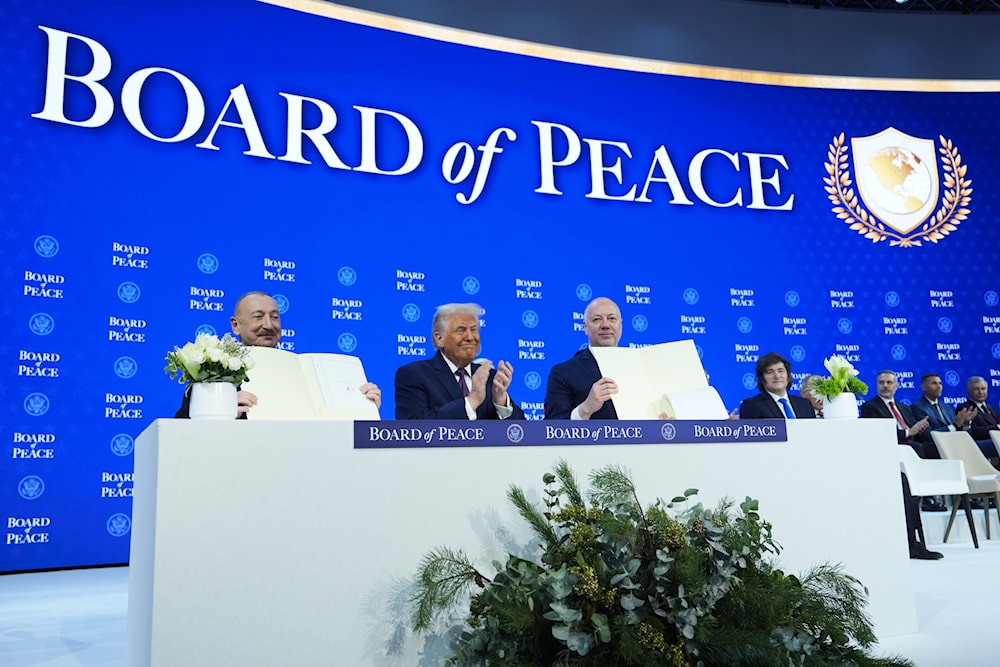
US President Donald Trump applauds as Ilham Aliyev, President of Azerbaijan, and Bulgaria's Prime Minister Rossen Jeliazkov, hold up their Board of Peace charter during the Annual Meeting of the World Economic Forum in Switzerland, Jan. 22, 2026 (AP)
The official fund established for US President Donald Trump’s so-called “Board of Peace” remains empty months after the organization’s launch, leaving major reconstruction efforts in Gaza stalled amid legal and political uncertainty, according to a report by the Financial Times.
Trump had described his "Board of Peace" as one of the most consequential international bodies created in recent years. The board sought $1 billion in “lifetime membership” fees from world leaders, while member states reportedly pledged $7 billion toward a Gaza relief package. Trump also promised an additional $10 billion in US funding for the initiative.
However, four months after the board’s establishment, the World Bank-administered financial mechanism created for Gaza reconstruction has reportedly received no contributions from donors, according to people familiar with the matter cited by the FT. One source said “zero dollars have been deposited” into the fund.
Instead of using the World Bank-managed mechanism endorsed by the United Nations, donations have reportedly been directed to a JPMorgan account controlled by the "Board of Peace". While the World Bank fund would require regular financial reporting to contributors and board members, no comparable independent transparency requirements reportedly exist for the JPMorgan account.
A "Board of Peace" official told the FT that multiple funding channels had been created, including the World Bank mechanism, adding that contributors had so far chosen alternative methods. The official said the organization would disclose its financial records to its executive board, composed of Trump administration officials and advisers, “at a time deemed appropriate.”
According to the report, contributions totaling approximately $23 million from Morocco and the United Arab Emirates have funded the office of Nickolay Mladenov, who serves as the board’s “high representative” for post-war Gaza, as well as salaries for a Palestinian technocratic committee formed to administer the territory. The UAE also reportedly allocated $100 million for training a new police force in Gaza, though the program has not yet begun and the funds remain frozen.
US funding remains unspent amid oversight concerns
The US State Department is seeking to redirect approximately $1.2 billion in aid spending toward projects linked to the "Board of Peace" agenda, though the funds have yet to be disbursed. The money would reportedly support initiatives related to Gaza reconstruction but would not be transferred directly to the board itself.
A senior congressional aide said, “None of that money [has gone to the board]. None of that money is being managed by the Board of Peace. And State tells us there’s no intent to have any of that money managed by the Board of Peace.”
The State Department is also attempting to allocate roughly $50 million directly to the "Board of Peace" for operational expenses, but those funds have likewise not been released. According to the congressional aide, US officials assured Congress that the board would not receive the money until sufficient financial oversight mechanisms and administrative controls are established.
In a statement, the State Department said it “supports the president’s vision” for the board and “continues to evaluate how existing authorities, programmes and inter-agency co-ordination can best support those objectives”.
Although the "Board of Peace" has reportedly begun issuing tenders for security and reconstruction projects in Gaza, no contracts have yet been awarded, according to the organization’s spokesperson. “A lot of it is because we’re not operating in Gaza yet,” because "Hamas had yet to disarm", the spokesperson claimed.
"Israel" has continued to launch attacks on Gaza every day since the ceasefire was first announced, killing Palestinians and destroying homes, while also continuing its blockade on the Strip. Its compliance rate with goods entering Gaza, between fuel and aid, has not yet reached 40%.
Legal and funding limbo stall post-war Gaza plans
Officials involved in postwar planning for Gaza said additional legal complications have emerged over the status of the "Board of Peace", particularly after a United Nations Security Council resolution described the body as a “transitional administration” pending the return of the Palestinian Authority to the territory.
One person familiar with the discussions questioned the long-term framework of the arrangement, asking: “What happens when this expires?” Concerns have also reportedly grown among private firms expected to participate in reconstruction efforts.
One prospective contractor said: “Who is responsible for Gaza? What law is applicable in Gaza? There’s a lot of risk for the companies that try to do this.”
Following a US-mediated ceasefire, President Donald Trump unveiled a broad postwar initiative centered on three main objectives: the disarmament of Hamas, the withdrawal of Israeli forces from Gaza, and the reconstruction of the enclave.
According to two people familiar with the planning process, none of those objectives has been achieved, while “not one US dollar” has yet been spent on rebuilding Gaza.
Bishara Bahbah, a Palestinian-American businessman who reportedly assisted negotiations with Hamas on behalf of the Trump administration, said the technocratic committee formed to administer Gaza has not begun operating inside the territory due to financial constraints.
“They know that if they go to Gaza, people are going to flood to them to ask for assistance, and they have no tools, no means,” Bahbah said, adding: “It’s really dismal.”
Responding to criticism over delays, the "Board of Peace" spokesperson said there was currently no functioning authority in Gaza “to handle the flow of services and goods that are imagined as part of the plan”. “We’re not, like, hoarding money in a bank account and then awarding contracts for things that can’t be delivered,” the spokesperson added.


