
Trump-backed Gaza board seeks immunity for actions in Gaza: Guardian
 5 Min Read
Draft documents reveal the Trump-backed Gaza governing body seeking sweeping legal immunity and free access to public property, raising alarm among legal experts.
-
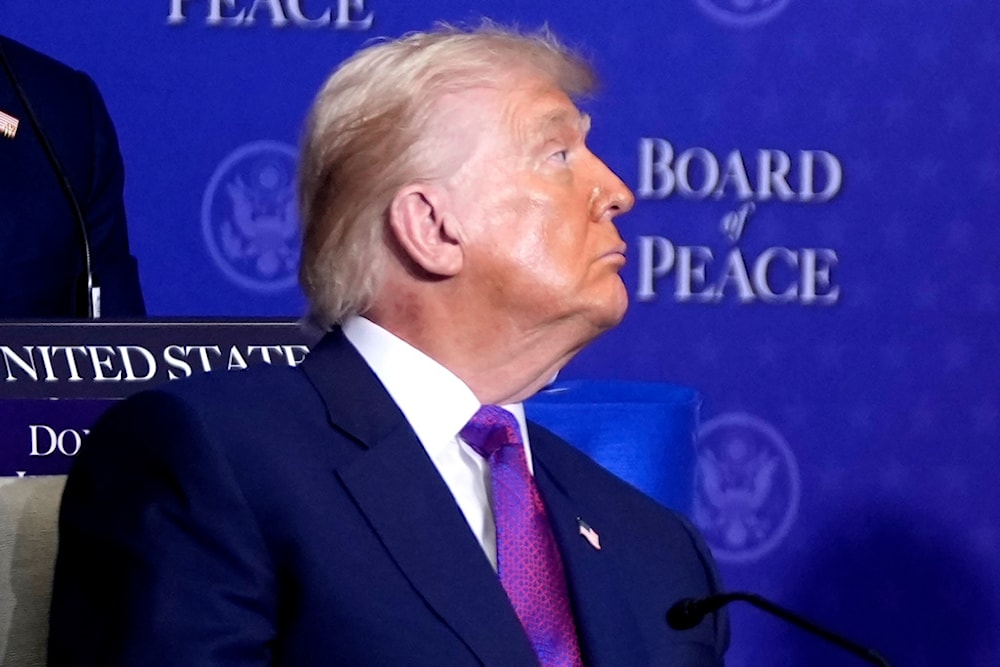
US President Donald Trump attends a "Board of Peace" meeting at the US Institute of Peace, Thursday, Feb. 19, 2026, in Washington. (AP Photo/Mark Schiefelbein)
A draft resolution obtained by The Guardian indicates that the Trump-backed Board of Peace overseeing post-war Gaza is seeking extensive legal protections for its officials, foreign personnel, and contractors, alongside authority to use public facilities in the besieged Strip without charge.
The proposal has drawn criticism from legal experts, who argue that the framework could shield officials from accountability while granting broad administrative powers over Palestinian territory.
The "Board of Peace", established under a UN-backed mandate earlier this year to administer Gaza through the end of 2027, has denied that any finalized immunity framework exists.
Read more: Hamas denies claims it refused to hand over governance in Gaza
Draft resolution proposes sweeping immunity
According to the four-page draft, members of the "Board of Peace", its Office of the High Representative (OHR), Palestinian administrators appointed to work under the body, international military personnel, and nonresident contractors would be protected from legal proceedings for actions in Gaza.
The document states that immunity would apply against "any arrest, detention or legal proceedings in the courts or other entities in Gaza".
The draft also reportedly gives Board Chair Donald Trump the authority to waive an individual's immunity, subject to majority approval by the organization's executive board.
That board includes Jared Kushner, Steve Witkoff, Susie Wiles, and Marco Rubio.
While several governments have pledged financial support for reconstruction efforts, the report states that much of the promised funding has yet to be transferred, and major reconstruction contracts have not been awarded.
Responding to questions, the Board rejected claims that such an immunity framework has been adopted.
"There is no operative resolution or immunity framework of the kind described in your questions … Any suggestion that this process is designed to create lawlessness or impunity is wrong, misleading and gets the issue entirely backwards," it said.
The Board further stated, "The suggestion that the President will have a role in establishing or waiving immunity in Gaza [is] categorically false."
Legal experts question accountability mechanisms
Legal specialists who reviewed the draft told The Guardian that the proposal raises significant questions regarding accountability for military personnel, officials, and contractors operating in Gaza.
Emily Schaeffer Omer-Man, a lawyer specializing in international humanitarian law, said, "It looks like an attempt to exempt the board, and all of its personnel, from accountability for potential legal violations."
Particular concern has focused on provisions allowing the Board itself to adjudicate claims involving property damage, personal injury, illness, or death arising from its own activities.
Rutgers University international law professor Noura Erakat argued, "They are basically saying there's no external oversight, including applicable international law regarding occupation."
"It's creating a legal system unto itself."
Several experts compared the proposed framework to legal controversies surrounding US-led reconstruction efforts in Iraq and Afghanistan, where private military contractors faced allegations involving civilian deaths, corruption, and abuse.
Read more: Indonesia could withdraw from BoP if it fails to benefit Palestinians
Public property provision raises concern
The draft's final section provides that the "Board of Peace", "shall be provided, free of charge, public premises and facilities needed for the accomplishment of the missions in Gaza".
Lawyers interviewed by The Guardian warned that the language could permit the appropriation of Palestinian public property without clearly establishing legal authority or compensation mechanisms.
The proposal does not specify which authority would transfer control of public facilities or under what legal framework.
According to the report, the Board plans to establish logistical centers and facilities supporting an international military deployment tasked with implementing aspects of Washington's post-war plan for Gaza.
Jared Kushner has previously promoted plans envisioning large-scale redevelopment of Gaza, including commercial projects, luxury tourism, and regional investment initiatives.
Commenting on the draft, Omar Shakir, Executive Director of DAWN, said, "By unilaterally declaring the power to seize Palestinian land, property and buildings for their own use without consent, compensation or readdress, the Board of Peace is taking a page out of Israel's repressive playbook."
"Far from signaling an end to genocide, apartheid and occupation, this document suggests entrenching some of its ugliest signature characteristics," he added. "This risks not only complicity, but direct perpetration of grave abuses."
Brad Parker of the Center for Constitutional Rights also questioned the proposal's legal basis.
"If they don't have a status of forces agreement with Israel, then it's not clear what the board's legal authority would be," Parker said.
Board continues planning Gaza administration
The report also states that Nickolay Mladenov, serving as the Board's High Representative for Gaza, has been meeting Palestinian administrators in Cairo to discuss the body's governing framework.
According to individuals familiar with those discussions, the draft immunity resolution has not yet been presented to the Palestinian officials participating in the process.
The draft reportedly states that it would enter into force upon Mladenov's signature, although it remains unclear whether additional parties would need to approve or recognize the framework before implementation.
Read more: Could Turkey be 'Israel's' next target after Iran?


