
Trump closes NATO summit on conciliatory note after rocky start
 4 Min Read
Trump swung from anger over allies' Iran stance to warmth at NATO's Ankara summit, pledging Ukraine the right to build Patriot missiles.
-
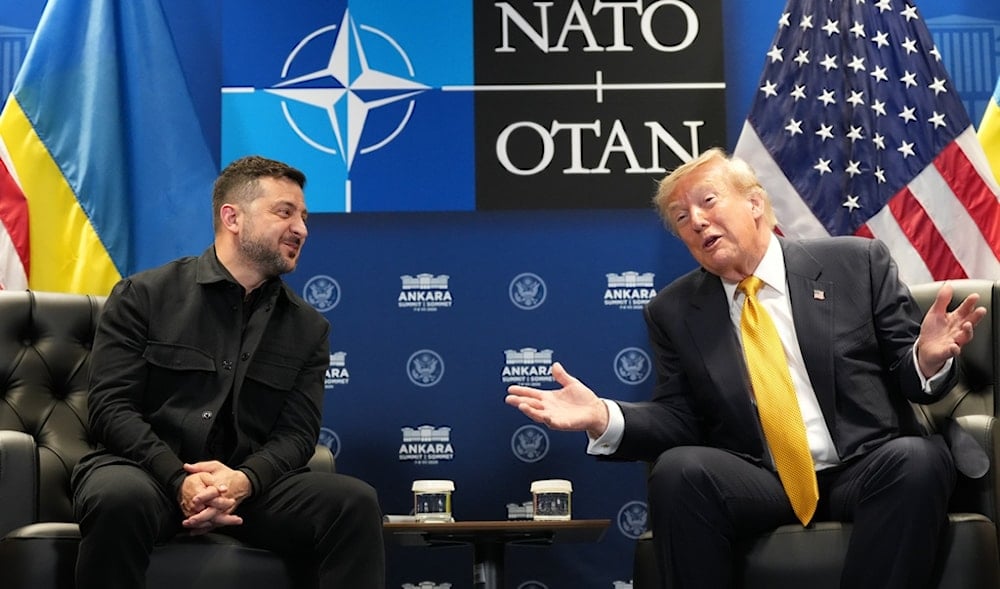
US President Donald Trump meets with Ukraine's President Volodymyr Zelensky on the sidelines of the NATO summit in Ankara, Turkey, Wednesday, July 8, 2026 (AP)
US President Donald Trump swung from public criticism to a notably warmer tone by the close of Wednesday's NATO summit in Ankara, capping a day that began with him venting frustration at allies over their stance on his war on Iran.
Trump told reporters after the closed-door session of 32 heads of state that the meeting was marked by "a lot of love" and unity, a sharp contrast to his mood hours earlier, according to AFP.
Trump had opened the day by criticizing NATO members for not backing his aggression on Iran, threatening to cut trade ties with Spain, and reiterating his insistence on annexing Greenland from Denmark. He said he was "very upset" with the alliance over both issues.
Public rhetoric diverged from closed-door tone
Once inside the private session, Trump's posture reportedly shifted. A source present at the talks told AFP there was "a strong contrast" between Trump's public statements and what he said behind closed doors, an issue confirmed by POLITICO sources as well.
Inside the room, Trump reassured allies of Washington's continued commitment to the alliance, telling leaders, "We want to remain with you." His rhetoric on Iran also softened considerably from the "scum" and "vicious, violent people" language he had used publicly, and he made no further reference to Spain or Greenland once talks began.
Estonian Prime Minister Kristen Michal echoed this account, describing Trump's internal tone as more measured and "constructive", centered on pushing Europe to increase defense investment.
Lithuanian Foreign Minister Kestutis Budrys cautioned against reading Trump's public outbursts as evidence of NATO fracturing, saying the transatlantic bond remained intact and urging less dramatization of the tensions.
Trump pledges Patriot missile production rights
A significant development emerged from Trump's sideline meeting with Ukrainian President Volodymyr Zelensky, where the Ukraine war featured prominently in summit discussions.
Trump said the US would grant Ukraine the right to manufacture Patriot air-defense missiles domestically, telling Zelensky, "We're going to give a licence to you to make Patriots," while noting the missile manufacturer had not yet been informed of the arrangement.
The pledge comes as Ukrainian forces face a shortage of US-supplied Patriot interceptors while trying to counter intensifying Russian ballistic missile strikes. Despite the pressure, Kiev appears to have stabilized front-line positions and has escalated strikes deep into Russian territory.
Trump characterized these Ukrainian strikes as a form of escalation that could nonetheless push the conflict toward resolution, reiterating his view that both Zelensky and Russian President Vladimir Putin are inclined toward reaching a deal to end the fighting.
Separately, the summit's final declaration confirmed that European allies and Canada would maintain military assistance to Ukraine at roughly $80 billion (70 billion euros) annually through both 2026 and 2027, according to the text reviewed by Reuters.
Summit declaration reaffirms 'ironclad' mutual defense pledge
The NATO summit closed with a formal declaration in which member states, including the US, reaffirmed an "ironclad commitment" to the alliance's Article 5 collective defense clause, stating that an attack on one member constitutes an attack on all.
The declaration also noted that European allies and Canada were taking on greater responsibility for the bloc's defense, accompanied by more than $50 billion in newly announced procurement deals.
NATO Secretary-General Mark Rutte claimed the alliance is emerging stronger despite the visible friction, comparing NATO to a family that grows more resilient through occasional conflict as much as harmony.
Ahead of the summit's close, allies had already unveiled tens of billions of dollars in new arms contracts on Tuesday, seen as an effort to preempt further pressure from Washington over defense spending commitments.


