
Trump says doesn't care about Iran uranium he used as casus belli
 4 Min Read
Trump says he doesn't "care" about Iran's 440 kg enriched uranium stockpile, the same stockpile his administration cited as the reason for launching the war on Iran.
-
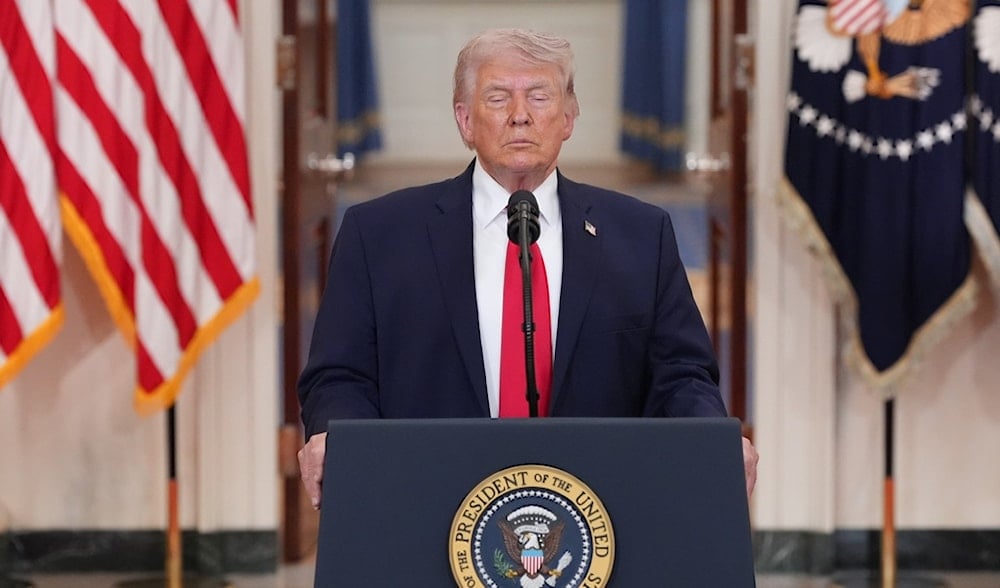
US President Donald Trump pauses as he speaks about the Iran war from the Cross Hall of the White House on Wednesday, April 1, 2026, in Washington. (AP Photo/Alex Brandon)
US President Donald Trump declared this week that he does not "care about" Iran's stockpile of highly enriched uranium, the very material his administration invoked to justify going to war on February 28.
Asked by Reuters about claims of Iran having a 440-kilogram HEU stockpile, Trump replied: "That's so far underground, I don't care about that."
He added that US satellites would monitor any movement, and warned that Iran would be struck "very hard again" if it made any move toward the material.
What he did not say was how this posture fits into the core justification his administration offered for launching the largest US war in West Asia in nearly a quarter century.
A diplomatic track killed before it could bear fruit
Two days before the US-Israeli aggression, Iran and the United States were engaged in what all available accounts describe as substantive nuclear talks in Geneva. Iranian Foreign Minister Abbas Araghchi had confirmed that February 26 was set for a further round, saying the two sides could "build something in the form of an agreement, a deal."
Tehran had reportedly put a detailed proposal on the table: a partial export of its HEU stockpile, a reduction in enrichment levels, the establishment of a regional enrichment consortium, and a restoration of comprehensive IAEA monitoring; measures that would have limited Iran's nuclear program far more effectively than any outcome now within reach, Reuters wrote.
Omani Foreign Minister Badr Albusaidi, who had been mediating, expressed deep dismay at the start of the war, highlighting how "active and serious negotiations have yet again been undermined." The UK's National Security Advisor, Jonathan Powell, was in Geneva alongside British nuclear experts and independently assessed that significant progress had been made.
A checklist of abandoned goals
The HEU is only the latest in a series of war objectives that Trump has quietly backtracked. His administration opened the war by invoking an "imminent nuclear threat" and demanding Iran's "unconditional surrender," with US war planners explicitly eying regime change. Yet, the Islamic Republic has proven incredibly resilient, with US intelligence assessing regime change unlikely.
Trump has nonetheless claimed that regime change did occur in Iran, pointing to the leadership transition that followed the assassinations of senior Iranian officials. Experts across the board have naturally dismissed the claim.
Trump also declared Iran's military capabilities "obliterated." Khatam al-Anbiya Central Headquarters spokesperson Lt Col Ebrahim Zolfaghari confirmed earlier today that US-Israeli strikes had failed to reach Iran's strategic arsenal. "Do not assume that you have destroyed our strategic missile production centers, long-range precision strike drones, advanced air defense systems, or electronic warfare capabilities," he said in a statement on Thursday.
The Strait of Hormuz tells the same story, where opening it was named by US officials as a prerequisite for any deal. Washington is now willing to end the war, with it still closed, having been caught entirely off guard by Iran's decision to blockade the waterway. A disruption the US triggered has become Iran's most powerful bargaining chip, with Tehran demanding formal recognition of its sovereignty over the strait as a condition of any settlement.
Iran is set to exit this war with its enriched uranium stockpile intact and its location largely unaccounted for, its missile arsenal substantially preserved, the Islamic Republic's standing, and control over the Strait of Hormuz transformed from a wartime measure into a recognized strategic asset.
According to nuclear proliferation expert and president of the Ploughshares Fund, Emma Belcher, Washington had likely only increased Tehran's calculus in favor of nuclear weapons as the only credible deterrent against future aggression.


