
Trump softens on Iran's missile arsenal, attacks Pope over war stance
 4 Min Read
Trump softened his stance on Iran's missile arsenal in a Monday interview, saying his real focus is preventing Tehran from obtaining a nuclear weapon.
-
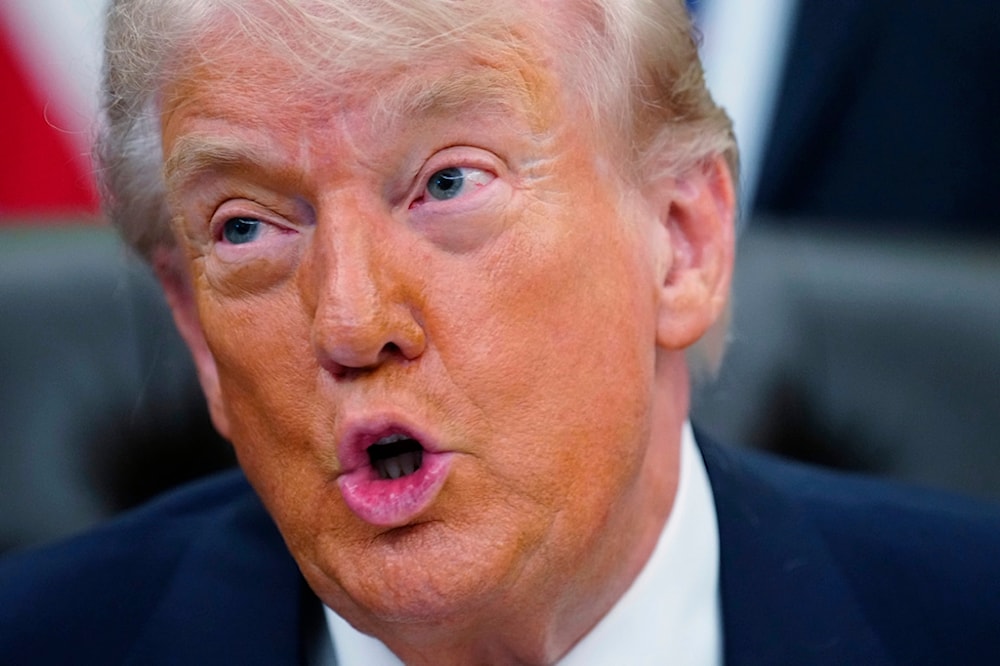
President Donald Trump speaks before signing a proclamation in the Oval Office at the White House, Tuesday, May 5, 2026, in Washington. (AP Photo/Jacquelyn Martin)
US President Donald Trump has indicated that while capping Iran's missile programme remains a demand, it is not his primary concern in any potential deal with Tehran.
Speaking in a phone interview with conservative host Hugh Hewitt on Monday, Trump was asked whether requiring Iran to cap its missile programme and submit to intrusive inspections constituted a red line.
He confirmed it did, but immediately qualified his answer. "You have to look a little bit, like, at the neighbours," Trump said, referencing Iranian arguments about why restrictions should apply to Tehran but not to other regional powers. "They say: what about other people? Look, missiles are bad, and they do have to cap it, but this is about they cannot have a nuclear weapon."
Tehran has shown no willingness to engage on that basis. Iranian officials have repeatedly stated that the country's missile capabilities are not up for discussion, with sources close to the negotiations indicating that "no one in Iran is willing to negotiate over the missile file."
The Islamic Republic has also insisted its missile arsenal cannot be neutralised through military strikes, a position that has held throughout the US-Israeli aggression that began in February.
Trump attacks Pope Leo XIV over Iran
Trump did not limit his attacks to Iran. In the same interview, he turned on Pope Leo XIV, accusing the pontiff of siding with Tehran on the nuclear question. "The pope would rather talk about the fact that it's OK for Iran to have a nuclear weapon," Trump said. "And I don't think that's very good. I think he's endangering a lot of Catholics and a lot of people."
The claim is false, however, as Pope Leo XIV has not said Iran should obtain a nuclear weapon. The pontiff has called for peace talks, criticised the war broadly, and condemned Trump's earlier threats of mass civilian strikes, comments rooted, the Vatican has said, in Catholic teaching rather than political opposition. Secretary of State Marco Rubio is expected to travel to Rome this week in what is widely seen as an attempt to manage the growing rift between Washington and the Holy See.
'We've already won,' Trump on the war
"We either make the right deal, or we win very easily. From the military standpoint, we've already won that. They had 159 ships; now they have none. They're all at the bottom of the sea," Trump said during the interview.
Despite his declarations of victory, Trump acknowledged fighting could continue for "probably another two weeks, maybe three weeks," while insisting time was not a constraint. "Time is not of the essence for us," he said.
Trump also downplayed Iran's enriched uranium stockpile, despite having used it as a casus belli to justify the war. "From a standpoint of value, it's not very valuable. Probably can't be used," he said, while adding that he would like to "get it back," a longstanding US demand Iran has firmly rejected, with Tehran insisting its uranium will not be transferred anywhere under any circumstances.
Trump's claim to have "taken over" the Strait of Hormuz is contradicted by the situation on the ground. Despite Washington's naval blockade, Iran retains effective control over the waterway, setting the terms of passage and warning that US naval vessels approaching the strait will be targeted.
Read more: No compromise on enrichment or Hormuz: Inside Iran’s reply to US
Tehran: Washington's exhaustion is showing
Iran's reading of the current standoff stands in sharp contrast to Trump's victory narrative. The Islamic Republic has repeatedly asserted that its missile capabilities remain intact and "indestructible," and that no military campaign or negotiating pressure has altered that reality.
Iranian Parliament Speaker Mohammad Bagher Ghalibaf declared on Tuesday that a new equation is solidifying in the Strait of Hormuz, and that it is Washington, not Tehran, that finds the current situation unsustainable. "We know full well that the continuation of the status quo is intolerable for America, while we have not even begun yet," Ghalibaf said.
Tehran has outlined its conditions for any formal agreement while signalling full readiness for all possible scenarios, reinforcing its posture that it enters any negotiations from a position of strength, not concession.


