
US troops withdrawal from Germany made without staff review
 5 Min Read
The US decision to pull 5,000 troops from Germany came with no staff review, no unit assessment, and no strategic planning, The Atlantic reports.
-
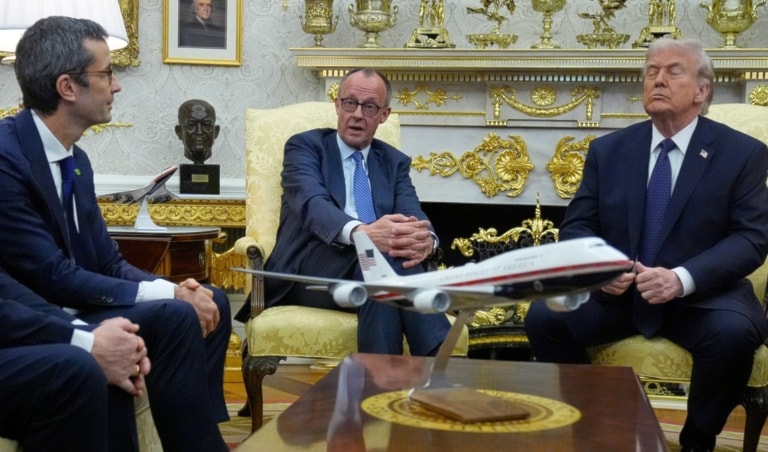
German Chancellor Friedrich Merz speaks during a meeting with President Donald Trump in the Oval Office at the White House, Tuesday, March 3, 2026, in Washington. (AP Photo/Mark Schiefelbein)
The United States decision to withdraw 5,000 troops from Germany was made without an in-depth staff review, with no assessment conducted of which units would be affected or of the broader implications of the drawdown, The Atlantic reported on Monday, citing current and former US officials.
The Pentagon confirmed the withdrawal on May 1, with spokesperson Sean Parnell announcing that roughly 5,000 troops would leave Germany within six to twelve months.
The move affects only a fraction of the nearly 40,000 US service members stationed in Germany, and officials have described it as largely symbolic, though its potential to disrupt joint training exercises and erode NATO's deterrence posture has drawn concern from European partners already navigating a deepening rift with Washington.
The decision was reactive rather than strategic. It followed remarks by German Chancellor Friedrich Merz, who said that Iranian leaders had "humiliated" the United States in its ongoing war. Trump reacted sharply, writing on Truth Social that Merz "doesn't know what he's talking about," and within days the Pentagon announced the partial withdrawal, before any formal military planning had taken place.
The Atlantic reports that the announcement fits a pattern that has defined Washington's handling of its European alliances since the war on Iran began: erratic signals, absent coordination, and grievance-driven policy.
Europe kept in the dark
NATO allies were neither warned about the war nor consulted on its objectives before it began.
Early in the campaign, the Pentagon advised German officials to focus on NATO's eastern flank while the US managed West Asia, a division of labor European capitals never agreed to, according to The Atlantic.
As the war dragged into a stalemate and the closure of the Strait of Hormuz sent energy prices surging, the fallout landed hardest on a continent that had no say in starting the conflict. Inflation, supply chain disruptions, and energy shocks have rippled across Europe, hitting industries from plastics to textiles. Slovenia became the first European country to introduce fuel rationing in late March; others have since followed.
Despite bearing these costs, Europe has had no meaningful role in shaping the war's trajectory. A European-led coalition is weighing options to ensure freedom of navigation through the Strait of Hormuz, but its leaders have said military assets will only be deployed once a durable ceasefire is in place, which remains distant.
NATO's institutional architecture under strain
The institutional damage runs deeper than the diplomatic turbulence. In March, the director of NATO policy within the Office of the Secretary of Defense, Mark Jones, a 20-year institutional figure who had shaped US engagement with the alliance since 2003, was abruptly reassigned for being viewed as too pro-NATO, The Atlantic reported.
His removal, which had not been previously disclosed, gutted US capacity for European coordination precisely when the war on Iran was straining those relationships most.
The result has been a posture without coherence. Trump labelled NATO a "paper tiger" and called allies "cowards" for not sending navies to reopen the Strait, yet The Atlantic's reporting reveals the administration never made specific military requests of its European partners. Multiple European officials told the outlet that had they been formally asked, some countries likely would have contributed.
Germany's position captures the contradiction most sharply. Berlin allowed Washington to use Ramstein Air Base as a staging ground for attacks on Iran, a latitude that Spain and Italy did not extend, and Trump personally acknowledged Merz's cooperation at their March meeting in Washington. Weeks later, he threatened to reduce the US military presence there over a single comment about the war's outcome.
Europe moves toward strategic autonomy
Faced with an unreliable Washington, European governments are accelerating a military buildup long in the making. Germany spent $114 billion on defense in 2025, a 24 percent year-on-year increase, and is rebuilding tank fleets, munitions stockpiles, and air defence systems.
German Defense Minister Boris Pistorius has called for a clear road map under which Europe gradually compensates for any US drawdown. "We must strengthen the European pillar within NATO," he said following the withdrawal announcement. "As Europeans, we must take on more responsibility for our own security."
The transatlantic relationship is being dismantled not by a grand strategy but by dysfunction, and Europe seems to have stopped waiting for it to be repaired.


