
Trump sons linked to $1.6bln US-backed mining venture in Kazakhstan
 5 Min Read
US President Donald Trump's sons are linked to a company involved in the Kazakhstan tungsten project, previously set to receive $1.6 billion in US government support.
-
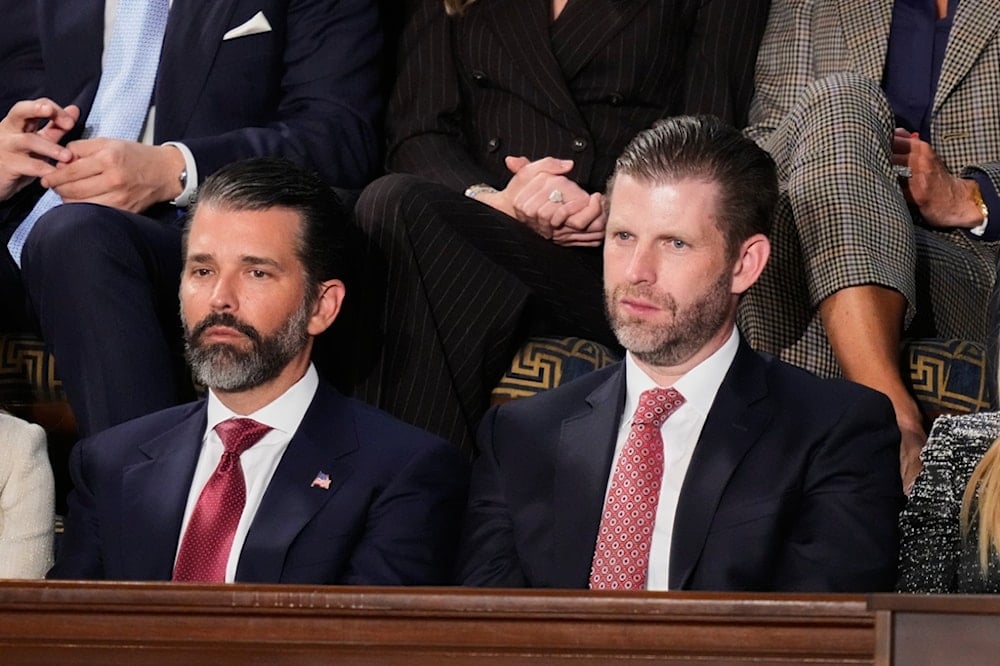
Donald Trump Jr. and Eric Trump listen to President Donald Trump's State of the Union address to a joint session of Congress in the House chamber at the US Capitol in Washington, Tuesday, Feb. 24, 2026 (AP, File)
A shell company linked to Donald Trump Jr. and Eric Trump has reportedly merged with a critical minerals group involved in a tungsten mining project in Kazakhstan that was previously lined up for up to $1.6 billion in US government backing, the Financial Times reported.
The deal is set to expand the Trump family’s business interests, with the reported investment coming amid wider scrutiny of overseas ventures tied to figures associated with US President Donald Trump and his network.
The mining venture focuses on tungsten, a strategic metal used in defense manufacturing, including munitions. The United States currently relies heavily on China for much of its supply, making alternative sources strategically significant.
The project in Kazakhstan is backed by a consortium that has been in line for financing support from US development agencies, including potential funding worth up to $1.6 billion.
Deal structure and corporate links
According to the Financial Times, Trump's sons took stakes in Skyline Builders Group Holding through a special-purpose vehicle connected to Dominari Securities, a subsidiary of Dominari Holdings Inc.
Skyline later agreed to acquire a 20% stake in a company holding critical mineral assets in Asia, later identified as Kaz Resources, a unit of New York-based mining investment group Cove Capital.
Kaz Resources is also linked to Cove Kaz Capital, which has been competing with Chinese and Russian-backed interests for control of tungsten assets in Kazakhstan.
Kazakhstan resource push
Kazakhstan has been positioning itself as a major supplier of critical minerals, particularly tungsten, amid growing global competition for strategic resources.
In November, Cove Capital and Kazakhstan’s National Mining Company announced a partnership to develop what they described as one of the world’s largest undeveloped tungsten deposits.
Separately, US agencies, including the Export-Import Bank and the Development Finance Corporation, have previously committed to supporting the development of tungsten projects in central Kazakhstan.
The developments follow increased US engagement with Central Asia, including a summit last year between Donald Trump and leaders of five Central Asian states.
'Extremely wealthy'
At the meeting, Trump described the region as “extremely wealthy” in natural resources and said previous US administrations had failed to prioritize ties with it.
Kazakhstan’s president, Kassym-Jomart Tokayev, reportedly told Trump he was “a statesman sent by heaven” during discussions on expanding economic cooperation.
The Financial Times reported that the Trump family’s involvement in Skyline was not linked to any knowledge of US government financing decisions tied to the mining project.
A spokesperson for Donald Trump Jr. said he was a passive investor and had no operational role or interaction with federal agencies in relation to his investments.
Trump sons' drone company seeks to profit from strikes on Gulf
This is not the first controversy involving the sons of Donald Trump in recent weeks, with a series of developments drawing increased scrutiny over their business activities and potential ties to broader political and economic decisions.
A report by AP released earlier in April revealed that a drone maker backed by Trump's two oldest sons is trying to sell to Gulf countries while they find themselves under Iran's retaliatory fire. The sales drive positions the company to potentially profit from a war that their father began, even as Iran exercises its right to defend itself against US-Israeli aggression.
The Florida-based Powerus, which announced a deal last month to bring aboard Eric Trump and Donald Trump Jr., is pitching drone interceptors to Gulf states that have become targets of Iranian retaliation precisely because they host US military bases used to bomb Iran.
"These countries are under enormous pressure to buy from the sons of the president so he will do what they want," Richard Painter told AP, a former chief White House ethics lawyer under President George W. Bush. "This is going to be the first family of a president to make a lot of money off war, a war he didn't get the consent of Congress for."
Profiting from war
The president's oldest sons have expanded their business interests beyond hotels and golf courses since their father took office again. The companies they've invested in run the gamut from cryptocurrency ventures to prediction markets to federal contractors making rocket parts and rare earth magnets.
This latest Trump venture has its sights on $1.1 billion set aside by the Department of War to build up a US manufacturing base for armed drones, filling a hole left when the Trump administration banned such imports from China.
Powerus denied there were any conflicts when the Trump brothers' stake was first announced. Velicovich emphasized its determination to help the US catch up with Chinese and Russian drone makers.
"We are at war, my friend, we are in an arms race and America will lose if we don't build fast," said Velicovich. "We should be thankful anyone is trying to invest in American manufacturing now. That idea transcends politics."
The Trump Organization, where the two sons are executives, has dismissed claims of conflicts of interest in the past. The sons have said they didn't get credit for their restraint in their father's first term, so they have decided not to hold back much this time.
Asked about potential Powerus conflicts of interest specifically, Eric Trump sent AP a statement last month saying, "I am incredibly proud to invest in companies I believe in. Drones are clearly the wave of the future."


