
Trump threatens Diego Garcia strike on Iran if talks falter
 4 Min Read
Trump says US may use Diego Garcia to strike Iran if talks fail, as Washington prepares Gaza reconstruction pledges exceeding $5 billion.
-
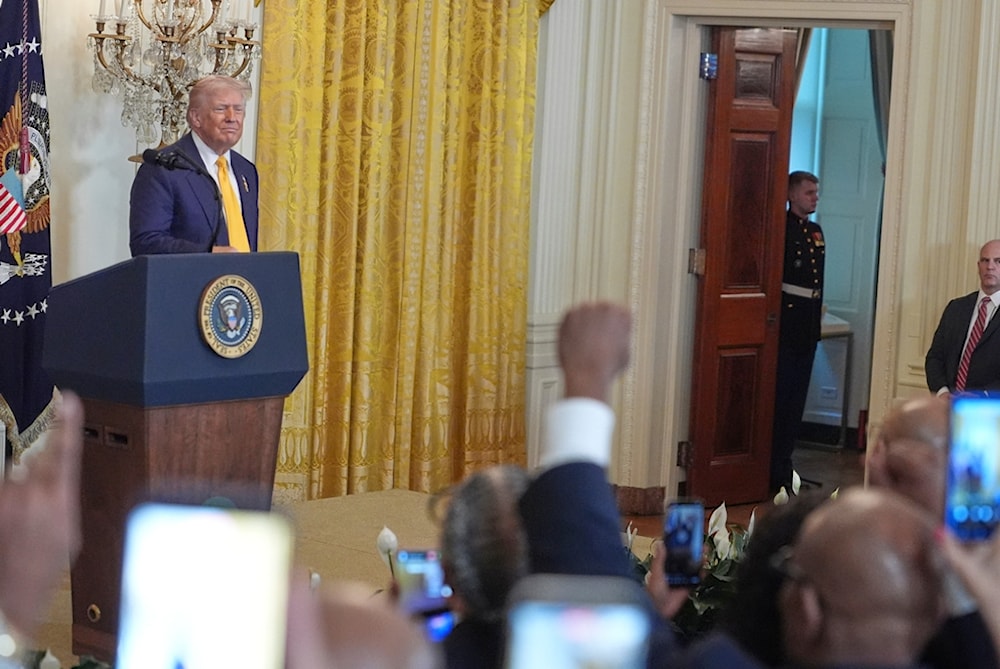
US President Donald Trump in the East Room of the White House, Wednesday, February 18, 2026, in Washington, DC (AP)
US President Donald Trump said Washington could be compelled to use the Diego Garcia base in the Indian Ocean to strike Iran if Tehran declines to finalize a nuclear agreement, as indirect talks continue amid rising regional tensions.
White House spokesperson Karoline Leavitt said on Wednesday that the United States has “many arguments” that would justify a strike on Iran, while stressing that it would be “wise” for Tehran to reach a deal to avoid confrontation. She added that US officials expect the Iranian side to return with more detailed proposals within the next two weeks, noting limited progress so far.
In a separate development, the White House announced that Trump will host a meeting of a “Peace Council” in Washington on Thursday, where he is expected to declare that member states have pledged more than $5 billion for reconstruction and humanitarian efforts in Gaza.
Peace council meeting on Gaza reconstruction
Leavitt said participating countries also committed to providing thousands of personnel for an international force aimed at stabilizing Gaza.
Two rounds of indirect US-Iran negotiations on Tehran’s nuclear program have already taken place in Muscat and Geneva, amid heightened tensions and a reinforced US military presence in the region. Iranian officials have reiterated their commitment to what they describe as legitimate nuclear rights under the Nuclear Non-Proliferation Treaty.
The latest diplomatic efforts follow the collapse of previous talks last year, which coincided with the aggression launched by the Israeli regime against Iran and subsequent US strikes on Iranian nuclear facilities.
Iran, US cite progress in talks
Iran and the United States reported progress after the indirect, Omani-mediated talks in Geneva on Tuesday, with Tehran saying the sides agreed on “guiding principles” for a potential deal, while US Vice President JD Vance cautioned that key American red lines had yet to be acknowledged.
Speaking after the talks, Iranian Foreign Minister Abbas Araghchi said the discussions were “more constructive” than the previous round earlier this month and resulted in broad agreement on a framework to move forward.
“Ultimately, we were able to reach broad agreement on a set of guiding principles, based on which we will move forward and begin working on the text of a potential agreement,” Araghchi told state television. He added that once draft texts are prepared, they would be exchanged and a third round of talks scheduled.
However, in Washington, Vance struck a more cautious tone, saying that while both sides agreed to continue discussions, Tehran had not yet accepted all US demands.
Iran maintains its position, says talks 'productive'
Iran agreed to mediated talks if the United States commits to the proposed agenda, which is limited to the nuclear issue and lifting US sanctions imposed on the Islamic Republic. Iran has rejected any attempt to broaden discussions beyond those issues.
Tehran also reiterated that uranium enrichment remains a sovereign right and a non-negotiable principle within its civilian nuclear program.
Iranian Foreign Minister Abbas Araghchi also disclosed certain details after Tuesday's talks in Geneva, stating that the nature of the talks was constructive and "more productive."
"I can say that at this round, compared to the last one, we brought up absolutely serious issues for discussion, the atmosphere was more productive. Various ideas were put up for discussion, and we had serious discussions on these ideas, and finally we found a strategic route that we will follow, along which we will move and reach a text of a possible agreement," Araghchi said on Iranian television, following talks with the United States in Geneva.
According to Araghchi, the parties worked out the basic principles during the Geneva talks that will guide efforts toward a potential agreement on the Iranian nuclear dossier. He cautioned, however, that identifying principles does not necessarily guarantee a final deal.


