
UK-'Israel' ties plunge over sanctions on illegal settlements backlash
 6 Min Read
UK-Israeli relations have plunged to their lowest point in decades after London imposed sanctions on illegal West Bank settlements, prompting sharp Israeli diplomatic retaliation.
-
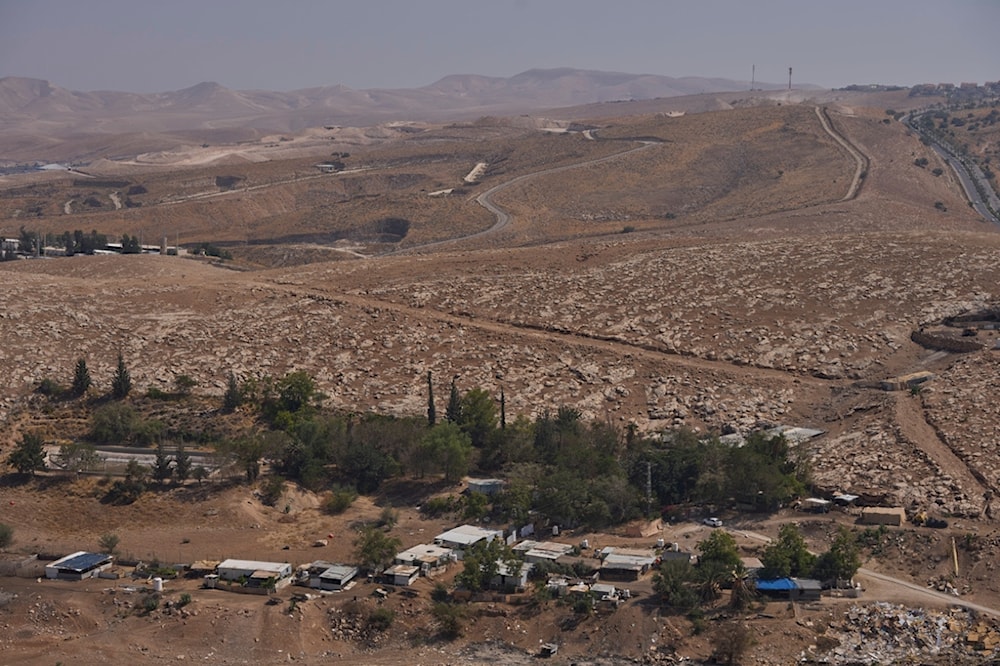
View of an area in the E1 zone near Maale Adumim, an Israeli settlement in the occupied West Bank, Tuesday, Sept. 8, 2026 (AP)
Britain’s decision to impose economic restrictions targeting illegal Israeli settlements in the occupied West Bank has triggered a sharp retaliation from the Israeli occupation, pushing relations between London and “Israel” to what the BBC described as their lowest point in decades.
The measures, announced alongside 11 other countries, including France, Spain, and Canada, mark a significant departure from years of Western governments condemning settlement expansion while largely avoiding concrete measures against the entities sustaining it.
London will prohibit trade in goods produced in illegal Israeli settlements and target companies involved in construction, infrastructure, financing, and other activities connected to the settlement enterprise.
Britain has also introduced restrictions on arms sales that “materially contribute to the occupation."
UK shifts policy after ICJ ruling
The move comes after the British government formally accepted the International Court of Justice’s 2024 advisory opinion declaring the Israeli occupation of Palestinian territory unlawful.
Foreign Secretary Ed Miliband described the new approach as a “reset” in British policy, signaling that London intends to align at least part of its economic relationship with its stated position on the illegality of the occupation.
Israeli occupation retaliates against Britain
The Israeli response was immediate.
Israeli Foreign Minister Gideon Saar ordered Britain to shut down its consulate in occupied eastern al-Quds, which handles London’s relations with the Palestinian Authority and Palestinians in the occupied West Bank.
According to Reuters, British diplomats were given 30 days to close the consulate, while UK representatives stationed in Ramallah and personnel participating in a US-led Gaza coordination mission were ordered to leave within seven days.
The BBC said British officials had expected Israeli anger over the measures but appeared surprised by the speed and severity of the retaliation.
UK-'Israel' ties sink to decades low
The outlet described the closure of the consulate and the removal of British representatives from Gaza coordination efforts as highly hostile measures, arguing that the confrontation has brought British-Israeli relations to their lowest level in decades.
The Israeli regime is also expected to discuss possible measures against other states that joined the coordinated initiative.
Settlement sanctions carry wider political weight
Although goods produced in settlements account for only a relatively small share of Israeli exports, the political significance of the measures extends considerably further.
For decades, Britain and other Western governments maintained that Israeli settlements built on occupied Palestinian land violated international law while continuing extensive political, military, and economic relations with the occupation.
The latest measures establish a more direct economic consequence for settlement activity and the businesses facilitating it.
Miliband breaks with decades of British inaction
The Guardian described the decision as a break with decades of Foreign Office inertia toward the expansion of illegal settlements.
Successive British governments repeatedly issued statements condemning settlement construction but stopped short of policies capable of materially obstructing it.
Miliband adopts unusually stark language
Miliband has also adopted language rarely heard from senior British officials regarding Israeli practices in the occupied West Bank.
The foreign secretary said that “settler terrorism is rampant” and accused the Israeli government of turning a blind eye to the “ethnic cleansing” of Palestinians in parts of the occupied territory.
According to The Guardian, he is the first British foreign secretary to characterize developments in the West Bank in such terms.
Miliband rejects conflating 'Israel' with Jewish people
Miliband, who described himself as a “proud British Jew... unwavering in my support for the state of Israel,” argued that Palestinian self-determination and an eventual "two-state" settlement were necessary for Israeli security.
Responding to attempts to portray criticism of the Israeli government as antisemitic, he said, “Holding Jewish people responsible for the actions of the Israeli government is antisemitism, plain and simple.”
His government has also formally endorsed the ICJ’s finding that the occupation itself, rather than settlements alone, is unlawful, potentially creating broader obligations for Britain not to assist activities sustaining it.
Coordinated action adds to Israeli isolation
The participation of several countries has amplified concern within the Israeli government.
France and Canada joined Britain in restricting settlement goods, while a total of 12 states moved together in measures targeting the occupation.
According to The Guardian, London helped convince Paris to act without waiting for consensus across the European Union, where opposition from Germany and reluctance within parts of the bloc had prevented collective action.
The coordinated measures also complicate Israeli retaliation, as targeting every participating government risks widening the diplomatic confrontation.
The BBC noted that growing international measures against “Israel” are contributing to an increasing sense of isolation, alongside protests at international cultural and sporting events and legal proceedings targeting senior Israeli officials.
Palestinians call for measures that go further
Palestinian officials welcomed the measures while stressing that the Israeli occupation and settlement expansion remain firmly in place.
The Palestinian Foreign Ministry praised the countries involved but demanded “urgent, concrete measures” to stop "Israel's" “illegal settlement enterprise."
Palestinian Ambassador to Britain Husam Zomlot called the decision “a turning point in the UK-Palestine relationship."
He said Britain’s “courageous steps” could help advance Palestinian independence on the 1967 borders with occupied eastern al-Quds as its capital.
UK measures stop short of full break with 'Israel'
Yet the measures remain far from a comprehensive severing of British support for “Israel”.
The Guardian noted that London continues to exempt components destined for the international F-35 fighter jet spare-parts pool from its restrictions, on the grounds that the aircraft “do not materially support the occupation."
Miliband has also explicitly rejected the Boycott, Divestment and Sanctions movement because it targets the Israeli economy as a whole rather than limiting action to occupied Palestinian territory.
The secondary legislation required to implement some of the new sanctions could moreover take months to enter into force.
The confrontation therefore represents a significant shift in British policy toward the occupation, but not a wholesale break in London’s relationship with “Israel”.
Occupation continues despite diplomatic pressure
Meanwhile, the Israeli occupation of the West Bank, now approaching six decades, continues alongside settlement expansion and the seizure of Palestinian land.
The BBC acknowledged that measures by Britain and its partners are unlikely by themselves to fundamentally change those realities, pointing to Washington as the external actor possessing the greatest leverage over the Israeli government.
The administration of US President Donald Trump, however, has shown little willingness to restrain Israeli settlement policy.
Read more: Hamas warns of Israeli escalation in Anata, Shuafat


