
UK officially declares sanctions on West Bank settlements
 4 Min Read
Foreign secretary says London will introduce import ban within six to nine months as part of 12-nation coalition
-
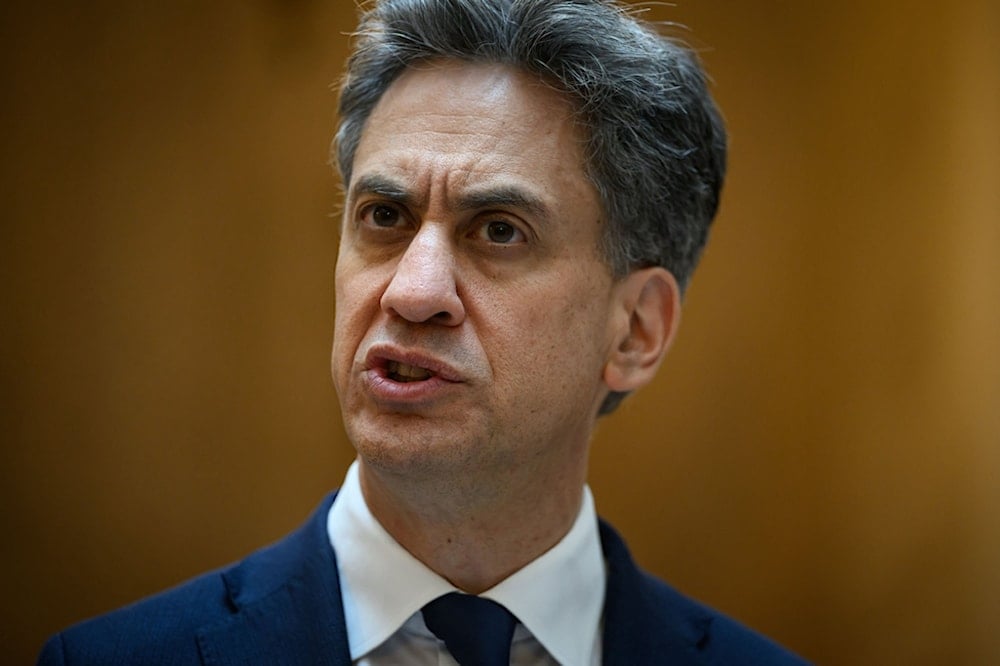
Britain's Foreign Secretary Ed Miliband speaks during a press conference in Madrid, Spain, on July 29, 2026. (Leon Neal/Pool Photo via AP)
Britain confirmed Tuesday it will introduce an import ban on goods from illegal settlements in the occupied West Bank, as Foreign Secretary Ed Miliband accused the Israeli government of turning a "blind eye" to ethnic cleansing carried out by settlers.
Miliband told parliament the ban, to be implemented within six to nine months, would be coordinated with other countries.
"The British government agrees that there is ethnic cleansing of Palestinians in areas of the West Bank, perpetrated by settler terrorists," Miliband said.
"All too often the Israeli government has turned a blind eye to this, and worse, members of it have made statements and taken actions to support the forced displacement of Palestinians," he told MPs.
Package of measures announced
Alongside the import ban, Miliband said Britain would "take action against specific companies and individuals who provide services such as construction, infrastructure, financing, or real estate for settlement expansion."
He also announced a further round of sanctions on "extremist settlers who have supported or incited acts of violence against Palestinian communities."
On arms exports, Miliband said Britain would "refuse all license applications for arms and other exports that materially contribute to the occupation," building on the government's earlier suspension of more than 30 export licenses for arms used by the 'Israeli' military during the war on Gaza.
Part of a 12-nation coalition
Britain's announcement forms part of a coordinated move by 12 countries, including France, Canada, Denmark, Finland, Iceland, Ireland, Norway, Poland, Portugal, Spain, and Sweden, who said Tuesday they would impose sanctions on trade with Israeli settlements following a surge in settler attacks on Palestinian villages in the occupied West Bank.
In a joint statement, the 12 foreign ministers said "the government of Israel's actions in the West Bank are undermining the possibility of a two-state solution," warning that "the situation is rapidly deteriorating amid unprecedented levels of settler violence and settlement expansion."
The ministers called on the Israeli government to "immediately halt the expansion of settlements and civilian administrative powers, ensure accountability for settler violence, and investigate allegations against Israeli forces."
The statement said the 12 nations "confirm their intention to introduce national and/or support European restrictions on trade in goods with settlements which are illegal under international law, or that they are actively considering these and other measures, in accordance with their national procedures."
Ireland and Spain have already taken unilateral measures against settlement trade, while France has spent weeks pushing for a bloc-wide decision from the European Union, "Israel's" leading trading partner, a push that has so far been blocked by some member states.
US threatens Britain with reprisals over 'Israel' sanctions
The United States has threatened Britain with repercussions over sanctions targeting goods produced in Israeli settlements in the occupied West Bank, as Washington moves to pressure London over measures against "Israel's" settlement enterprise.
The proposed measures have triggered an immediate response from Washington, with US Ambassador to "Israel" Mike Huckabee warning that the United States will retaliate.
Speaking to the BBC's Newsday program, Huckabee said there would be “without a doubt” a US response.
Accusing the British government of “discrimination" against "Israel" Huckabee said, “It’s like throwing a stone and not having an idea of where it’s going to land. The UK is a sovereign country, they can do what they want, but so is the US.”
The remarks amount to an explicit warning from Washington that Britain could face consequences for imposing economic measures on goods originating in settlements built on occupied Palestinian land.
Read more: How Israeli rhetoric weaponizes history and faith to justify violence


