
UK sanctions Syrian figures over civilian violence
 5 Min Read
The UK has imposed new sanctions on Syrian individuals and militias accused of civilian abuses, targeting war-era atrocities and recent coastal violence.
-
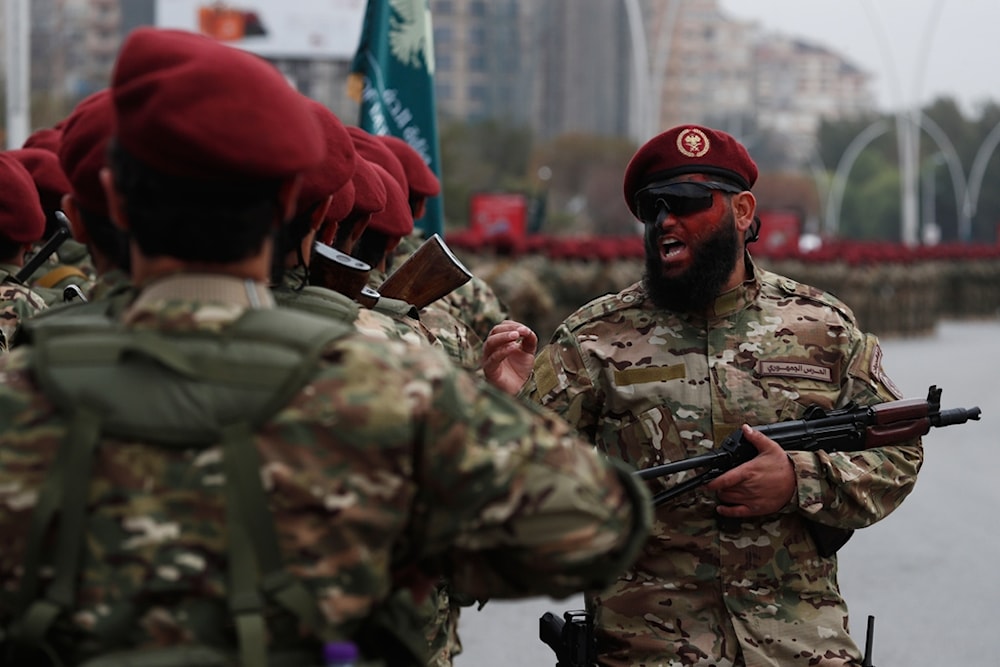
A member of the new Syrian army shouts instructions to soldiers during a parade marking the first anniversary of the ousting of former President Bashar Assad in Damascus, Syria, Monday, December 8, 2025 (AP)
The UK has imposed new sanctions on individuals and organisations linked to violence against civilians in Syria, targeting figures accused of involvement in atrocities during the war on Syria and more recent violence along the country’s coast.
In an announcement on Thursday, the Foreign Secretary unveiled measures against four individuals and three groups implicated in suspected abuses at the height of the war, as well as in violence reported earlier this year in the coastal governorates of Latakia and Tartous. Two additional individuals accused of making financial contributions to the former government were also sanctioned.
The package includes asset freezes, travel bans, and director disqualifications, and forms part of what the UK government described as its ongoing effort to pursue accountability for "abuses committed against the Syrian people," both by the former Assad authorities and other actors.
Sanctions mark a year since Sharaa
Foreign Secretary Yvette Cooper said the measures come more than a year after the takeover of the interim Sharaa government. “Over a year since the liberation from the brutal Assad regime, the UK continues to stand with the Syrian people and support the Syrian Government in delivering an inclusive political transition,” she said. “Accountability and justice for all Syrians is vital to ensure a successful and sustainable political settlement in Syria.”
Cooper added that the sanctions were aimed at those responsible for “horrific violence against the civilian population in Syria,” saying the designations “send a clear message to those who seek to undermine the peaceful and prosperous future of all Syrians.”
Among those sanctioned are former military commanders and leaders of armed groups: Ghaith Dalla and Miqdad Fatiha, Mohammad al-Jasim of the Sultan Suleiman Shah militia, and Sayf Boulad of the Hamza Division. Also targeted are Syrian-Russian businessmen Mudallal Khoury and Imad Khoury, who the UK says helped "finance the activities of the Assad regime."
UK supports Syria 'economic recovery'
Three armed factions were placed under asset freezes: the Sultan Murad Division, the Sultan Suleiman Shah Division, and the Hamza Division.
“The UK remains committed to working with the Syrian Government to support the country’s economic recovery and deliver for a Syria that recognises the voices and needs of all citizens,” Cooper said.
The announcement follows changes made on 24 April, when the UK amended its Syria sanctions regime to lift restrictions on certain sectors, including finance, trade, and energy production, in an effort to facilitate investment.
The US approves appeal of sanctions
The US Congress has approved the repeal of sweeping sanctions imposed on Syria under the so-called 2019 Caesar Civilian Protection Act, a measure originally designed to punish the former government of Bashar al-Assad but which US officials now say is obstructing Syria’s fragile postwar recovery.
The repeal was included in the US government’s annual defense policy bill, a $900bn package authorizing defense, foreign policy, and intelligence spending. The House of Representatives passed the legislation last week, and the Senate approved it on Wednesday. US President Donald Trump is expected to sign the bill into law.
The Caesar Act had imposed broad sanctions on any entity providing goods or services to the Syrian government. While the Trump administration had issued two six-month waivers on enforcement of the sanctions, including one last month following Syrian interim President Ahmad al-Sharaa’s visit to Washington, officials argued that temporary waivers created uncertainty that deterred long-term investment.
Sanctions threatening recovery
US allies in the Middle East and Europe, alongside Syrian officials, warned that ambiguity over the sanctions regime was threatening Syria’s prospects for political and economic recovery after 14 years of war. The United Nations estimates that Syria will require more than $200bn for reconstruction, including rebuilding damaged infrastructure, clearing unexploded ordnance, and delivering food and medical care.
“Serious investors and partners will not commit billions under continued uncertainty, which is why Congress moved forward with full repeal,” Senator Jeanne Shaheen, who sponsored the repeal, said. She added that supporting Syria’s economic recovery would reduce Iran’s ability to "exploit instability" and limit the space for the Islamic State group to operate.
The move faced opposition from the Israeli government and several Republican lawmakers, who argued that fully lifting sanctions would reduce Washington’s leverage over al-Sharaa. The Syrian president, a former terrorist leader who once headed an al-Qaeda affiliate, has gained cautious support from US and European officials following his rise to power and pledges to unify the country.


