
UN rebukes US justifications to destroy Iran's civilian infrastructure
 3 Min Read
The UN warned that US threats to destroy Iran’s infrastructure violate international law, rejecting Washington’s justification as an escalation that deepens regional instability.
-
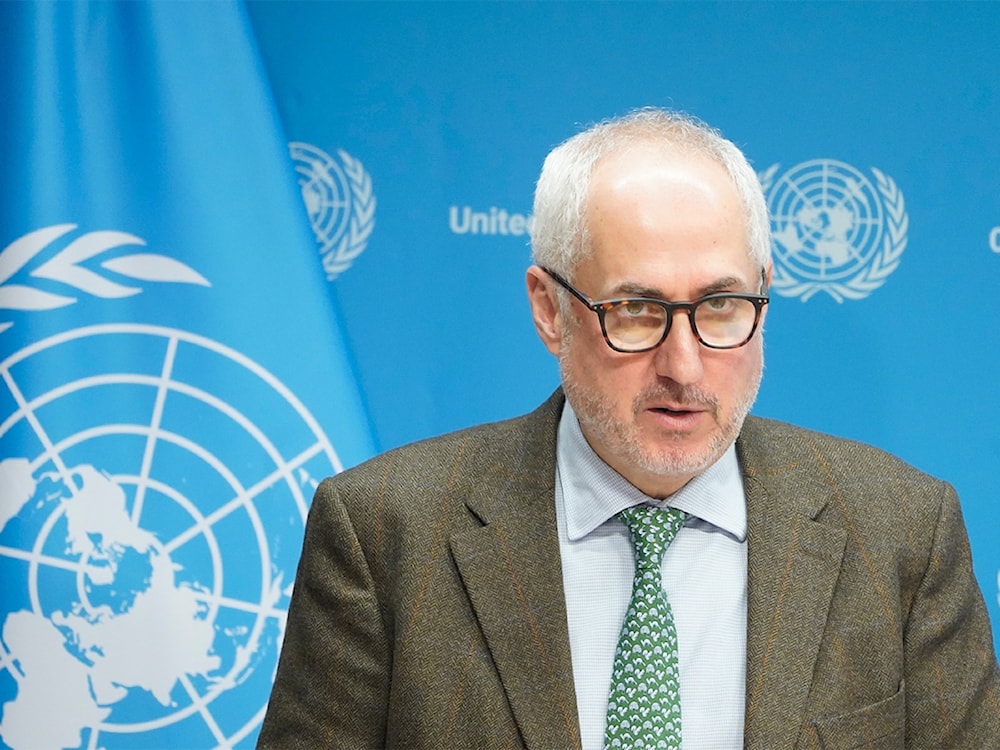
UN spokesperson Stéphane Dujarric speaks during a press briefing at UN Headquarters in New York on March 27, 2026 (UN)
The United Nations has pushed back against US threats to target Iranian infrastructure, warning that such actions cannot be justified under international law.
During a press briefing, UN spokesperson Stéphane Dujarric was asked about remarks by US President Donald Trump, who said, “We are offering a very fair and reasonable deal, and I hope they take it because if they don't, the United States is going to knock out every single power plant, every single bridge in Iran.”
Responding to the question, Dujarric said, “Whether it's true or not, we have the same information that you have, Stefano. No one ever shares battle plans with us. What I can tell you, and I will reiterate what we've said already in the past, that there is no military objective that justifies the wholesale destruction of civilian infrastructure or the deliberate infliction of pain on a civilian population.”
The remarks come amid a broader US war against Iran that has included a naval blockade, the seizure of Iranian vessels, and repeated threats to expand strikes on energy infrastructure, measures that constitute violations of international law and ceasefire agreements.
Despite this, US Ambassador to the United Nations Mike Waltz defended the targeting of Iranian infrastructure, claiming that facilities linked to the Islamic Revolution Guard Corps are “absolute legitimate military targets” and dismissing concerns over war crimes as “false, fake and ridiculous.”
Legal experts and UN-linked officials have repeatedly warned that such positions contradict international humanitarian law, which prohibits attacks on infrastructure essential to civilian life and requires strict limits even in cases of dual-use facilities.
Hormuz crisis escalates
The escalation unfolds against the backdrop of a US-imposed naval blockade in the Strait of Hormuz, a critical global energy corridor, which has disrupted shipping, triggered retaliatory threats, and fueled instability across the region.
Addressing the situation, Dujarric pointed to growing risks in the waterway: “We've seen a lot of activity and frankly, a lot of confusion about the status of the Strait of Hormuz… the Secretary-General continues to be concerned by the restrictions that are put in place, as well as the maritime incidents that we've seen over the last 48 hours.”
He stressed that “we need to see full restoration of international navigational rights and freedom of navigation in the Strait of Hormuz,” calling on all parties to respect international law.
The UN also warned that the US-led escalation is already having global economic consequences. “About 10% or 10 to 12% of the world's fertilizer supplies are blocked… we've seen a hike in the price of fertilizer… [and] a rise in the price of oil without any sort of stability,” Dujarric said, noting the impact on humanitarian operations and global supply chains.
Read more: Xi urges 'immediate, comprehensive ceasefire', opening Hormuz Strait


