
US-Israeli attack on gas infrastructure in Isfahan, Khorramshahr: Fars
 3 Min Read
A US–Israeli attack strikes gas infrastructure in Isfahan and Khorramshahr, marking a sharp escalation despite earlier claims by Donald Trump that strikes on energy facilities would be postponed.
-
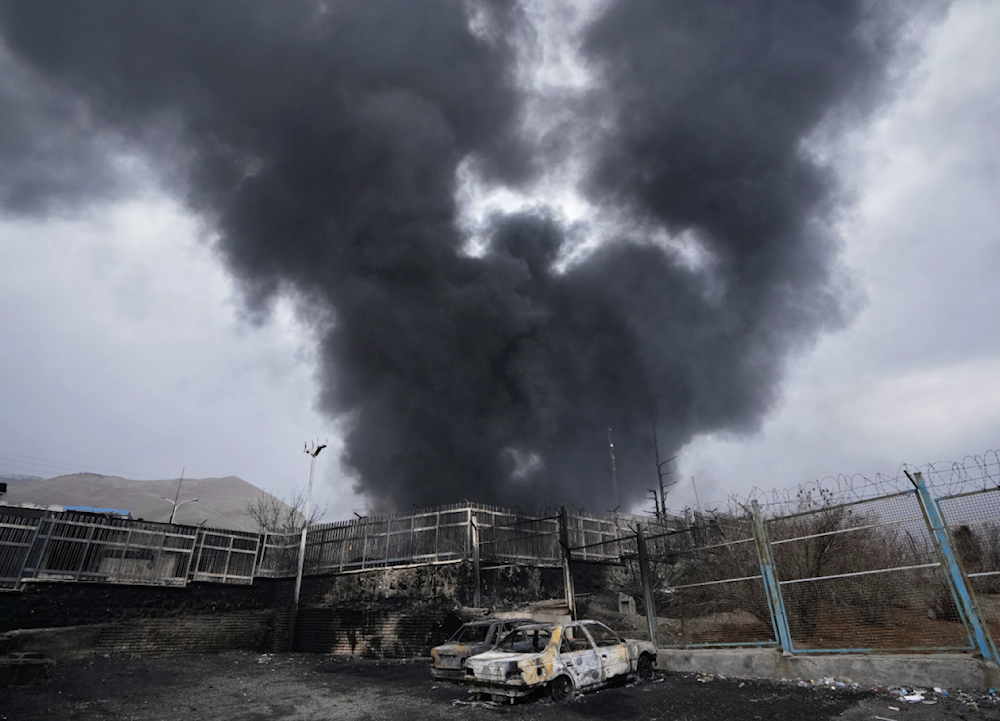
A thick plume of smoke rises from an oil storage facility hit by a U.S.-Israeli bomb late on March 8, in Tehran, Iran, Sunday, March 8, 2026. (AP)
In the continued US-Israeli aggression, a gas administration building and a pressure reduction station on Kaveh Street in Isfahan were targeted, causing damage to parts of the facilities and nearby residential homes, according to Iran’s Fars News Agency.
At the same time, reports indicated an attack targeting a gas pipeline linked to a power station in Khorramshahr.
The governor of Khorramshahr confirmed that a projectile landed outside the gas pipeline facility, with no casualties reported.
Isfahan is considered a key node in Iran’s gas distribution network, with supplies flowing through it to cities and industrial sectors, making any damage there impactful on both production and services.
Khorramshahr, located in the heart of southern energy infrastructure, is part of a broader system linked to electricity generation and gas supply, meaning any attack there affects national operational capacity, not just a single facility.
US–Israeli strike exposes Trump's shifting stances
The reported strikes stand in contrast to earlier statements by US President Donald Trump on Truth Social, where he claimed that attacks on gas and energy infrastructure would be postponed for five days, raising questions about the consistency between political declarations and actions on the ground.
In his statement, he falsely claimed that "The United States of America, and the country of Iran, have had, over the last two days, very good and productive conversations regarding a complete and total resolution of our hostilities in the Middle East."
Trump also claimed the Strait of Hormuz could reopen "very soon" should an agreement be finalised, and said the Israeli regime would be "very happy" with what was on the table, remarks that painted a picture of near-concluded diplomacy that Iranian officials were quick to reject.
Claims in his statement were quickly denied by Iranian officials.
Iran denies talks with US
Iranian Foreign Ministry Spokesperson Esmail Baghaei confirmed on Monday that Tehran had received messages through intermediary countries conveying a US request for negotiations to end the war, but stressed that Iran's responses were issued strictly in line with its principled positions, including explicit warnings about the consequences of any attack on the country's energy infrastructure.
"No negotiations have been held with the US," he wrote.
Baghaei added that Iran had made clear that any strike on its energy infrastructure would be met with "a decisive, immediate, and effective response" from its armed forces.
In a similar statement, Iran's Defense Council warned on Monday that any aggression targeting power plants or energy infrastructure will be met with a “decisive and destructive” response, asserting a heightened level of deterrence as the joint US-Israeli war escalates.
The council stressed its firm commitment to responding to any attack on energy facilities, recalling that, as part of a retaliatory response to the strike on Iran’s Natanz nuclear facilities, the Israeli Dimona nuclear complex was also targeted, reinforcing its posture of immediate and reciprocal action.


