
UN rights chief urges protection of ICC officials from US 'reprisals'
 3 Min Read
UN human rights chief Volker Turk condemns new US sanctions on International Criminal Court officials Tomoko Akane and Abdoulaye Seye.
-
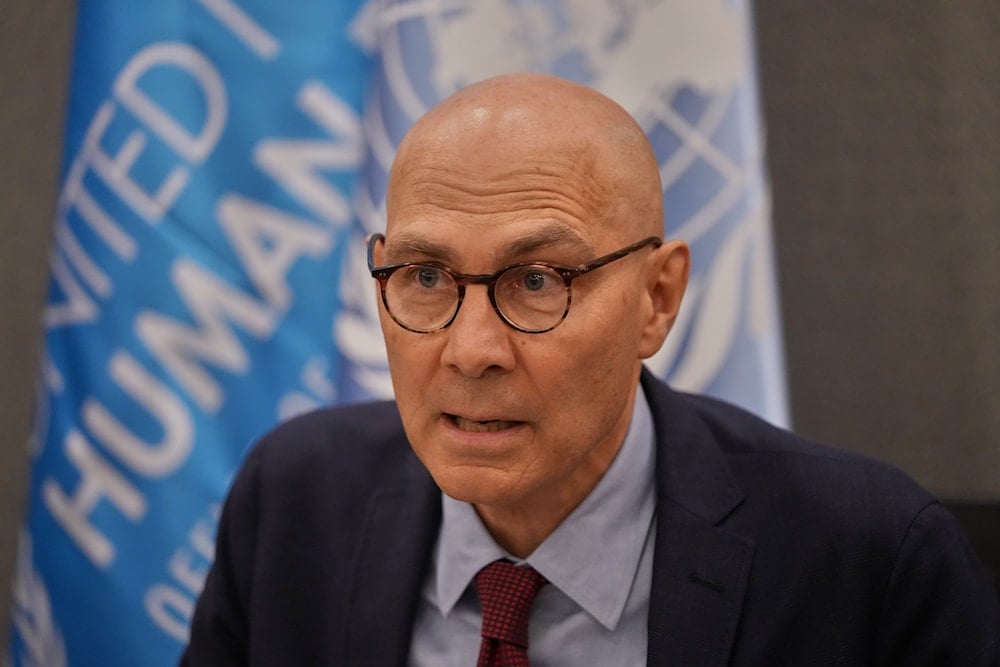
UN High Commissioner for Human Rights Volker Turk speaks to the media during a press conference in Beirut, Lebanon, Monday, July 27, 2026 (AP)
The United Nations high commissioner for human rights on Wednesday condemned the United States’ decision to impose new sanctions on officials of the International Criminal Court, calling the move “unacceptable” and urging states to protect court personnel from such measures.
UN High Commissioner for Human Rights Volker Turk joined a chorus of international criticism over the sanctions. In a statement posted on the social media platform X, his office said, “Unacceptable new sanctions imposed by the USA against the International Criminal Court’s President and a prosecution staff member must be lifted.”
Unacceptable new sanctions imposed by the USA against the International Criminal Court’s President and a prosecution staff member must be lifted. @volker_turk renews his calls on States to stand in defence of the institutions they have created to uphold and defend human rights…
— UN Human Rights (@UNHumanRights) August 19, 2026
Turk reiterated his “calls on States to stand in defence of the institutions they have created to uphold and defend human rights and the rule of law,” according to the statement. He further urged countries “to protect court officials targeted by such reprisals.”
US adds to assault on ICC judges
The Trump administration on Tuesday imposed sanctions against ICC President Tomoko Akane of Japan and Senior Trial Lawyer Abdoulaye Seye of Senegal, marking the latest action in Washington’s campaign against the Hague-based tribunal, which it claims is a “corrupt and fatally politicised” body.
The State Department announced on August 18 that International Criminal Court President Tomoko Akane of Japan and Senior Trial Lawyer Abdoulaye Seye of Senegal had been placed under US sanctions.
The measures allow Washington to freeze any assets belonging to the two officials that fall under US jurisdiction and largely shut them out of the US financial system, with which most internationally operating banks maintain links.
Secretary of State Marco Rubio defended the decision by accusing the Hague-based court of exceeding its authority and targeting countries that do not recognize its jurisdiction.
"The Trump Administration has been clear: the International Criminal Court is a corrupt and fatally politicized supranational court that has maliciously abused its authority and exceeded its mandate," Rubio said in a statement. "We will not tolerate its assault on state sovereignty."
Gaza at the center of the US sanctions on ICC
The latest US sanctions form part of a wider campaign by the Trump administration against the International Criminal Court, which has pursued investigations linked to crimes in Afghanistan, Iraq and Gaza.
Washington has repeatedly argued that the court should not investigate or prosecute nationals of countries that are not parties to the Rome Statute, including the United States and Israel. Critics, however, dispute the suggestion that non-membership alone places US or Israeli nationals beyond the court's reach.
Under the Rome Statute, the ICC can exercise jurisdiction over crimes committed on the territory of a member state even when the alleged perpetrator is a national of a country that has not joined the court.
In the Palestine situation, an ICC chamber ruled in 2021 that the court's territorial jurisdiction extends to Gaza and the occupied West Bank, including East al-Quds. Palestine became a party to the Rome Statute in 2015.
The dispute has intensified over ICC actions linked to Gaza and Afghanistan. Abdoulaye Seye, one of the two sanctioned officials, served on the prosecution team that sought an arrest warrant for Israeli Prime Minister Benjamin Netanyahu. The ICC previously issued arrest warrants for Netanyahu and former Israeli Security Minister Yoav Gallant over the genocide in Gaza, drawing fierce opposition from Washington.


