
How Lindsey Graham helped shield the Gaza genocide from justice
 4 Min Read
An analysis examines Lindsey Graham's role in defending the Israeli occupation from international legal accountability over Gaza, focusing on his opposition to ICC investigations.
-
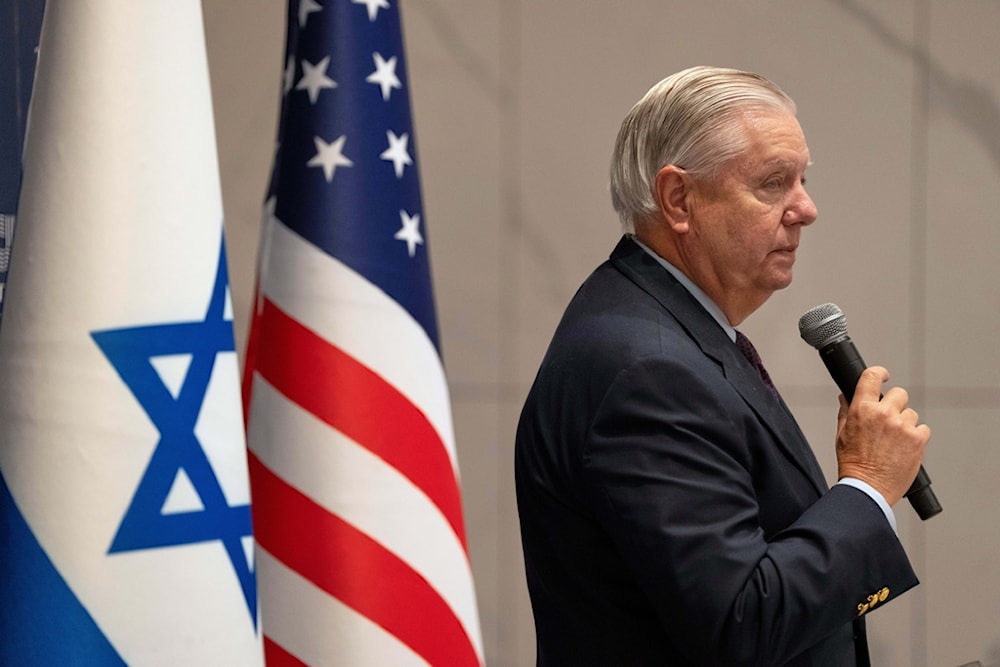
Sen. Lindsey Graham speaking to the media in occupied Palestine, Sunday, Dec. 21, 2025 (AP)
The late US Senator Lindsey Graham was instrumental in helping shield the Israeli occupation from international accountability over its war on Gaza, argues Juan Cole, a Historian and founder of Informed Comment, in an article published by ScheerPost, contending that his political interventions contributed to what he describes as the "manufacturing of consent for genocide."
Cole writes that Graham's political legacy should be assessed not through personal tributes following his death but through the role he played in defending the occupation from legal scrutiny as mounting allegations of genocide and war crimes emerged during the assault on Gaza.
According to Cole, the Israeli war on Gaza differed from previous mass atrocities because it unfolded in full public view through widespread digital documentation.
He argues that despite extensive footage showing the destruction of Gaza and the killing of civilians, the occupation's leadership has faced limited political consequences.
"Lindsey Graham is part of the answer to the question of how a genocide could be pursued in plain sight with impunity," Cole writes.
The ScheerPost contributor contends that Graham became one of Washington's leading defenders of "Israel" as international legal institutions sought to investigate alleged war crimes.
Read more: 'Israel's' 'greatest friend': Lindsey Graham's war-driven legacy
ICC confrontation highlighted as defining moment
A central focus of Cole's article is Graham's reported confrontation with International Criminal Court Prosecutor Karim Khan after Khan moved in 2024 to seek arrest warrants for Israeli Prime Minister Benjamin Netanyahu and former War Minister Yoav Gallant.
The ScheerPost contributor recounts reports that Graham criticized the move during a conference call, saying ICC prosecutions were intended for "Africa and thugs like Putin," rather than the United States or its allies.
If Khan's account is accurate, Cole argues, the remarks reflected both hostility toward international accountability and what he characterizes as a racial double standard.
"It is hard to see the reference to Africa as anything but racism," he writes.
Cole further argues that Graham's comments echoed a broader belief that Western powers and the Israeli occupation should remain beyond the reach of international law.
Essay argues Washington applies international law selectively
Cole writes that "Israel's" supporters lacked both factual and legal grounds to oppose the ICC investigation and instead resorted to political pressure.
He points to reported Western efforts to dissuade or pressure the ICC over the Gaza investigation, including remarks attributed to former British Prime Minister David Cameron opposing the warrants.
Summarizing Graham's approach, Cole writes, "It isn't a crime if the United States or Israel does it."
The article argues that this mindset helped normalize impunity despite growing international allegations of war crimes and genocide committed during the assault on Gaza.
Linking domestic and foreign policy
Cole also connects Graham's foreign policy positions with broader questions of race and power in the United States.
He examines South Carolina's history of racial segregation and argues that Graham's reported comments about the ICC reflected longstanding patterns of unequal application of justice.
The article additionally references previous remarks by Graham regarding Iran, arguing they reflected broader racialized assumptions in US political discourse.
Cole concludes that Graham's political legacy lies not only in his support for US military intervention abroad but also in defending what he describes as the exceptionalism of Washington and the Israeli occupation in the face of international legal accountability.
"And that is how Graham, in his guise as master prestidigitator, made the elephant of genocide disappear," Cole writes.
Read more: 'Israel's' 'greatest friend': Lindsey Graham's war-driven legacy


