
US, 'Israel' behind riots targeting Iran's security: Pezeshkian
 3 Min Read
Iranian President Masoud Pezeshkian accuses the United States and "Israel" of orchestrating riots to destabilize Iran.
-
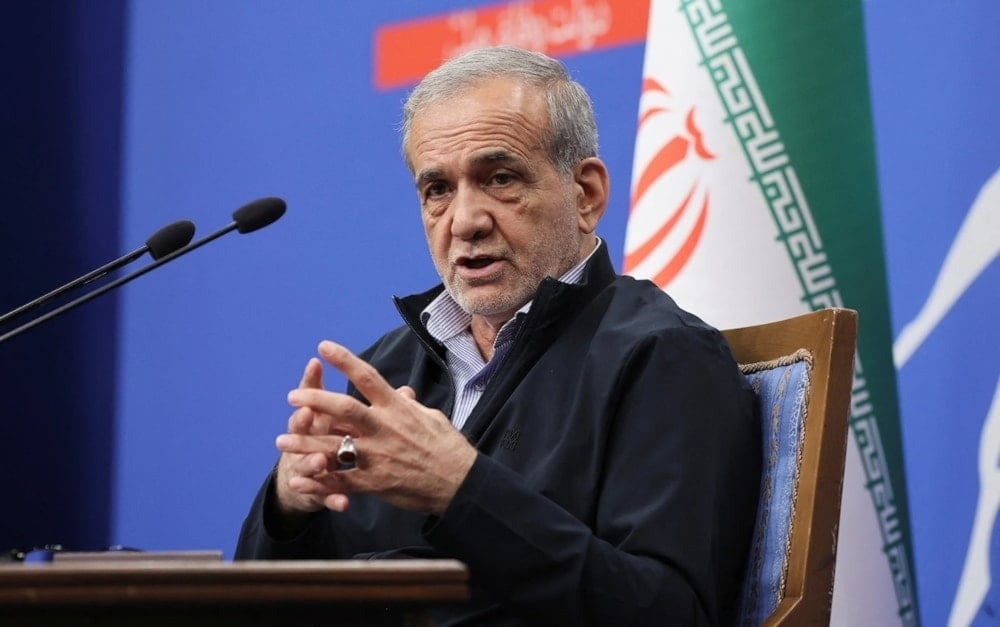
Iran's President Masoud Pezeshkian attends a press conference in Tehran, Iran, September 16, 2024. (image sourced from WANA)
Iranian President Masoud Pezeshkian said in a televised address to the nation that “the riots are being directed by the United States and "Israel," which are issuing orders with the aim of undermining Iran’s security.”
Pezeshkian stressed that “the people of this country protest and voice their objections, but they do not set fire to markets or commit crimes,” affirming that the government is “determined to continue its economic reforms and clearly distinguishes between legitimate protests and organized acts of rioting.” He underlined that Iran’s institutions remain committed to addressing economic grievances through lawful and institutional channels.
He urged the Iranian people to “take to the squares to shape decisions and not allow acts of rioting to distort their rightful demands,” noting that state institutions are “always ready to listen to the demands of the people,” and warning against allowing foreign-backed violence to hijack genuine social concerns.
The president said that “some terrorist elements entered the country from abroad,” adding that “there are trained elements operating inside Iran, alongside other terrorists brought in from outside to carry out acts of sabotage.” He described these groups as operating within a coordinated destabilization strategy designed to turn economic pressure into insecurity and chaos.
National unity
Pezeshkian underlined that “those who burned people alive and carried out beheadings are not among the sons of the Iranian nation,” pointing to attacks on civilians, security forces, and religious sites as evidence that the violence is not rooted in popular protest.
He also confirmed that he had issued clear instructions to the government to “hold direct meetings with merchants, parts of which have already been implemented,” stressing that “the enemy first sought to undermine Iran’s security through military aggression and is now attempting to escalate tensions by exploiting economic pressures.” Iranian officials have repeatedly said that sanctions, financial warfare, and psychological operations are being used alongside violence to strain social cohesion.
The president expressed condolences to the Iranian people for the “civilian martyrs who fell,” calling on young people to “avoid being drawn into terrorism and rioting,” and affirming that “Iranian society does not accept those who burn mosques,” describing such acts as a direct assault on Iran’s religious and social fabric.
Foreign-Backed Unrest
Since the beginning of the year, Iran has witnessed armed riots in several provinces, resulting in the martyrdom of members of the police and the Basij, as well as widespread damage to public and private property. Officials have also reported the killing of civilians, including a child, and the torching of mosques and public facilities. The unrest has coincided with clashes involving separatist movements in western Iran, leading to the martyrdom of several members of the Islamic Revolutionary Guard Corps.
Iranian authorities say they are pursuing those responsible for sabotage and rioting, while exposing their links to terrorist and separatist groups operating in service of Mossad and the United States. Security officials have described the unrest as part of a broader hybrid war aimed at weakening Iran from within, stressing that while peaceful protest is legitimate, violence and foreign-directed destabilization will not be tolerated.
Read more: IRGC declares Iran's security a 'red line', vows to protect Revolution


