
US, Bahrain push revised UN resolution on Strait of Hormuz: Report
 4 Min Read
The US and Bahrain, backed by Gulf states, are reportedly pushing a revised UN Security Council resolution on the Strait of Hormuz that removes references to military force.
-
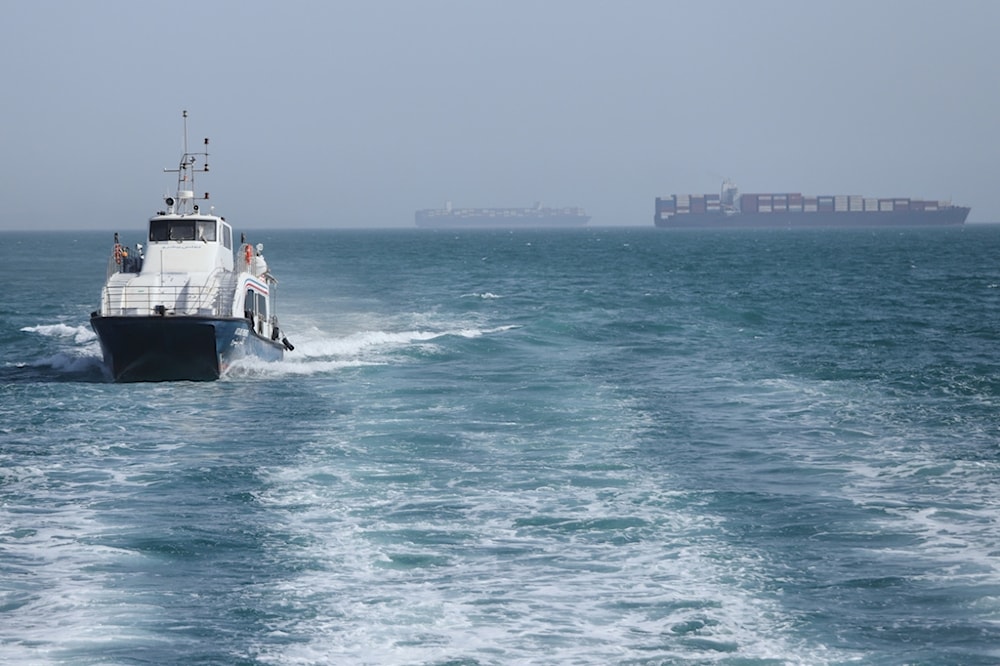
A patrol boat moves through the water as cargo ships sit at anchor in the Strait of Hormuz off Bandar Abbas, Iran, Saturday, May 2, 2026 (ISNA)
Al Mayadeen has learned that the United States and Bahrain, with support from Gulf Arab states, are pressuring for a revised draft resolution at the United Nations Security Council aimed at securing the Strait of Hormuz.
According to the information obtained, the amended draft shifts focus toward maritime mining issues and shipping fees while softening earlier language that had allowed for direct military force.
The revised proposal reportedly removes references to Chapter VII of the UN Charter, which authorizes the use of force or sanctions to reopen the Strait of Hormuz.
Revised draft focuses on maritime security
The proposed resolution calls on Iran to “immediately cease” laying naval mines, disclose the locations of existing mines, halt attacks on commercial shipping, and stop attempts to impose shipping fees.
The draft also supports the creation of a humanitarian corridor. US Ambassador to the United Nations Mike Waltz reportedly argued that disruptions in the waterway had hindered aid deliveries to crises in Sudan, the Congo, and Gaza.
Rather than authorizing military action, the revised text strongly encourages states to coordinate “defensive” maritime protection efforts and safeguard navigation through the strategic waterway.
It also promotes voluntary multinational naval escorts for commercial vessels instead of establishing a formal UN force.
Russia urges Security Council to reject proposal
The latest effort follows the rejection of an earlier draft resolution in April, when Russia and China argued the text amounted to a “blank check” for escalation despite receiving support from 11 Security Council members.
Washington is now seeking a vote within days while attempting to build backing for what officials describe as a narrower and less aggressive proposal.
Saudi Arabia, the UAE, Kuwait, and Qatar are reportedly among the main supporters of the revised resolution.
Meanwhile, Russia’s permanent mission to the United Nations urged Security Council members to reject the new US-Bahrain proposal, describing it as a “unilateral and confrontational” measure that could further escalate tensions in the region.
Iran denies mining allegations
Moscow reiterated support for its own alternative diplomatic draft alongside China and warned that previous US-backed texts contained “unbalanced and confrontational elements” that could legitimize the use of force against Iran.
No date has yet been set for a Security Council vote on the proposal.
Iran has not confirmed allegations that it planted mines in the Strait of Hormuz, while a recent letter from Iran’s UN envoy Amir Saeid Iravani denied the accusations.
Iran’s mission to the United Nations has maintained that “the only viable solution in the Strait of Hormuz is a permanent end to the war, lifting the naval blockade, and restoring normal passage.”
Hormuz power struggle
The amended proposed resolution, backed by several Gulf states aligned with the United States, calls for measures framed around “freedom of navigation” and maritime security. However, Tehran says the initiative is aimed at shielding unlawful US military actions in the Gulf and providing political cover for Washington’s blockade and attacks on Iranian-linked vessels.
Iranian officials have repeatedly condemned the US naval blockade imposed in April as an “act of war” and a violation of international law. Tehran argues that Washington cannot simultaneously impose an economic and naval siege on Iran while accusing the Islamic Republic of destabilizing regional shipping lanes.
Araghchi further warned against efforts to invoke Chapter VII of the UN Charter, saying the move could open the door to sanctions or military enforcement measures against Iran under the pretext of maritime security. “The international community should not allow the Security Council to be abused by aggressors or turned into a tool for legitimizing illegal actions,” he stated.


