
US Democrats consider lawsuit against Trump over war on Iran
 3 Min Read
Democratic lawmakers in Congress are weighing legal action against Trump if he continues military operations in Iran beyond May 1 without congressional approval, as the War Powers Act deadline approaches.
-
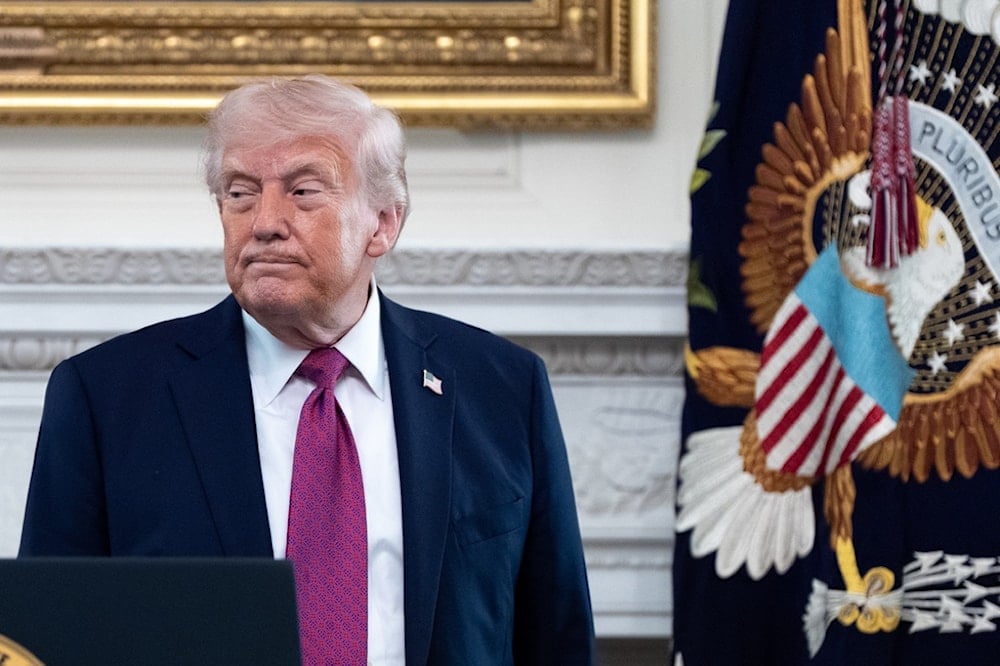
US President Donald Trump departs after speaking at an event for NCAA national champions in the State Dining Room of the White House, Tuesday, April 21, 2026, in Washington. (AP Photo/Alex Brandon)
May 1 marks 60 days since Trump notified Congress of the war against Iran, which began on February 28. After this period, the president is legally obligated to either secure legislative approval to continue military action or confirm in writing that an additional 30 days are needed to safely withdraw troops.
Democrats have not yet made a final decision on filing a lawsuit, seeking first to pursue all possible legislative measures, Time Magazine reported on Tuesday. Additionally, as per the report, Senator Adam Schiff plans to hold another vote on a resolution limiting the president's war powers later this week.
Following the US-Israeli strikes on Iran, dozens of Democrats in Congress sharply criticized the Trump administration's actions, citing high risks of escalation and violations of constitutional procedures. However, the Senate has repeatedly rejected their resolutions to limit the president's war powers in the aggression against Iran.
Trump expected to seek extension beyond legal limit
As reported earlier today, Trump is expected to seek ways to prolong the war on Iran as he approaches the 60-day legal limit for unauthorized military operations, raising further concerns over Washington's adherence to its own legal framework and the risk of deeper regional escalation.
Retired US Army Lieutenant Colonel Earl Rasmussen told RIA Novosti that "Trump is in a no-win situation, yet attempting to find a way out. He will likely seek an additional extension".
The law allows for only a limited extension under specific conditions, but critics argue that successive US administrations have repeatedly stretched or bypassed these constraints to maintain military operations abroad.
Initial attack a 'major miscalculation'
Rasmussen cautioned that Trump faces a political dilemma, suggesting that Washington may opt for escalation rather than retreat despite the risks. "If Trump pulls forces out, it will not look good politically. He may double down and go forward with his threats, but the most probable outcome will be worse," he said.
He described the initial decision to attack Iran as a major miscalculation, warning that continued pressure from "Israel" and segments of the US political establishment could push the administration toward further confrontation rather than de-escalation.
Rasmussen believes the US is attempting to avoid what increasingly appears to be a strategic setback, as expectations that Iran would capitulate remain unrealistic. "The US is looking for any way to avoid defeat but will likely need to, otherwise the future is unknown," he said.
Economic risks of continued escalation
Rasmussen warned that continued escalation could have severe global consequences, particularly for the economy. "President Donald Trump knows that further escalation will probably send the world into a global recession or depression," he said.
Since mid-April, Washington has intensified its pressure campaign, including a naval blockade in the Strait of Hormuz, a move widely seen as a direct threat to global energy flows.
Meanwhile, Iranian military officials have reinforced the message of continued readiness. Mohammad Akraminia, spokesperson for the Iranian army, stated that the armed forces do not consider the war to be over, noting that "conditions are still considered wartime."
Based on this assessment, he confirmed that military planners are updating target banks and operational equipment, indicating ongoing preparation for potential escalation.
Read More: Trump may push to extend Iran war beyond legal limit


