
US embassy in 'Israel' authorizes departure amid US military build up
 4 Min Read
The US embassy in occupied al-Quds has authorized the departure of non-emergency personnel as Washington increases its military presence in the region and President Donald Trump renews threats against Iran.
-
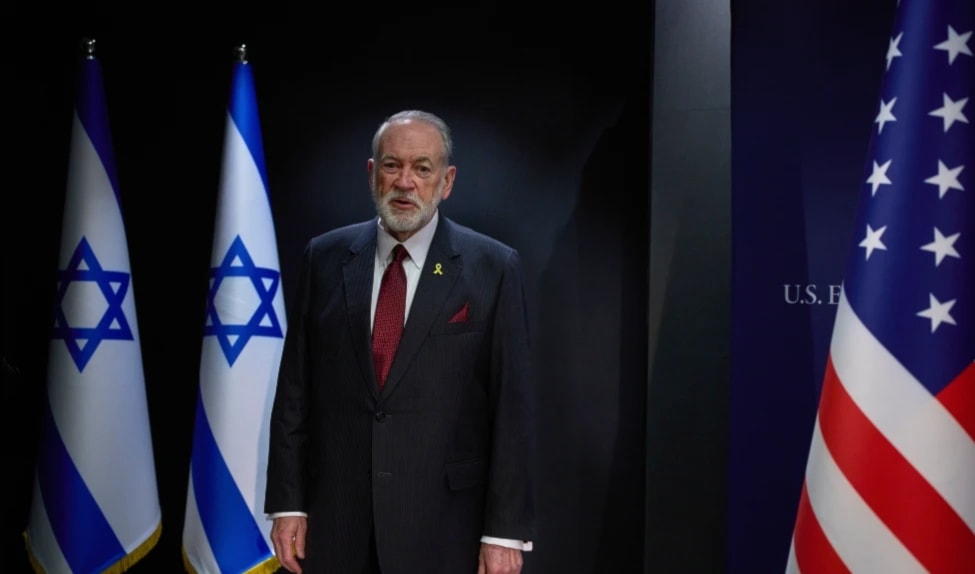
US Ambassador to occupied Palestine Mike Huckabee poses for a photo during an interview in occupied al-Quds on August 20, 2025. (AP Photo, file)
The US embassy in occupied al-Quds announced on Friday that it had authorized the departure of non-emergency government personnel and family members from "Israel" due to safety concerns, urging those wishing to leave to do so while commercial flights remain available.
"On February 27, 2026, the Department of State authorized the departure of non-emergency US government personnel and family members of US government personnel from Mission Israel due to safety risks," the embassy said on its website. "Persons may wish to consider leaving Israel while commercial flights are available," it added.
The announcement comes amid escalating regional tensions and growing speculation about possible US military action against Iran.
According to The New York Times (NYT), US Ambassador Mike Huckabee sent an email to embassy staff urging those who wished to leave to do so immediately. "Focus on getting a seat to anyplace from which you can then continue travel to DC, but the first priority will be getting expeditiously out of country," he was quoted as writing.
The developments coincide with Washington’s largest regional military build-up in decades.
The USS Gerald R. Ford, the world’s largest aircraft carrier, was expected to arrive off the coast of northern "Israel" on Friday as part of the reinforcement.
The US already maintains a significant naval presence in West Asia, including the aircraft carrier USS Abraham Lincoln, nine destroyers, and three additional combat ships. It is uncommon for two US aircraft carriers, each carrying dozens of warplanes and crewed by thousands of sailors, to operate simultaneously in the region.
Trump renews threats against Iran
US President Donald Trump, who previously ordered strikes on Iran last year, has repeatedly threatened Tehran with fresh military action if it does not reach a new agreement with Washington.
On February 19, Trump reportedly gave the talks 15 days to reach a deal.
Iran stated on Friday that for an agreement to be reached, the US must abandon its "excessive demands," tempering earlier optimism surrounding Oman-mediated talks viewed as a last-ditch effort to avoid war.
While Iran insists that negotiations focus solely on its nuclear program, Washington is seeking broader concessions, including limitations on Tehran’s missile program and its support for regional militant groups. The current escalation follows months of heightened tensions across the region, amid ongoing unrest and geopolitical confrontation.
US intelligence casts doubt on Trump Iran ICBM claim: Reuters
On a related note, US intelligence sources have cast doubt on claims by US President Donald Trump that Iran is close to developing a missile capable of striking the United States, according to officials familiar with the assessments to Reuters.
During his State of the Union address on Tuesday, Trump said Tehran was "working on missiles that will soon reach" the United States, as he laid out part of his justification for potential military action against the Islamic Republic. However, three sources familiar with intelligence reporting told the news agency that the claim is not supported by current US intelligence assessments and appears exaggerated.
Two sources told Reuters that there have been no changes to an unclassified 2025 Defense Intelligence Agency assessment concluding that Iran could take until 2035 to develop a "militarily viable intercontinental ballistic missile" (ICBM) from its existing satellite-launch vehicles.
One source added that even with potential technological assistance from China or North Korea, Iran would likely need up to eight years at the earliest to produce "something that is actually ICBM level and operational."
The New York Times first reported that US intelligence agencies believe Iran is probably years away from having missiles that can strike the United States.


