
US escalates blockade on Cuba with sanctions targeting key state firms
 6 Min Read
Havana denounced the move as an escalation of the blockade aimed at deepening economic hardship and deterring foreign investment.
-
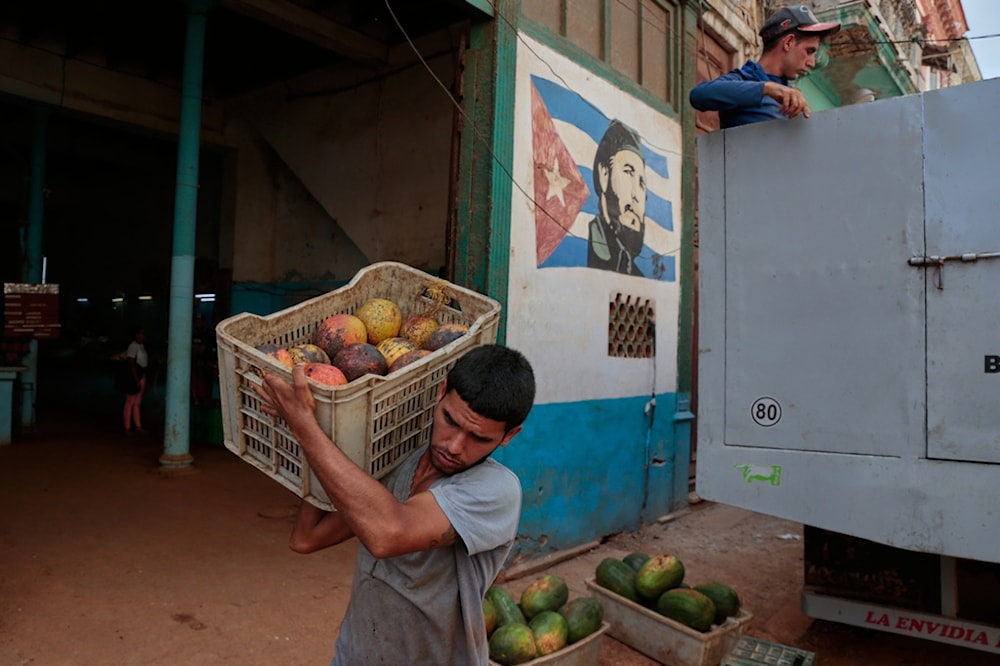
A worker unloads boxes of fruit at a state-run market in Havana, Cuba, Wednesday, June 17, 2026 (AP)
The United States has imposed a new round of sanctions on major Cuban state companies, escalating its decades-long blockade at a time when the island is struggling with severe economic hardship, blackouts, shortages, and mounting pressure on basic services, the Associated Press reported.
The sanctions, announced Tuesday, target five Cuban entities, including three linked to Grupo de Administración Empresarial S.A., known as GAESA, a business conglomerate run by Cuba’s Revolutionary Armed Forces. The move is expected to make foreign companies and investors more hesitant to operate in Cuba, further tightening Washington’s pressure on the country’s economy.
US Secretary of State Marco Rubio framed the measures as against Cuba’s leadership and state economic institutions.
“The situation in Cuba is devolving as the island’s corrupt, brutal and anti-American Communist regime continues to prioritize its own total control over the freedom, opportunity and basic well-being of the Cuban people,” Rubio wrote on X.
Rubio also accused “regime elites” of using GAESA to “steal the island’s few resources, diverting them for repression, anti-American subversion and spying instead of schools, power plants, and basic necessities for the Cuban people.”
Havana responds
Havana rejected the accusations, saying Washington is once again presenting punitive measures against the Cuban economy as support for the Cuban people, while in practice deepening the suffering caused by the blockade.
Cuban Foreign Minister Bruno Rodríguez condemned Rubio’s remarks, calling him “dishonest and mendacious.”
“Cuba has proven stronger, more capable, and more effective than he anticipated in the face of the ruthless aggression and collective punishment inflicted upon its people and their living conditions,” Rodríguez wrote on X. “What this individual is promoting from the world’s greatest power is a crime.”
Havana denounces collective punishment
Cuba’s UN Ambassador Ernesto Soberón Guzmán also denounced the sanctions, accusing Rubio of directing “a chorus of lies” alongside US Ambassador to the United Nations Mike Waltz and Republican Representative María Elvira Salazar.
“No government, no rational person — and certainly not the people of Cuba who suffer from the economic impact of the U.S. economic war — can believe that the intensification of the blockade, the energy siege, and the rest of the most recent sanctions are aimed at supporting the Cuban people,” he said.
For Havana, the latest measures are part of a broader campaign to isolate Cuba, frighten away foreign investment, and force political change through economic strangulation. The sanctions threaten any individual or company that provides services to the targeted entities with possible penalties and exclusion from the US financial system.
Michael Bustamante, professor and chair in Cuban and Cuban-American Studies at the University of Miami, said the designations send a clear warning to investors.
“By designating specific entities, they’re making it clear to foreign investors: ‘If your business in Cuba touches any of these folks, you risk being banned,’” Bustamante told AP.
“For most of these companies, it’s a bridge too far,” he added.
Sanctions target Cuba’s trade and finance infrastructure
Among the sanctioned entities is Almacenes Universales S.A., or AUSA, Cuba’s main logistics and warehousing company. The firm plays a central role in the country’s import and export system and operates as the main logistics provider at the port of Mariel, west of Havana.
Targeting AUSA could disrupt the flow of goods into the country, including supplies used by state institutions, private businesses, and foreign partners. The measure comes as Cuba is already facing shortages of food, medicine, fuel, and other basic necessities.
The US also sanctioned Rafin S.A., described by Bustamante as a “very opaque” company believed to operate as a corporate financial arm within GAESA. Another targeted entity is Banco Financiero Internacional S.A., a commercial bank used by foreign investors operating in Cuba.
“If you don’t have a bank where you can go as a foreign investor, it makes your operations logistically quite difficult, to put it mildly,” Bustamante said.
Max Meizlish, a former US Treasury sanctions enforcement officer, said Banco Financiero Internacional was targeted because it is “a key nexus” for GAESA-related funds.
“This is significant,” he said.
The sanctions also hit Geominera S.A., a state-owned mining company, and Empresa Siderúrgica José Martí, which Washington described as Cuba’s largest raw steel producer. The US also sanctioned Annalie Lilliam Rueda Cardero, the daughter-in-law of former Cuban President Raúl Castro.
Washington moves after Cuba announces reforms
The sanctions were imposed shortly after Cuba announced a series of economic reforms, including steps to allow the private sector to import goods without relying on state intermediaries.
Bustamante described the reforms as “potentially the most significant liberalization of the Cuban economy in 60 years,” while noting that questions remain over how they will be implemented.
Washington, however, dismissed the measures.
On Tuesday, a US State Department spokesperson said the reforms “are modest, long overdue and ultimately superficial smoke signals from the Cuban regime. This is part of the dictatorship’s handbook: announce a cycle of supposed reforms to insinuate a desire for change, then quickly roll back any changes the moment the regime’s total control is at all threatened.”
Timing says it all
The timing of the sanctions suggests that Washington is seeking to block any opening that could ease Cuba’s economic crisis or attract foreign investment. Analysts said the measures could make even basic business operations more difficult for companies working on the island.
Bustamante questioned whether the pressure campaign is tied to a broader attempt to reshape Cuba’s economy from outside.
“It’s very, very hard to suss out what’s going on here,” Bustamante said. “Is this setting the table for the great sale of Cuba state assets to the highest bidder or the lowest bidder?...Is this part of the recipe of a hostile takeover?”
Meizlish said the Trump administration intends to keep increasing pressure on Havana.
“The U.S. administration is going to continue applying pressure on the regime until the regime is a different beast entirely,” he said.
Cuba has repeatedly denied that it poses a threat to the United States and has blamed Washington’s blockade for worsening living conditions on the island. The country continues to face severe blackouts, food and water shortages, and a strained healthcare system, with the latest sanctions expected to further complicate trade, investment, and access to essential goods.
Read more: Cuba unveils major reforms amid escalating US economic siege


