
US involvement in Ukraine may come to an end, says Trump Jr.
 5 Min Read
Donald Trump Jr. suggested that the United States may scale back or withdraw from its role in the Ukraine conflict even as the Trump administration pursues active peace negotiations with both Moscow and Kiev.
-
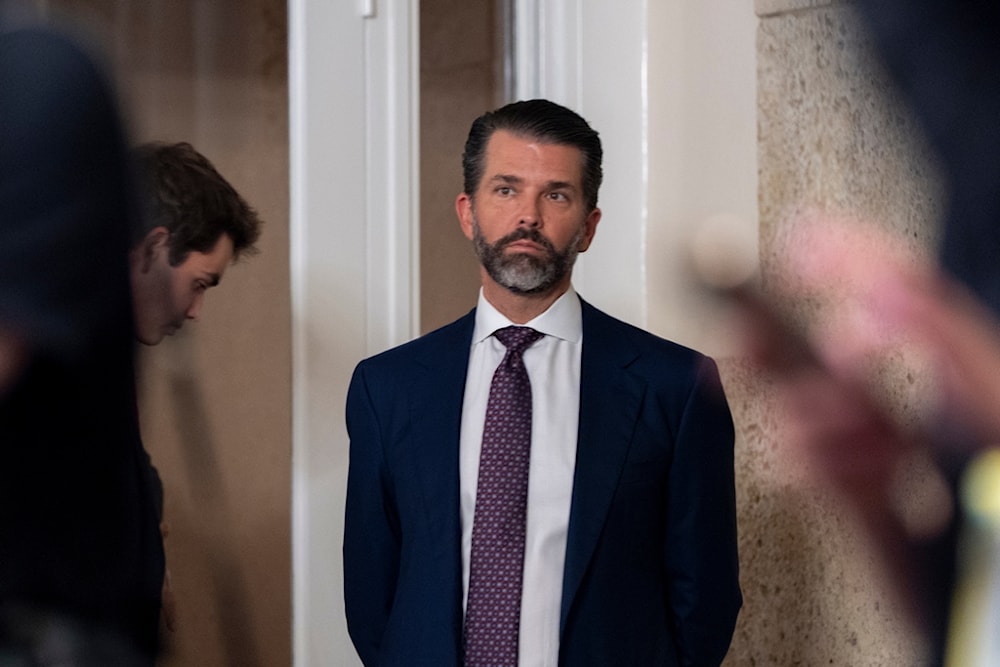
Donald Trump Jr. listens as his father, President Donald Trump, speaks to troops via video from his Mar-a-Lago estate on Thanksgiving, Thursday, Nov. 27, 2025, in Palm Beach, Fla. (AP)
Donald Trump Jr. has fueled speculation about a major shift in US policy toward Ukraine after suggesting that President Donald Trump could scale back, or even exit, Washington's role in the conflict.
Speaking during a session at the Doha Forum on Sunday, he was asked whether the US president might disengage from the Ukraine file. "I think he may [do that]," he replied, adding that his father's unpredictability sets him apart from traditional policymakers: "Whats good about my father, and whats unique about my father is you dont know what hes going to do: the fact that hes not predictable. Hes not following the playbook of every clown whos, again, been a bureaucrat for decades."
Dual strategy
Trump Jr.’s remarks coincide with a period of intense diplomatic activity led by White House envoys. While publicly signaling that the United States may distance itself from the conflict, the administration has simultaneously been promoting a multi-stage peace plan now under discussion with both Moscow and Kiev.
Earlier this month, US envoy Steve Witkoff and senior advisor Jared Kushner held a five-hour meeting with Russian President Vladimir Putin in the Kremlin. The talks centered on a detailed American proposal that Moscow says was initially presented as a 27-point settlement framework. According to Putin, the US team later "divided the initial 27-point settlement plan presented to Russia into four parts and proposed discussing them separately."
Kremlin aide Yury Ushakov confirmed receiving the 27-point document followed by "four documents" outlining a long-term settlement. Moscow has suggested that several US ideas could be workable but insists that "radical changes" are still required for any agreement to take shape.
Plan backlash
The broader initiative has drawn scrutiny. An earlier 28-point draft, reportedly influenced by a Russian "non-paper", envisioned Ukraine relinquishing additional territory, reducing the size of its military, and formally abandoning NATO accession in exchange for security guarantees and economic incentives. The proposal sparked alarm across Europe and within Ukraine, prompting calls for substantial revisions.
Despite the controversy, Washington has maintained direct channels with Kiev. On December 6, Ukrainian President Volodymyr Zelensky said he held a "long and substantive" call with Witkoff and Kushner to review potential formats, timelines, and next steps. He emphasized that any outcome must protect Ukraine’s sovereignty and remain acceptable to the Ukrainian public.
Mixed signals
Trump Jr.’s suggestion that the president might "walk away" has deepened uncertainty among partners already uneasy about the direction of US policy. European governments complain of being sidelined, with officials in London, Paris, and Berlin warning that Washington’s bilateral contacts with Moscow could pave the way for concessions made without adequate European involvement. Some have raised the specter of "betrayal" if Kiev is pressured into accepting a deal without firm security guarantees, especially amid growing difficulty coordinating with both Washington and the Zelensky administration.
The fear is compounded by Europe’s longstanding reliance on US defense assurances. Diplomats warn that a sudden US disengagement could leave European states facing the conflict’s consequences largely alone, as domestic turbulence within Ukraine, including corruption scandals and recent leadership reshuffles, threatens to weaken Kiev’s negotiating position at a critical moment.
Final stretch
At the same time, US officials insist that a breakthrough may be close. Keith Kellogg, President Trump’s special representative for Ukraine, said the negotiations are now in the "final stretch," describing progress as akin to traversing "the last 10 meters to the goal." He pointed to two unresolved issues, control over parts of Donetsk Oblast and the status of the Zaporozhye nuclear power plant, as the final barriers to a settlement.
Kellogg’s remarks reflect a broader diplomatic push by Witkoff and Kushner, who are leading negotiations on a revised version of the US peace blueprint. Axios reports that the thorniest topics remain territorial concessions and security guarantees, with Russia continuing to insist on Ukrainian withdrawals from additional areas in Donetsk while US negotiators examine alternative arrangements.
Zelensky confirmed that discussions with the US team are set to continue as Ukrainian and American officials hold their second round of negotiations in Miami. Led by Ukrainian National Security Advisor Rustem Umerov and Military Chief of Staff Gen. Andrii Hnatov, alongside Witkoff and Kushner, the talks are focused on refining Trump’s original 28-point design, which remains the core of the dialogue.
Read more: Europe on edge as US navigates new Russia peace overtures


