
US military bases, carriers in W. Asia within missile range: Iran Army
 4 Min Read
Brigadier General Mohammad Akrami-Nia warns that any hostile act will trigger a swift Iranian response, noting that US military bases and carriers in West Asia are within missile and drone range.
-
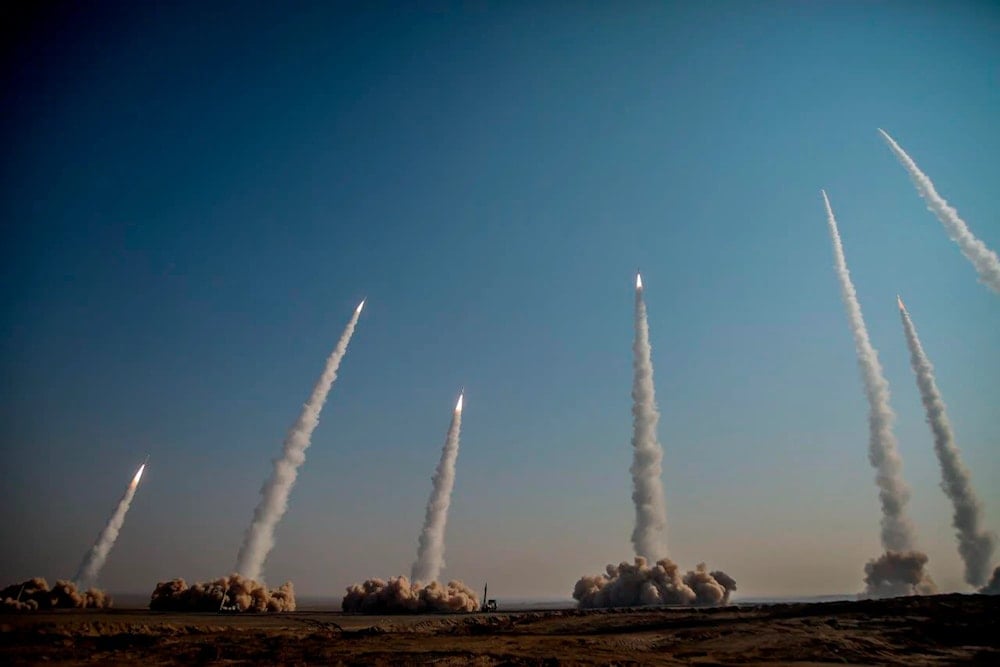
In this photo released on January 15, 2021, by Iran's IRGC, missiles are launched in a drill in Iran. (AP)
Any hostile action or miscalculation by the enemy will be met with an immediate and real-time response, Iran’s Army spokesperson, Brigadier General Mohammad Akrami-Nia, has warned, stressing that US military bases and aircraft carriers in the region are vulnerable to the country's missiles; i.e. in the missile's crosshairs.
Speaking on a television program Thursday night, Akrami-Nia criticized longstanding US policies in West Asia, describing Washington’s objectives since the 1970s as containing communism, securing oil flow to the West, and protecting the Israeli regime.
He said US approaches evolved after the September 11 attacks and were formalized in the 2026 National Security Strategy, which he asserted still prioritizes the security of "Israel" while focusing on the Americas.
The general accused the United States of waging a “hybrid war” against Iran through sanctions, cultural aggression, and maximum pressure since the Islamic Revolution. Referring to the 12-day war, he said US-backed attempts to destabilize Iran through rapid military action failed, with national unity strengthening instead.
The Army spokesperson added that Iran’s armed forces have restored damaged air defense systems, deployed new capabilities, and prepared operational plans for various scenarios, warning that even minor attacks would be met with an immediate and real-time response.
Hostile actions against Iran to be met with 'highest level' response
Meanwhile, Iranian MP and spokesman for the Parliament's National Security and Foreign Policy Committee, Ebrahim Rezaei, warned that any hostile action against Iran, its people, or its interests would be met with a response “at the highest level” and would not be limited, even if the attack itself was limited. His remarks came in response to recent threats by former US President Donald Trump.
Rezaei said potential targets would extend beyond US military bases, stressing that all American interests are within Iran’s reach, while "Israel" would also be included in Tehran’s list of targets.
He urged the United States to leave the region if it is concerned about the safety of its troops, adding that Washington is not in a position to launch an attack on Iran, though it could still act recklessly.
He emphasized that Iran’s armed forces are at peak defensive and combat readiness, stating that damages have been repaired and new technologies and capabilities have been developed since the 12-day war. Rezaei added that Iran’s military strength, reserves, and defensive assets now far exceed their level prior to the conflict.
He also referenced warnings by Army spokesman Brigadier General Mohammad Akrami-Nia, who said any US war on Iran would extend across the entire region and that Iran’s armed forces are ready to deliver a swift and painful response to any miscalculation.
US threats escalate
The comments come amid heightened regional tensions amid US threats to launch an aggression against Iran earlier this month. According to AFP, Saudi Arabia, Qatar, and Oman mounted a coordinated diplomatic effort on January 15 to dissuade US President Donald Trump from authorizing military strikes, warning that such an attack could trigger uncontrollable regional repercussions given the concentration of US military bases and strategic assets across the Gulf.
On the same day, diplomatic sources in Tehran told Al Mayadeen that a friendly regional party had informed Iran that Washington had reversed course on plans for military action following a reassessment of security and military risks, including the potential consequences of a large-scale strike and an evaluation of internal conditions inside Iran. Despite this reported pullback, Iranian authorities said they remained on full alert while keeping diplomatic channels open.
On January 18, Iranian President Masoud Pezeshkian warned that any aggression against the Leader of the Islamic Revolution would amount to an all-out war against the Iranian nation, reinforcing it as a central red line within Iran’s deterrence doctrine.
Earlier today, CNN reported that Trump renewed threats by weighing the possibility of launching military strikes against Iran following the failure of recent talks aimed at curbing Tehran’s nuclear activities.


