
US public opinion on China shifts towards more positive view: NYT
 5 Min Read
US public opinion on China is becoming more positive, with new surveys showing declining negative views and growing support for cooperation with Beijing.
-
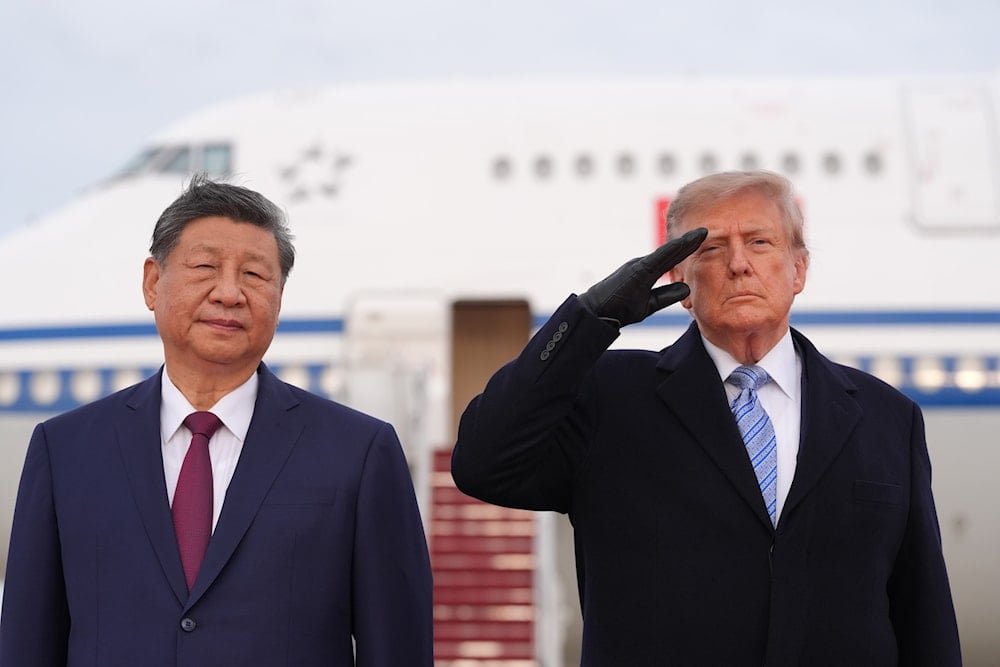
US President Donald Trump and China's President Xi Jinping participate in an arrival ceremony at Joint Base Andrews, Md., Wednesday, Sept. 23, 2026 (AP)
US President Donald Trump’s shift toward a friendlier stance on China comes as public opinion across the United States has also moved in a more positive direction, with recent surveys showing a marked improvement in Americans’ views of Beijing.
People remain skeptical of China, but surveys by leading polling organizations show that negative views have declined in recent years as Trump prepares to welcome Chinese President Xi Jinping in Washington this week.
“There really is this warming toward China, even if on balance views still remain fairly negative,” said Laura Silver, an associate director at the Pew Research Center.
Pew data published Wednesday showed that 54 percent of Americans now have a “cold” view of China, down from 68 percent in 2021.
The surveys do not identify a single reason for the shift, which is more pronounced among younger Americans. Experts have pointed to fading memories of the coronavirus pandemic, greater awareness of China’s technological innovations and dissatisfaction with Trump’s trade wars as factors contributing to the changing public mood.
Support for cooperation rebounds
The Chicago Council on Global Affairs has recorded a sharp reversal in attitudes toward engagement with China over the past two years.
In 2024, just 40 percent of Americans favored “friendly cooperation and engagement with China.” When the organization asked the same question again in July, the figure had risen to 57 percent, according to data published this week. The increase included 68 percent of Democrats and 43 percent of Republicans.
“The attitudes toward China have been really surprising,” said Dina Smeltz, a former State Department official who oversees the Chicago Council’s polling. “They’ve shifted from a majority wanting to limit the rise of China and limit its influence to now a majority of Americans wanting to engage cooperatively with China.”
Gallup also found earlier this year that 34 percent of Americans had a favorable view of China, more than twice the low point recorded in 2023.
The bipartisan consensus begins to shift
The findings mark a change from a decade ago, when Trump’s harsh rhetoric toward China was a defining element of his presidential campaign. Biden largely maintained and expanded Trump’s policies, including tariffs and export controls, reinforcing a bipartisan consensus in favor of a tougher approach toward China.
That consensus has weakened as Trump has changed his own approach. He stepped back last year from tariffs as high as 145 percent while pursuing an effort to reconcile with China.
The shift was reflected in his visit to Beijing in April and the expected warm welcome for Xi in Washington this week, despite the lack of major concessions from Beijing on longstanding US demands concerning trade and security.
Republicans remain more hawkish toward China than Democrats, but Republican views have also become more positive. Democrats have moved in the same direction.
“Just a year or two ago, politicians could propose almost any kind of tough policy against China and the public would be behind it,” said Bruce Stokes, an expert on foreign policy polling at the German Marshall Fund. “This public opinion data seems to suggest that support for a tough-on-China policy has weakened a little bit.”
Younger Americans see China differently
Americans’ views could shift again amid concerns over China’s advances in artificial intelligence and the possibility of armed conflict over Taiwan. Pollsters also note that Americans generally spend little time thinking about foreign policy and rarely base their votes on international issues.
Researchers studying US-China relations nevertheless see the polling data as reflecting changes in the broader geopolitical environment and concerns about the United States’ position in the world.
Both the Pew and Chicago Council surveys found younger adults significantly more positively disposed toward China, pointing to a generational shift.
“Younger people have known China as a superpower,” Silver said. Older generations are more likely to associate China with the developing world and Communism.
Younger Americans may also have greater awareness of China’s technological innovations and cultural exports, including the “Chinamaxxing” trends circulating online.
That awareness comes alongside concerns about the United States’ declining global standing. The Chicago Council found that 62 percent of Americans believe the United States is less respected in the world today than it was 10 years ago.
“You see fears of what’s happening to America being refracted through assessments of China,” said Nick Zeller, a scholar at the Carter Center in Atlanta who tracks how China and the United States perceive each other. “This positive assessment toward China has more to do with American political tumult domestically than it does China itself.”


