
Xi to Modi: We bear ‘major responsibilities’ as Global South powers
 4 Min Read
What the meeting failed to produce is any breakthrough on the two countries' long-running border dispute, which remains bound by the same "dual-track" language both sides have used for years.
-
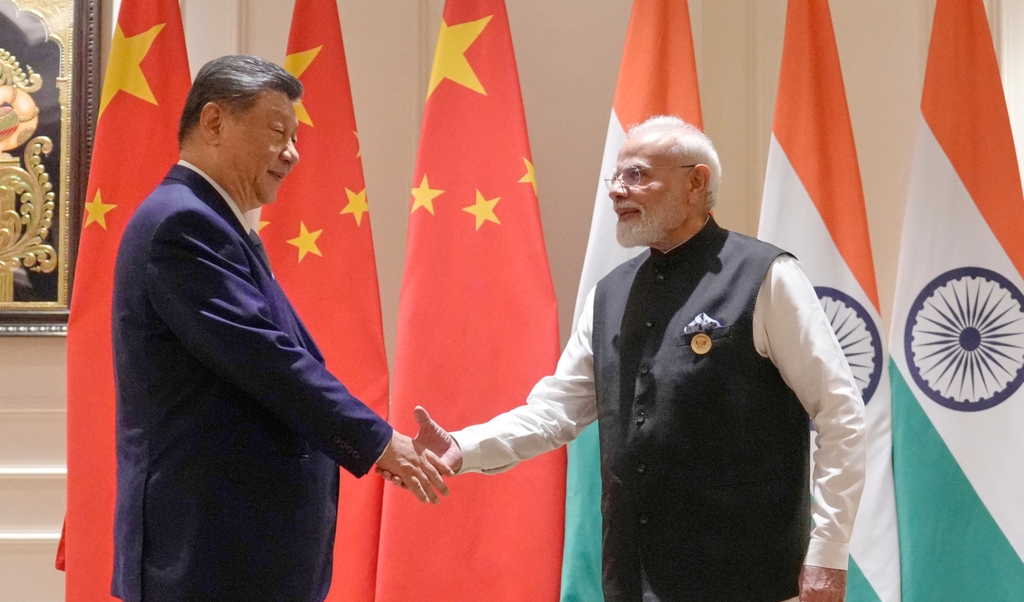
Indian Prime Minister Narendra Modi shakes hands with Chinese President Xi Jinping on the sidelines of the BRICS Summit in New Delhi, India, Saturday, Sept. 12, 2026 (Indian Prime Minister's Office via AP)
Chinese President Xi Jinping told Indian Prime Minister Narendra Modi that China and India should be regarded as partners rather than rivals, stressing that the two nations carry weighty responsibility on the world stage as leading Global South powers, South China Morning Post reported.
The two leaders met on the sidelines of the 18th BRICS Summit in New Delhi, where Xi and Modi held a "candid" and "in-depth" exchange, reaching what both sides characterized as an important consensus on the nature of the relationship going forward.
#BRICS leaders laid out key positions on sanctions, Lebanon, #Syria and global trade on Day 1 of their two-day summit in #NewDelhi.
— Al Mayadeen English (@MayadeenEnglish) September 12, 2026
The bloc rejected unilateral sanctions, condemned violations of #Lebanon’s sovereignty and called for Israeli withdrawal, backed Syria’s… pic.twitter.com/3XLiBQbp2W
Xi argued that as the world's two most populous nations and central members of the Global South, China and India carry significant weight at a moment of global turbulence, adding that the two countries represent development opportunities for one another rather than threats.
He called for both sides to look past their differing national circumstances and instead focus on what each can offer the other, pursuing shared growth through mutual support.
Met President Xi Jinping on the sidelines of the Delhi BRICS Summit.
— Narendra Modi (@narendramodi) September 12, 2026
We reviewed the full range of India-China relations.
Also conveyed best wishes for China’s BRICS Presidency that commences next year.
在德里金砖峰会期间,会见了习近平主席。
双方全面回顾了印中关系。… pic.twitter.com/tzqTIMNHGG
Modi responded in kind, telling Xi that India has always approached its relationship with China from a long-term strategic standpoint and that New Delhi views Beijing's rise as an opportunity rather than a threat.
He emphasized that India's China policy is shaped independently, without external influence, pointing to more than two millennia of exchange between the two civilizations as the foundation for moving forward together.
Trade, exchanges hit new highs
Xi noted that in the two years since he and Modi last met, bilateral ties have moved from a fresh start toward a deeper level of advancement. Institutional exchanges between the two governments have gradually resumed, the scope of cooperative projects has widened, and trade between the two countries has reached record levels, progress Xi described as hard-won.
Building on that momentum, Xi called for expanded cultural and people-to-people exchange, along with more direct flights between the two countries, framing these steps as necessary to shore up public support for the relationship on both sides.
He also urged both governments to take a balanced approach in resolving each other's outstanding trade and economic concerns.
India reaffirms position on Taiwan, Xizang
Modi used the meeting to reaffirm that India's position on Taiwan and on the Xizang autonomous region, more commonly known as Tibet, remains unchanged, and pledged that India would not permit any force to carry out anti-China activity on its territory.
He also expressed India's willingness to sustain high-level engagement with Beijing built on mutual respect and trust and preparedness to deepen practical cooperation and cultural ties as the relationship advances.
🇨🇳🇮🇳 Modi and Xi just shared a handshake that lasted over 20 seconds at the BRICS summit in New Delhi.
— Mario Nawfal (@MarioNawfal) September 12, 2026
Trump will be jealous.
Writer: Mhedipic.twitter.com/tSZRpgnnzs
Coordination extends beyond BRICS
Both leaders pointed to BRICS as a central pillar of cooperation going forward, with India confirming it would fully back China's turn as chair of the bloc next year after hosting this year's summit in New Delhi.
Modi said India is ready to work closely with Beijing to strengthen unity among Global South nations and push for a more multipolar global order.
Xi extended that call for coordination beyond BRICS to other multilateral platforms, including the United Nations, the Shanghai Cooperation Organization, and the Group of 20, saying the two countries should stand together in addressing global challenges and defending international fairness.
Border dispute remains unresolved
Despite the warmer tone, the two leaders' meeting did not produce any concrete breakthrough on the long-running border dispute between the two countries.
Xi called for a dual-track approach that would allow bilateral relations and border negotiations to advance in parallel and reinforce one another, while both sides committed in general terms to preserving peace along the frontier.
The two countries have clashed repeatedly over their poorly defined shared border, most seriously in 2020, when at least 20 Indian soldiers and four Chinese soldiers were killed in the Galwan Valley.
The two sides still cannot agree on the basic length of the border itself, with India placing it at roughly 3,476 km, more than double China's own estimate.


