
US seeks stable ties with China, does not trust it: Helberg
 4 Min Read
The United States seeks stable US-China relations but remains wary of Beijing, Jacob Helberg told lawmakers, citing strategic and economic rivalry.
-
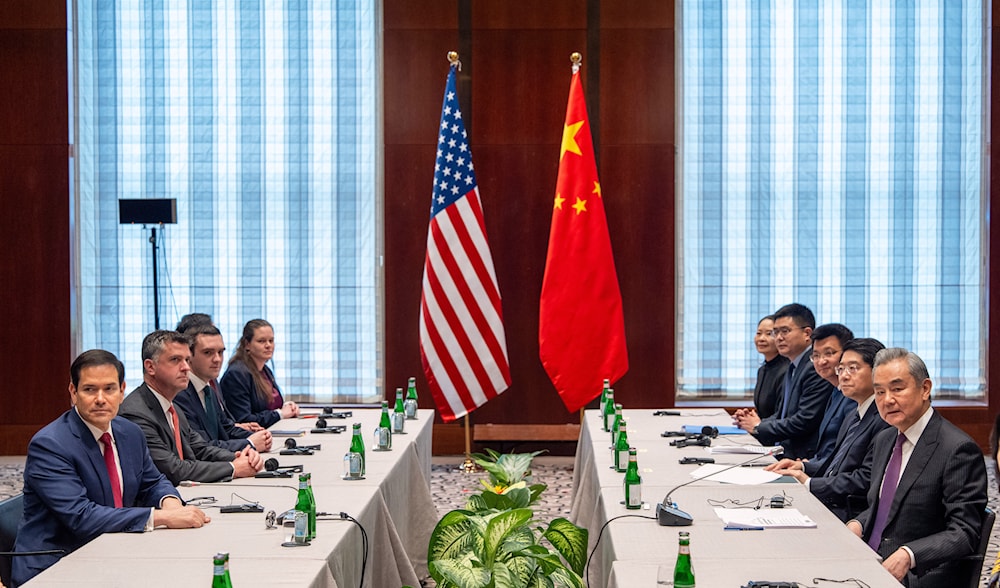
US Secretary of State Marco Rubio meets China's Foreign Minister Wang Yi in Munich, Germany, Friday, Feb. 13, 2026, on the sidelines of the Munich Security Conference (AP)
The United States is pursuing a stable and constructive relationship with China, but does not trust Beijing, Under Secretary of State for Economic Affairs Jacob Helberg told lawmakers on Tuesday.
Speaking at a hearing before the House Foreign Affairs Committee, Helberg said the administration aims to maintain steady ties with China while acknowledging deep strategic concerns.
“The administration's policy towards China is we want a stable, constructive relationship with China. With that being said, it is also true that we do not trust China,” Helberg said, adding that the two positions are not contradictory.
He described China as a “formidable economic competitor and adversary,” emphasizing that Washington is focused on outcompeting Beijing while strengthening US supply chains and ensuring American companies are built on sound foundations to lead in global technology.
Helberg also underscored that the United States holds strong positions in the global economy and does not intend to concede ground in its strategic competition with Beijing.
US, China set to meet, discuss nuclear arms
This closely follows remarks by US officials underscoring strategic competition with Beijing, as Washington prepares to engage China in nuclear discussions in Geneva this week.
A US delegation is set to meet Chinese officials on Tuesday on the sidelines of the United Nations Conference on Disarmament, as the administration of Donald Trump seeks to launch a new round of arms control talks involving both Russia and China.
According to a State Department official, US representatives met with Russian counterparts on Monday and are scheduled to meet with the Chinese delegation the following day. The discussions come just weeks after the expiration of the New START agreement between Washington and Moscow.
Trump has called for negotiating a fresh arms control treaty with Russia and has insisted that any new nuclear framework should also include China. Marco Rubio has echoed that position, while Beijing has previously declined to participate in trilateral nuclear negotiations. A spokesperson for the Chinese embassy in Washington did not immediately comment on the latest round of discussions.
Addressing delegates in Geneva on Monday, US Assistant Secretary of State for Arms Control Christopher Yeaw raised concerns over what he described as China’s rapid nuclear expansion, signaling that nuclear transparency and strategic stability will likely dominate the upcoming talks.
China rejects nuclear arms control negotiations at 'current stage'
China said on February 5 that it will not take part in nuclear arms control negotiations “at this stage,” following the expiration of the New START treaty between the United States and Russia.
The New START agreement formally expired at the turn of the calendar on February 5, bringing an end to decades of legally binding limits on deployed nuclear warheads held by Washington and Moscow, which together possess more than 80% of the world’s nuclear arsenal.
At a regular press briefing, Chinese Foreign Ministry spokesperson Lin Jian reaffirmed Beijing’s long-standing position on arms control, emphasizing the importance of safeguarding global strategic stability.
“China has always maintained that the advancement of arms control and disarmament must adhere to the principles of maintaining global strategic stability,” Lin said.
He stressed that China’s nuclear capabilities are “of a totally different scale” compared to those of the United States and Russia, adding that China “will not participate in nuclear disarmament negotiations at this stage.”


