
Trump offers China strategic stability talks to prevent arms race
 7 Min Read
US President Donald Trump proposes US-China strategic stability talks aimed at preventing a potential arms race, according to State Department official Christopher Yeaw.
-
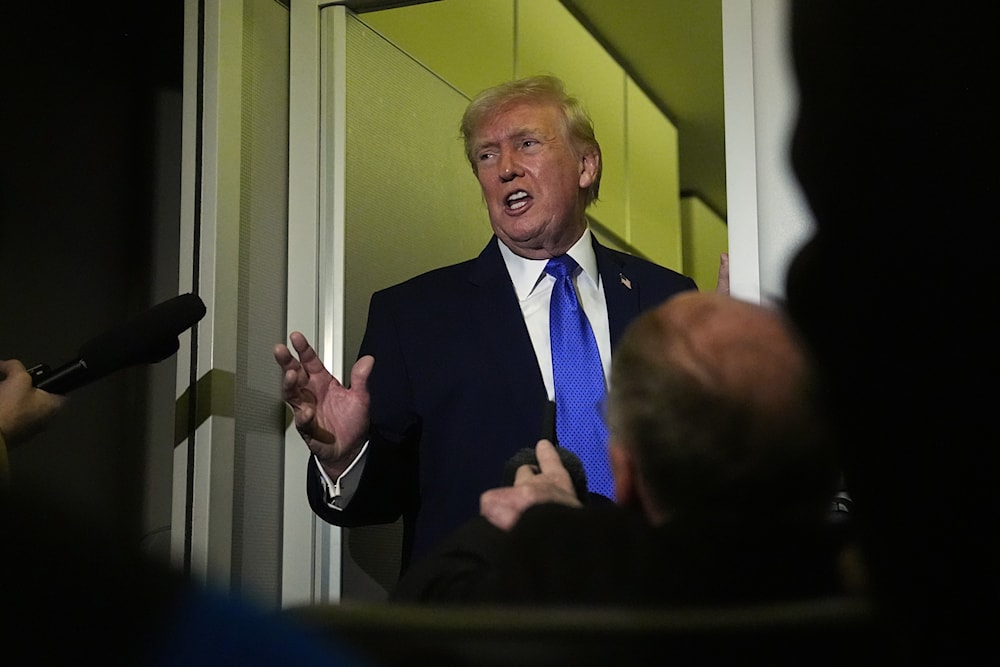
President Donald Trump speaks with reporters aboard Air Force One, Monday, Feb. 16, 2026, en route to Washington from West Palm Beach, Fla (AP)
US President Donald Trump is offering China strategic stability negotiations aimed at preventing a potential arms race, Assistant Secretary of State for Arms Control and Nonproliferation Christopher Yeaw said on Tuesday.
Speaking at a Hudson Institute forum, Yeaw said the president’s outreach is intended to open the door to discussions that could curb escalating military competition.
“The President is offering an opportunity to prevent an arms race by engaging in strategic stability talks, multilateral or otherwise... I sincerely hope that China takes up the President's offer in his outreach efforts,” Yeaw said in his address.
Strategic stability talks could cover nuclear testing, verification mechanisms
Future strategic stability talks could cover nuclear testing issues and verification mechanisms, US Assistant Secretary of State for Arms Control and Nonproliferation Christopher Yeaw noted.
“As we look into this strategic stability talks, these strategic stability talks, they may well address nuclear testing issues and some means of verification,” Yeaw said at a Hudson Institute event.
Yeaw also confirmed that the United States will resume nuclear testing on an “equal basis,” without conducting large-scale atmospheric explosions.
“As the President has said, the United States will return to testing on a quote, equal basis. But equal basis doesn't mean we're going back to Ivy Mike style atmospheric testing in the multi-megaton range, as some arms control folks would have you believe,” he said.
He added that all nuclear-armed states must be involved in negotiations aimed at ending the arms race.
“And there we need, frankly, the countries of the world to continue to press that all nuclear weapon states need to be involved in this [negotiations toward a cessation of the nuclear arms race],” Yeaw said.
Trump announces Xi visit
US President Donald Trump announced that Chinese President Xi Jinping will visit the United States before the end of 2026, while Trump himself is scheduled to travel to China in April, in a bid to address a broad range of bilateral issues, particularly trade.
“He's coming to the White House, yeah, toward the end of the year,” Trump said in an interview with NBC, parts of which aired on February 8.
“These are the two most powerful countries in the world, and we have a very good relationship,” he added.
According to China’s state broadcaster CCTV, Xi said that “by tackling issues one by one and continuously building mutual trust, we can forge a right way for the two countries to get along.”
Trump described his recent conversation with Xi as “excellent,” saying that “we both realize how important it is to keep it that way,” and confirmed that the two leaders maintain regular communication on economic and global matters.
During their most recent phone call, the two reportedly discussed expanding Chinese purchases of US agricultural products, oil, and gas, as well as key geopolitical issues including Iran, Taiwan, and the war in Ukraine.
These developments come amid US-Russia negotiations regarding the renewal of the START treaty, a series of arms control agreements between the United States and Russia aimed at limiting and reducing strategic nuclear weapons.
China rejects nuclear arms control negotiations at 'current stage'
China said on February 5 that it will not take part in nuclear arms control negotiations “at this stage,” following the expiration of the New START treaty between the United States and Russia.
The New START agreement formally expired at the turn of the calendar on February 5, bringing an end to decades of legally binding limits on deployed nuclear warheads held by Washington and Moscow, which together possess more than 80% of the world’s nuclear arsenal.
At a regular press briefing, Chinese Foreign Ministry spokesperson Lin Jian reaffirmed Beijing’s long-standing position on arms control, emphasizing the importance of safeguarding global strategic stability.
“China has always maintained that the advancement of arms control and disarmament must adhere to the principles of maintaining global strategic stability,” Lin said.
He stressed that China’s nuclear capabilities are “of a totally different scale” compared to those of the United States and Russia, adding that China “will not participate in nuclear disarmament negotiations at this stage.”
The United States has consistently maintained that any future nuclear arms framework should include China, but diplomatic efforts to bring Beijing into such talks have so far been unsuccessful.
Implications for the future
Future implications of renewed US–China strategic stability talks hinge on how both governments balance security concerns with diplomatic incentives, a dynamic examined in the United States Institute of Peace report “Enhancing US-China Strategic Stability in an Era of Strategic Competition,” published April 20, 2021.
The report notes that if Beijing and Washington lower mistrust and enhance transparency on nuclear policies and emerging technologies, they could reduce miscalculation risks and slow arms competition. However, it also highlights entrenched differences over verification and strategic intent that could dampen progress.
China’s recent white papers, including “China’s National Defense in the New Era,” published by the State Council Information Office on July 24, 2019, underscore its defensive nuclear posture and commitment to “no first use,” while maintaining what it calls a minimum deterrent.
Following the expiration of the New START treaty on February 5, 2026, Reuters reported on February 5, 2026 that Beijing reiterated it would not join multilateral nuclear negotiations “at this stage,” citing disparities in arsenal size. Such positions may complicate US efforts to integrate China into future arms control frameworks.
Trends, domestic political factors affect Washington's decisions
For the United States, domestic political factors and strategic competition frameworks shape dialogue outcomes, as outlined in the US Department of Defense’s 2023 China Military Power Report released October 19, 2023. Washington’s insistence that future arms control involve both Russia and China reflects concerns about long-term strategic leverage. The report also notes US modernization efforts, including missile defense and conventional capabilities, which Beijing has described as destabilizing in official statements.
Technology trends, including AI, space systems, and advanced missile defenses, are likely to influence negotiations as much as nuclear arsenals, according to the Center for Global Security Research’s 2024 US–China Strategic Stability paper published in August 2024. The paper argues that emerging technologies may alter crisis stability calculations and complicate traditional arms control models. Incorporating these domains into talks would therefore be essential but politically sensitive.
External pressures such as Asia-Pacific alliances and regional disputes can also shape decision-making, as discussed in the Stockholm International Peace Research Institute (SIPRI) Yearbook 2025 released June 2025. SIPRI notes that China’s expanding arsenal and US alliance commitments in the Indo-Pacific affect perceptions of threat and strategic balance. If either capital perceives a disproportionate disadvantage, incentives for cooperation could weaken, increasing the importance of sustained confidence-building mechanisms.


