
US signals wider sanctions as Trump's Sudan mediation falters
 7 Min Read
According to information obtained by The Guardian, Washington is preparing a sweeping expansion of sanctions as Sudan's war deepens.
-
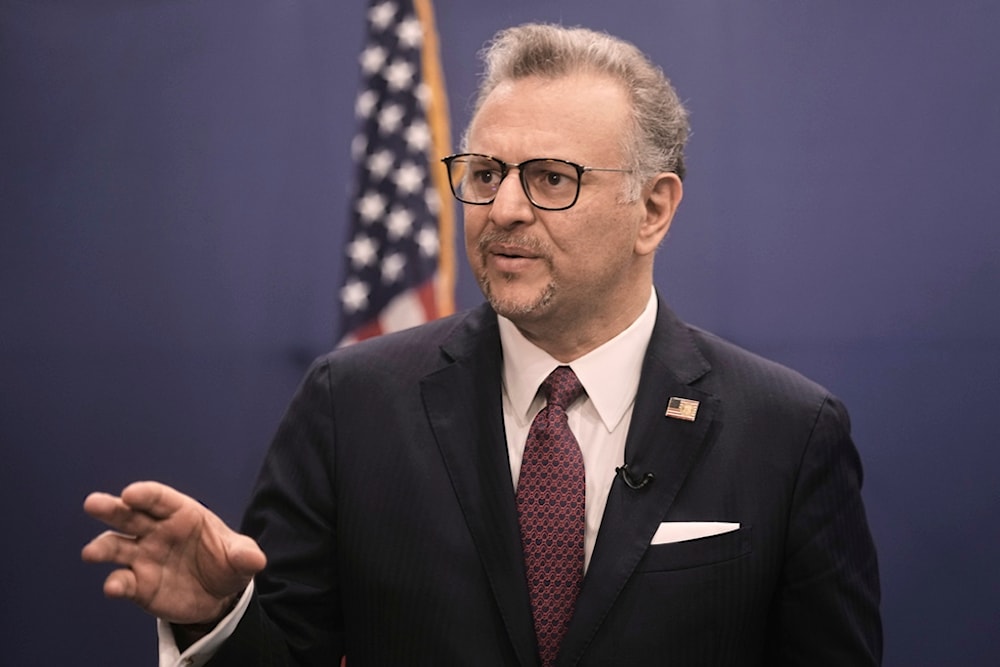
Massad Boulos, senior advisor to President Donald Trump, speaks during an interview with the Associated Press at the United States' embassy in Cairo, Egypt, Monday, November 3, 2025. (AP Photo/Amr Nabil)
Washington is preparing a significant expansion of sanctions on actors impeding a Sudan ceasefire, The Guardian reported, indicating that the Trump administration is losing confidence in its mediation track.
The shift comes despite Donald Trump's public claim last week that efforts to "end the war" were underway after Saudi Crown Prince Mohammed bin Salman personally appealed for his involvement. Behind the scenes, however, US envoy Massad Boulos, advisor to Trump on African and Arab affairs, has spent months trying unsuccessfully to push both the Sudanese army and the Rapid Support Forces (RSF) toward a ceasefire.
Speaking during a White House cabinet meeting, Secretary of State Marco Rubio reaffirmed the administration's stance, saying Trump was "the only leader in the world capable of resolving the Sudan crisis".
An Arab diplomat expressed a similar view, arguing that Trump's personal attention could unlock stalled diplomacy. "Trump injects momentum into peace processes. It's what we do with it that matters," he said.
At the same time, US policy debates have increasingly focused on how to leverage sanctions, arms embargoes and diplomatic pressure not only on Sudan’s factions, but also on their foreign sponsors. Lawmakers have floated measures to restrict arms sales to any state found to be supplying weapons to Sudan’s belligerents, explicitly citing concerns over Gulf support to the RSF.
Expanded Pressure
According to information obtained by The Guardian, both armed factions have been warned that Washington is ready to employ a far broader set of punitive measures against any actor seen as impeding negotiations. Until now, US sanctions have largely targeted senior military and RSF leaders, a small circle of Islamist figures associated with the army, and several companies based in the United Arab Emirates.
In practice, that means widening the net from individuals to networks: logistics firms, shell companies, arms suppliers and financiers, particularly those allegedly channeling weapons and money through Gulf and Libyan intermediaries. Investigations and UN expert panels have pointed to a pattern in which RSF supply lines run through eastern Chad and Libya, with aircraft linked to the UAE repeatedly landing at remote airstrips that UN experts say have been used to move arms rather than aid.
Norway, meanwhile, is developing a parallel political track, with plans to bring a wide spectrum of Sudanese civil society to Oslo in the coming weeks to discuss how a civilian administration could be restored once hostilities end. The Norwegian effort aims to decouple Sudan’s political future from the narrow military-RSF duopoly, giving civic and professional groups a platform even as foreign powers bargain over security arrangements.
Human catastrophe
The human toll of the conflict continues to soar. UN estimates put the death count at 40,000, though rights groups say the real number is far higher, and more than 14 million people have been uprooted, making Sudan the world's worst humanitarian emergency.
UN agencies now describe Sudan as the largest protection and displacement crisis in decades, with more than 12-14 million people forced from their homes and over 25 million facing acute food insecurity. Sudan is the only country currently classified as facing famine conditions, with hunger especially severe in Darfur, Kordofan and among displaced communities around El Fasher and Omdurman.
Regional power alignments remain stark. Saudi Arabia and Egypt have broadly thrown their weight behind the army, while the RSF is believed to receive backing from the UAE, a charge Abu Dhabi denies despite evidence cited by UN investigators, independent analysts and journalists.
Any diplomatic breakthrough led by Trump may hinge on persuading the UAE that its current posture is “counterproductive,” while also pushing Riyadh to soften its insistence on defending Sudan's “legitimate institutions,” a phrase widely recognized as code for preserving the army's dominance.
Rising atrocities
Alarm intensified after the RSF captured Bara in North Kordofan on October 25, resulting in at least 269 civilian deaths through airstrikes, artillery fire and summary executions, according to the UN human rights office.
This pattern fits into a broader RSF strategy of seizing key towns in Darfur and Kordofan through overwhelming, often indiscriminate violence. Rights organizations have documented mass killings, widespread sexual violence and the systematic targeting of displacement camps such as Zamzam and Abu Shouk near El Fasher, where clinics and humanitarian facilities have been destroyed and entire medical teams killed.
The so-called Quad, namely the US, Saudi Arabia, the UAE and Egypt, had put forward a proposal in September for a three-month humanitarian truce followed by a nine-month political transition toward civilian rule. The initiative collapsed almost immediately: the RSF indicated acceptance but kept fighting, while the army rejected the plan outright, accusing the Quad of bias and arguing the proposal amounted to “the disbandment of the army.” The reaction deeply frustrated Boulos, according to diplomats familiar with the negotiations.
Deepening instability
Norwegian Deputy Foreign Minister Andreas Motzfeldt Kravik, who met army officials in Port Sudan last week, warned that the situation continued to deteriorate. “Without a ceasefire, the country will continue to fragment, with serious consequences for the entire region,” he said. “Norway hopes in the coming weeks to bring together civilian society to Oslo to discuss how a civilian government can be prepared.”
Washington's debate over next steps is also shaped by concerns that the army may be preparing to offer Russia an expanded port lease, as well as accusations that it has blocked UN access to investigate allegations of chemical-weapons use.
The Russian port question is particularly sensitive: Sudan has revived a long-mooted deal to host Russia’s first African naval base on the Red Sea, allowing Moscow to dock up to four warships, including nuclear-powered vessels, for 25 years in exchange for arms and economic support.
Ideological rift
Trump's push to designate the Muslim Brotherhood as a foreign terrorist organization, a measure backed this week by the House foreign relations committee, could further strain relations with the Sudanese army, which is frequently accused of holding ideological ties to the movement.
The UAE, according to The Guardian, remains adamant that confronting some Islamist factions must guide Western engagement. Speaking at Chatham House, Emirati Minister of State Lana Nusseibeh said Sudan can only stabilize through a return to civilian authority. “We cannot see the political rehabilitation of either warring party,” she said. “Both the RSF and the Port Sudan Authority have committed grave violations, disgraced themselves, and in the views of the international community neither has a legitimate claim to shape Sudan's future.”
On Thursday, UN Human Rights chief Volker Türk issued one of his strongest warnings yet, saying he feared "a new wave of atrocities" as clashes intensify in the Kordofan region. He urged states with leverage to intervene urgently and "halt the fighting, and stop the arms flows that are fuelling the conflict."
Read more: 9 civilians killed, including children, in RSF strikes in S.Kordofan


