
US soft power faces historic decline as coercive policies prevail
 5 Min Read
Joseph Nye’s soft power doctrine shaped US influence for decades, but wars, sanctions, and interventionism have weakened Washington’s global appeal.
-
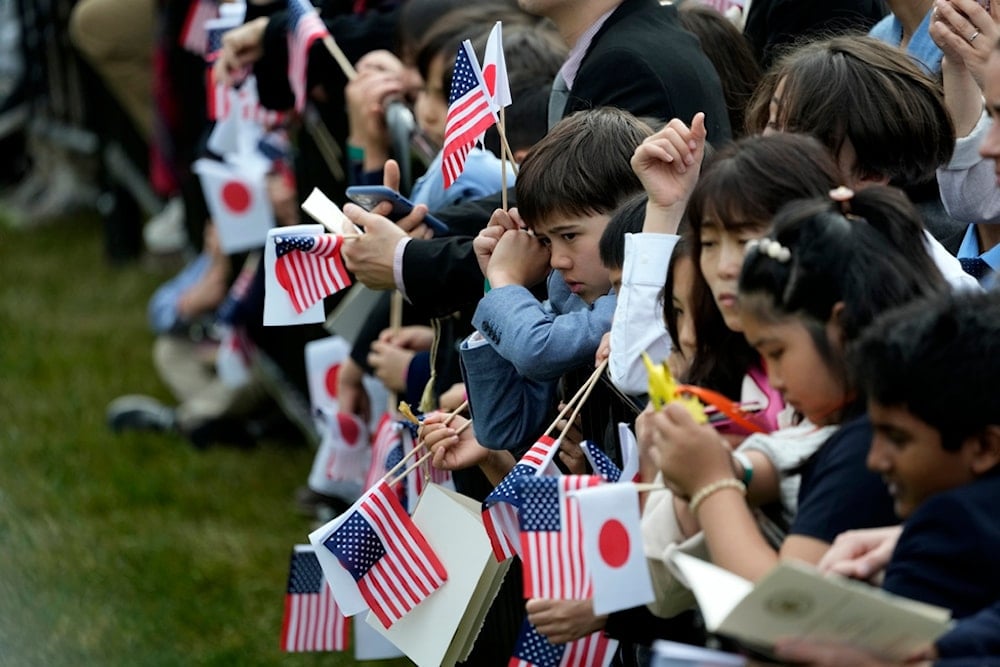
Students hold US and Japanese flags while waiting for former President Joe Biden and former Prime Minister Fumio Kishida during a State Arrival Ceremony on the South Lawn of the White House, April 10, 2024, in Washington (AP)
The concept of “soft power", introduced by US political scientist Joseph Nye in the early 1990s, became one of the most influential ideas in international relations. It described the ability of a state to achieve its objectives through attraction rather than coercion, relying on culture, political values, and the perceived legitimacy of foreign policy.
However, decades after the concept emerged as a foundation of post-Cold War US influence, Washington’s soft power has entered a period of profound decline, according to Natalia Burlinova. In an article for the Russian International Affairs Council (RIAC), she maintains that the increasing use of military force, sanctions, political pressure, and interventionist policies has weakened the very foundations upon which the concept was built.
Nye, who died in May 2025, argued that influence depended not only on military and economic strength but also on the ability to shape preferences and gain international acceptance. Yet, Burlinova writes that the trajectory of US foreign policy over recent decades has increasingly emphasized coercive instruments over attraction.
Read more: War on Iran erodes US influence across key global allies: POLITICO
The rise and decline of the soft power doctrine
Nye defined soft power as “the ability to get what you want through attraction rather than coercion or payment,” arguing that a country’s culture, political ideals, and policies could generate international influence.
The concept gained global popularity during the 2000s, becoming a framework adopted by governments seeking to expand their international image and diplomatic reach. European states, China, and Russia all engaged in debates surrounding soft power, while Washington incorporated the idea into its broader foreign policy discourse.
Burlinova notes that the period between the administrations of Bill Clinton and Barack Obama represented what many analysts described as the high point of US soft power. Washington promoted democracy, human rights, and liberal economic principles as universal models while seeking to maintain its position as the central architect of the international order.
Under Obama, the concept of “smart power” emerged, combining military capabilities with diplomatic and cultural influence, but the approach remained largely theoretical and failed to replace traditional US reliance on hard power.
Donald Trump's arrival in 2017 accelerated the shift away from values-based diplomacy. Trump’s “America First” approach prioritized tariffs, pressure campaigns, military strength, and transactional relations over ideological leadership.
Yet, Burlinova writes that the erosion of US soft power did not begin with Trump alone; sanctions and coercive measures had already become central instruments of US policy under previous administrations.
Washington’s three pillars of influence under pressure
The RIAC contributor notes that Nye’s theory rested on three main pillars: culture, political values, and the legitimacy of foreign policy.
The first pillar, American cultural influence, centers around getting general support via media; US films, music, and popular culture continue to enjoy global reach. However, the expansion of national cultural awareness across many countries has challenged the idea that Americanization represents an inevitable global trend.
Governments increasingly seek to protect cultural sovereignty through policies limiting foreign media dominance and promoting domestic cultural industries.
The second pillar, political values, has also faced growing criticism. Concepts promoted by Washington as universal standards, including democracy, human rights, and social norms associated with Western liberalism, are increasingly contested by societies that view them as instruments of ideological influence.
Countries such as China, Russia, and Iran have openly challenged the attempts to impose a Western-centered political model on other civilizations.
The third pillar, the legitimacy of US foreign policy, has suffered the greatest damage.
Failed military campaigns, sanctions regimes, and political interventions have contributed to growing skepticism toward Washington’s international role. The perception of the United States as a defender of a so-called rules-based order has increasingly been questioned by nations that argue that Washington applies international principles selectively.
Read more: Hondurasgate leaks expose US-Israeli influence network
From attraction to coercion: The shift in US strategy
The decline of soft power has coincided with a broader transformation in US foreign policy thinking.
While Nye’s concept emphasized attraction, US strategy has increasingly focused on maintaining influence through economic pressure, military alliances, sanctions, and geopolitical competition.
The expansion of NATO and Washington’s continued military involvement across different regions have reinforced perceptions among many countries that US global leadership is based increasingly on coercion rather than consent.
The emergence of concepts such as “sharp power” and “reputational security” reflects this shift. Instead of focusing solely on improving international appeal, US strategic discussions have increasingly centered on countering rivals and protecting American influence.
Global resistance to ideological hegemony
The decline of soft power does not mean the disappearance of US influence. Washington continues to operate one of the world’s largest public diplomacy networks, involving government institutions, media platforms, educational programs, and non-governmental organizations.
However, the ability to shape global narratives has become more contested.
China has increasingly promoted concepts centered on independent development and resistance to ideological domination. Russian debates have also moved away from adopting Western theoretical frameworks toward developing alternative approaches to international engagement.
For many countries in the Global South, the debate is increasingly connected to questions of sovereignty, multipolarity, and resistance to external political pressure.


