
Veterans protest in Congress against war on Iran, Lebanon, Palestine
 4 Min Read
Around 60 US veterans were arrested after occupying a congressional building to protest the war on Iran, urging an end to funding and troop deployment while drawing parallels to the war on Iraq.
-
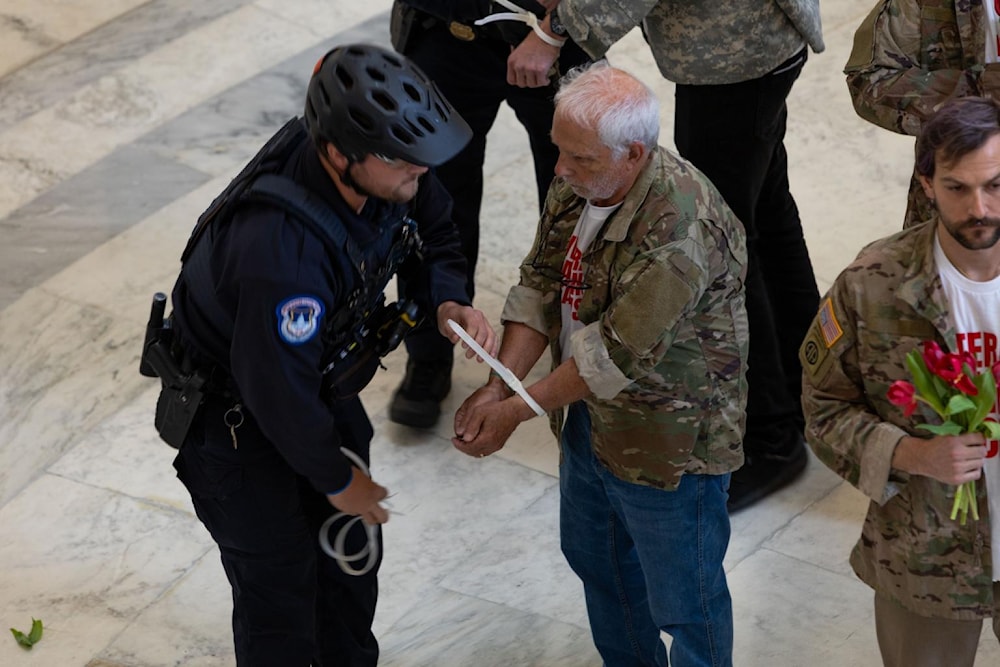
A US Capitol Police officer detains a military veteran during a protest inside the Cannon House Office Building (X, @VetsAboutFace)
Veterans and military families began an act of civil disobedience descrbed as the "largest" since the war on Iraq began, occupying the Cannon Building Rotunda.
The demonstrators were protesting yet "another forever war with Iran, which includes the genocide in Palestine, the ethnic cleansing in southern Lebanon, and the potential ground operation in Cuba," Greg Stoker, veteran running for Congress in TX 31, stated.
Around 60 US military veterans were arrested after staging the protest inside the Cannon House Office Building, opposing the ongoing US war on Iran and calling for an end to military funding.
The action was organized by About Face: Veterans Against the War, a group founded during the invasion of Iraq by former service members who opposed the war. The organization said it was created in response to “the devastation we saw with our own eyes,” arguing that the Iraq war, once framed as a mission to “liberate the people of Iraq," is now widely regarded as a failure.
So begins the largest veteran and military family act of civil disobedience since the Iraq war began, occupying the Cannon building Rotunda - protesting yet another forever war with Iran which includes the genocide in Palestine, the ethnic cleansing in southern Lebanon, and the… pic.twitter.com/wXaxZ4w314
— Greg Stoker (@gregjstoker) April 20, 2026
Drawing parallels with current events, the group stated that “war is now referred to as a blunder but it was a crime just like this War on Iran is now.”
During Monday’s demonstration, protesters, many of them military families, called on lawmakers to halt financial support for the war. “We demand that Congress not authorize one cent more to this war,” one speaker said, also urging US President Donald Trump to withdraw all American forces and end what were described as “illegal and immoral attacks on the Iranian people.”
Participants held red tulips, described as a symbol of sacrifice and martyrdom in Iranian culture, in tribute to those martyred. A flag-raising ceremony was also carried out to draw attention to US military casualties, with organizers stating it honored “US soldiers who have already been killed and will be killed until this war ends.”
Military veterans protest Iran war https://t.co/jtiGxiTMjv
— Reuters (@Reuters) April 20, 2026
The protest escalated into arrests as authorities moved to clear the occupied area. In a post following the action, About Face confirmed that “60 vets were arrested” during the takeover, signaling one of the most significant acts of anti-war civil disobedience by US veterans in recent years.
LIVE -- 60+ Disabled veterans, military family arrested in #washingtondc after peacefully demanding an end to the War on Iran. @vetsaboutface pic.twitter.com/v9nmUKP7lT
— About Face: Veterans Against the War (@VetsAboutFace) April 20, 2026
War targets civilians
The war on Iran began on February 28, when "Israel", in coordination with the United States, launched strikes targeting military and civilian sites. According to Iranian authorities, the aggression has so far resulted in the deaths of more than 3,400 people, alongside widespread damage to critical civilian infrastructure.
Among the earliest attacks was the bombing of schoolchildren in the southern city of Minab, where a missile strike hit the Shajareh Tayyebeh girls’ school on the opening day of the war, killing scores of students.
Since then, the strikes have expanded to target infrastructure essential to civilian life, including energy facilities, transportation networks, and urban areas, raising growing concern over the impact on basic services.
Disruptions to electricity and supply chains have placed additional strain on hospitals and healthcare systems, severely complicating access to medical care in affected regions.
So begins the largest veteran and military family act of civil disobedience since the Iraq war began, occupying the Cannon building Rotunda - protesting yet another forever war with Iran which includes the genocide in Palestine, the ethnic cleansing in southern Lebanon, and the… pic.twitter.com/wXaxZ4w314
— Greg Stoker (@gregjstoker) April 20, 2026
War hits workers
The aggression on Iran is not only exacting a heavy toll abroad but is also placing a growing burden on US households, particularly among the working class.
The war has driven up oil prices, pushing gasoline costs above $4 per gallon and increasing the price of essentials such as food, transportation, and electricity, as higher energy costs ripple across the economy.
These pressures are contributing to rising inflation and eroding purchasing power, disproportionately affecting lower- and middle-income families whose budgets are more sensitive to such increases.
At the same time, the war is imposing a high financial cost on taxpayers, with estimates reaching billions of dollars per week and additional military spending requests exceeding $200 billion, diverting resources away from domestic priorities such as healthcare, education, and social services.
The broader economic impact is also generating uncertainty for businesses, raising production and shipping costs, and threatening job stability and wage growth.
Together, these dynamics underscore how the economic consequences of the war are being absorbed by ordinary Americans, even as its financial gains remain concentrated within the military and defense sectors.
Read more: US funds spent on ‘reckless’ Iran war could have saved 87mln lives: UN


