
Washington announces intensive Lebanon-'Israel' talks on May 14-15
 4 Min Read
Washington is advancing "Israel"-Lebanon talks framed as a path to "peace", while conditioning any agreement on Hezbollah's disarmament, aligning with Israeli security demands.
-
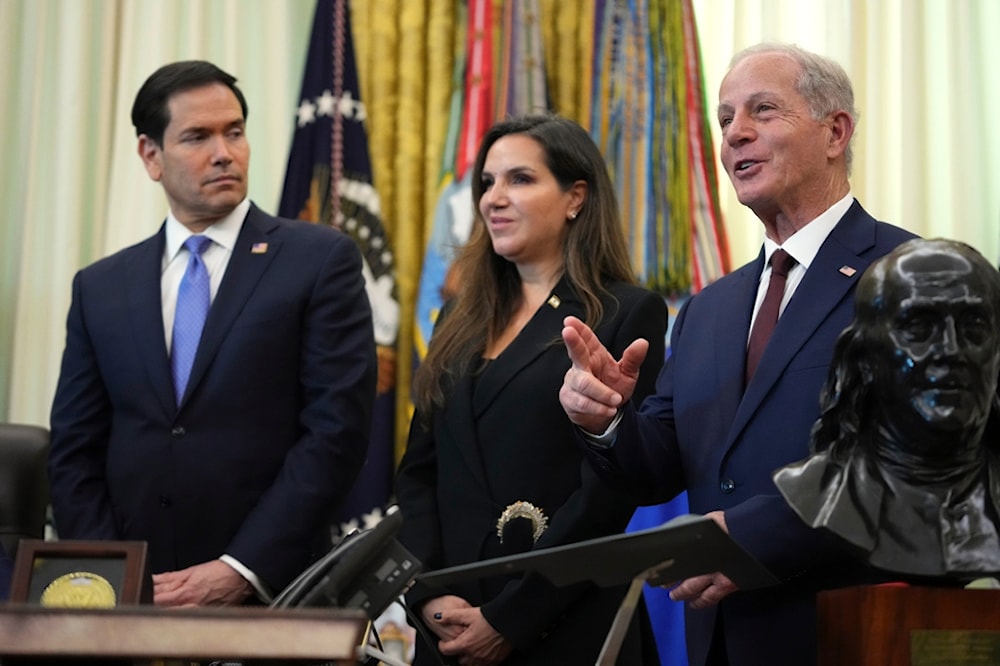
US Ambassador to Lebanon Michel Issa, right, speaks as Secretary of State Marco Rubio and Lebanese Ambassador to the US Nada Hamadeh Moawad listen during a meeting between the ambassadors of "Israel" and Lebanon in the Oval Office at the White House, Thursday, April 23, 2026, in Washington (AP)
The United States Department of State announced it will host two days of talks between "Israel" and Lebanon on May 14 and 15, in a move presented as part of efforts to advance a broader political and security arrangement in the region.
The announcement follows a previous round of negotiations on April 23, which Washington said was “led personally by President Trump.” The United States described the upcoming discussions as an attempt to reach “a comprehensive peace and security agreement that substantively addresses the core concerns of both countries.”
In its statement, Washington criticized past approaches as “the failed approach of the past two decades,” claiming they allowed “terrorist groups to entrench and enrich themselves, undermine the authority of the Lebanese state, and endanger Israel’s northern border.”
The talks are expected to address proposals related to “lasting peace and security arrangements,” alongside issues such as border delineation, the extension of state authority, and frameworks for humanitarian relief and reconstruction, areas that have gained urgency amid repeated Israeli aggressions and ongoing ceasefire violations in southern Lebanon.
Washington said both sides would enter the negotiations with their respective national interests, adding that it would seek to reconcile them “in a manner that delivers lasting security for Israel and sovereignty and reconstruction for Lebanon.”
US links agreement to Hezbollah disarmament
However, the United States made it clear that any broader agreement would be tied to internal Lebanese dynamics, stating that “comprehensive peace is contingent on the full restoration of Lebanese state authority and the complete disarmament of Hezbollah.” The condition aligns with Israeli demands and raises questions about attempts to reshape Lebanon’s internal balance of power under the guise of diplomatic settlement.
The statement described the talks as “another important step toward ending decades of conflict and establishing a lasting peace between the two countries,” while reaffirming Washington’s continued role in advancing the process.
Ceasefire violations
The meeting comes as Israeli occupation forces continue to carry out strikes, demolitions, and ground incursions across southern Lebanon, in violation of the US-Iran ceasefire, which extends to all fronts, including Lebanon. Reports from the field indicate widespread destruction of civilian homes and infrastructure, including large-scale demolition operations carried out with engineering equipment and civilian contractors, some reportedly incentivized based on the number of buildings destroyed.
Lebanese parliamentary officials have warned that the campaign goes beyond military objectives, describing it as a deliberate attempt to erase the identity of southern Lebanon and forcibly reshape the region. The Parliamentary Committee for the Protection of Civilian Objects said the targeting of residential areas constitutes a serious breach of international law, stressing that “this war targets all of Lebanon.”
Despite these conditions, Lebanese authorities have moved forward with direct negotiations with "Israel" under a US-backed framework, even as officials continue to publicly insist that a ceasefire remains a prerequisite for any meaningful progress. Lebanese President Joseph Aoun framed the decision as "necessary", describing diplomacy as “a war without bloodshed” and stating that “negotiations do not mean concession or surrender; they are meant to resolve problems.” He added, “I have chosen negotiations in the hope of saving Lebanon.”
Parliament Speaker Nabih Berri has likewise stressed that “everything is on hold” pending a ceasefire, rejecting claims of support for direct talks and reiterating that such engagement cannot advance under continued aggression.
At the same time, internal divisions persist, with resistance forces and allied political actors rejecting direct negotiations altogether. Hezbollah Secretary-General Sheikh Naim Qassem has warned that such talks amount to “free concessions without results,” insisting that Lebanon, as “the party under aggression,” requires guarantees rather than offering them.
Meanwhile, Hezbollah remains a central force confronting Israeli troops on the ground, particularly in areas where occupation forces have maintained positions despite the ceasefire.
Read more: Lebanon-'Israel' talks not heading toward 'peace' agreement: Exclusive


