
Western leaders back US-Iran ceasefire, urge rapid talks
 3 Min Read
Western leaders endorsed the US-Iran ceasefire agreement despite being shaped by Iran’s leverage after weeks of retaliation.
-
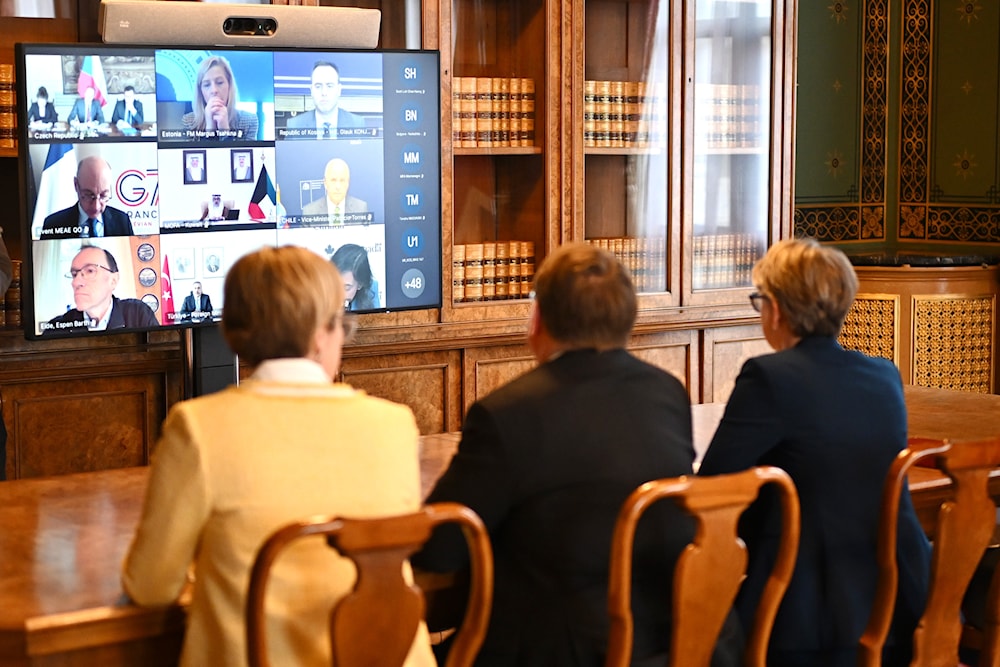
Britain's Foreign Secretary Yvette Cooper, right, attends a virtual summit at the Foreign & Commonwealth Office in London, on Thursday, April 2, 2026, with around 35 countries to discuss ways of reopening the Strait of Hormuz (Pool Photo via AP)
Western leaders endorsed on Wednesday the recently announced two-week ceasefire between the United States and Iran, as the agreement increasingly reflects Tehran’s ability to impose new realities on the ground following weeks of aggression.
In a joint statement, the leaders said they “welcome the two-week ceasefire concluded between the United States and Iran today,” while acknowledging mediation efforts led by Pakistan. The truce came just hours before a US-imposed deadline for large-scale aggression, effectively halting what had been expected to become a far broader war.
The ceasefire follows nearly 40 days of sustained Iranian retaliation, including operations that disrupted traffic through the Strait of Hormuz, one of the world’s most critical energy corridors, triggering global economic pressure that contributed to the push for de-escalation.
Tehran forces diplomatic track
Despite early US-Israeli objectives that included weakening Iran’s military capabilities and even pursuing regime change, the war has instead culminated in a negotiated pause, with Washington now engaging in talks shaped in part by Iranian proposals.
Reports indicate that negotiations are being organized around a multi-point framework proposed by Iran, signaling that Tehran has entered the diplomatic phase with considerable leverage.
The joint statement itself reflects this shift, stressing that “the goal must now be to negotiate a swift and lasting end to the war… through diplomatic means,” effectively acknowledging that a military resolution is no longer viable.
Hormuz emerges as decisive factor
Central to the outcome has been Iran’s control over the Strait of Hormuz. During the escalation, Tehran demonstrated its capacity to restrict global energy flows, causing major disruptions in oil markets and shipping routes.
Analysts describe the ceasefire as consolidating Iran’s influence over the waterway, with the crisis evolving from a temporary disruption to a more structured form of strategic leverage over global energy transit.
Western leaders implicitly recognized this reality, stating that their governments will “contribute to ensuring freedom of navigation in the Strait of Hormuz,” signaling both concern and acknowledgment of Iran’s central role in shaping maritime security.
Regional dynamics remain unresolved
While the ceasefire marks a pause in US aggression against Iran, tensions continue across parallel fronts. The statement calls for its implementation “including in Lebanon,” reflecting concerns that the war's regional dimensions remain active.
European officials have described the truce as a “step back from the brink,” but warn that it remains fragile and contingent on rapid diplomatic progress.
For Tehran, however, the current phase reflects a broader strategic outcome: despite sustaining heavy attacks, the state structure remains intact, its regional network active, and its leverage over global energy flows firmly established.
Read more: Ghalibaf, Vance to lead Iran-US talks in Islamabad on Friday


