
China commands humanoid robot market as US tech rivalry intensifies
 4 Min Read
Chinese firms accounted for over 97% of humanoid robot shipments in H1 2026, widening Beijing’s lead as Washington moves to restrict Chinese robotics.
-
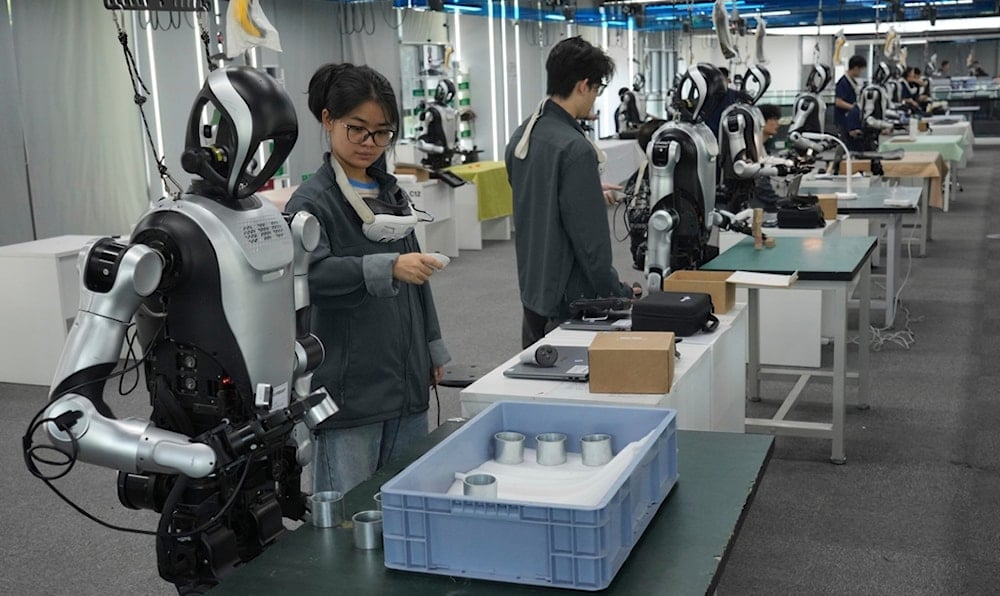
A worker remote controls humanoid robots during the one month countdown of 2026 China International Fair for Trade in Services (CIFTIS) at a robot training center in Beijing, China, Monday, Aug. 10, 2026 (AP Photo/Achmad Ibrahim)
Global humanoid robot shipments more than tripled year-on-year in the first half of 2026, with Chinese manufacturers accounting for more than 97% of units shipped, according to industry data cited by Smart Analytics Global (SAG).
Bloomberg reports that around 19,100 humanoid robots were shipped globally during the first six months of the year, compared with approximately 5,100 during the same period in 2025. SAG projects global shipments will reach about 60,000 units by the end of 2026 and could rise to 500,000 by 2030.
The figures point to a widening gap between China and its US competitors in a sector increasingly viewed as strategically important for advanced manufacturing, artificial intelligence, and industrial automation.
Read more: Why the US is losing the robot race to China
China takes commanding lead in humanoid robotics
Shanghai-based Agibot emerged as the largest manufacturer during the first half of 2026, accounting for 44% of global shipments with 8,400 units.
Hangzhou-based Unitree Robotics followed with 5,900 units. Their combined shipments significantly exceeded those of leading US companies including Tesla, Figure AI, and Agility Robotics.
The scale of Chinese production highlights the country's ability to move rapidly from technological development to mass manufacturing. China already possesses extensive industrial supply chains, manufacturing capacity, and experience in deploying automation across large-scale production environments.
The latest figures suggest those advantages are increasingly extending into humanoid robotics.
China’s policy support is also helping accelerate the sector. Government funding and initiatives at multiple levels have encouraged companies to develop increasingly capable machines, while major technology events have provided platforms for manufacturers to demonstrate advances.
At the World AI Conference in Shanghai last month, dozens of robotics companies showcased developments in dexterity, speed, and other capabilities.
From demonstrations to industrial deployment
The expansion is not simply being measured by the number of robots produced. Their intended use is also changing.
“Industrial and commercial applications accounted for more than 70% of shipments, up from approximately 50% a year earlier,” Linda Sui, founder and principal researcher at SAG, said, as reported by Bloomberg.
The shift indicates that manufacturers are increasingly targeting practical applications rather than relying primarily on demonstrations and experimental deployments.
Although the number of humanoid robots performing commercially productive tasks remains relatively small, their growing presence in industrial and commercial environments could accelerate the development of the technology by generating real-world data and exposing manufacturers to practical operating requirements.
If shipments reach SAG’s projected 60,000 units this year, the sector would be positioned for another substantial expansion toward the 500,000-unit projection for 2030.
US restrictions expose growing technology rivalry
China’s growing lead comes as Washington increasingly treats advanced technologies as matters of national security and strategic competition.
In late July, the US banned imports of new Chinese humanoid and quadruped robots, along with certain components, citing national security and cybersecurity risks involving critical US artificial intelligence infrastructure.
The restrictions form part of a broader pattern in which Washington has sought to limit China's access to advanced technologies and reduce Chinese companies’ ability to compete in strategically important sectors.
The emergence of humanoid robotics as another area of US-China technological competition reflects the expanding scope of that rivalry. What was once primarily associated with industrial automation and futuristic demonstrations is increasingly connected to manufacturing capacity, artificial intelligence, supply chains, and economic competitiveness.
SAG’s Sui warned that regulatory uncertainty and geopolitical risks could influence the industry's next phase of growth. For Chinese manufacturers, however, the current shipment figures indicate that the sector has already developed a substantial lead before the market reaches widespread commercial adoption.
Read more: China may block solar equipment exports to US: Reuters


