How Canada leads the way in closing down Zionist charities
-
 David Miller
- 4 Apr 2026 13:27
- 17 Shares
 9 Min Read
David Miller argues Canada has become a leading case in revoking charities linked to “Israel” by enforcing tax law through sustained, evidence-based advocacy, outlining the lessons that can be drawn for future use.
-

As the Canadian experience shows, sustained, evidence-based pressure on independent regulators can lead to enforcement of tax rules and removal of charitable status where breaches are established. (Al Mayadeen English; Illustrated by Batoul Chamas)
From mid-2024 through to early 2026, the Canada Revenue Agency (CRA) revoked or suspended the charitable registrations of eight organizations directing funds to activities in the Zionist entity, citing breaches of the Income Tax Act, including inadequate records, failure to operate exclusively for charitable purposes, and prohibited support for foreign military entities. This article examines each of the cases in order to salute those involved in bringing the genocidal ‘charities’ low, but also to assess which tactics and targets were successful in order to apply the lessons of Canada more widely to the US, UK, Australia and beyond.
Origins of scrutiny and early advocacy (Late 2010s–2023)
Campaigns questioning the charitable status of organizations supporting the Zionist entity gained momentum in the late 2010s. Independent Jewish Voices Canada submitted detailed complaints to the CRA, arguing funding patterns violated charitable rules. Their efforts particularly targeted the Canadian branch of the premier land theft agency in occupied Palestine: the Jewish National Fund of Canada (JNF Canada), claiming its projects supported land policies and military infrastructure inconsistent with Canadian charitable requirements.
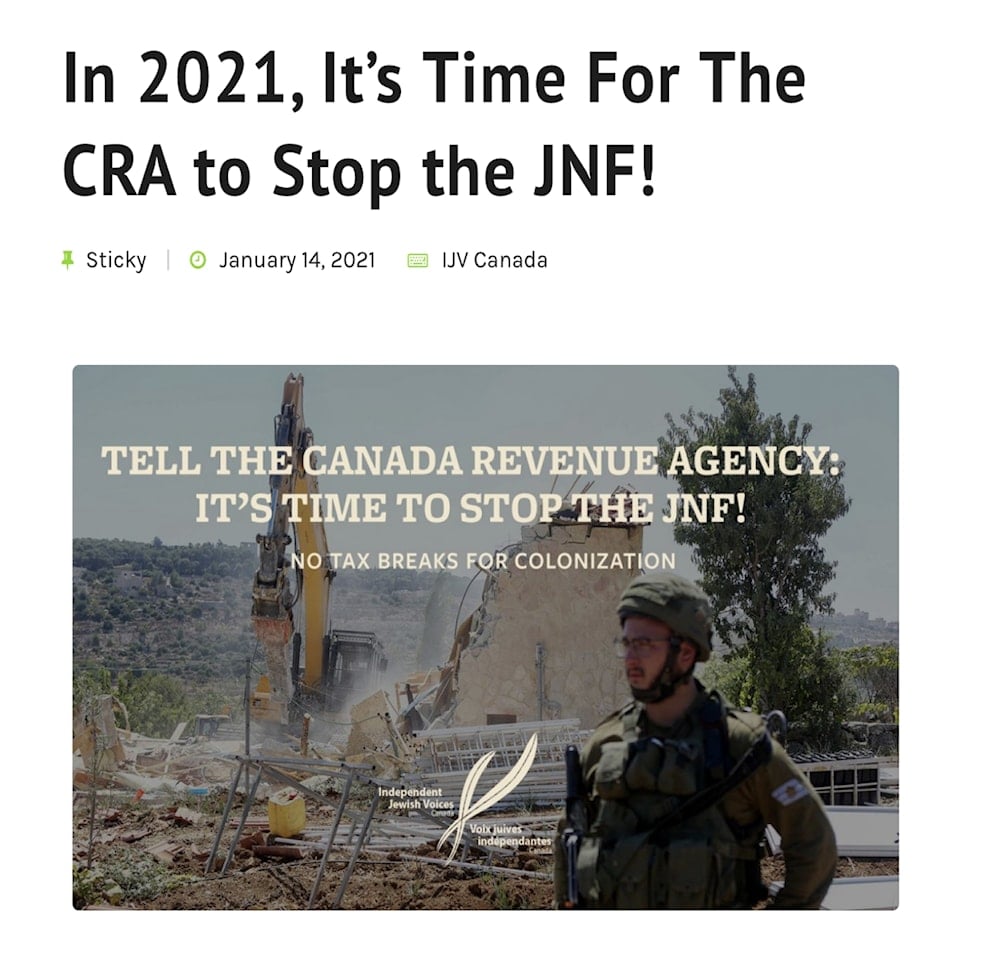
Just Peace Advocates and allied groups contributed by compiling evidence on financial flows and project specifics. Tactics included parliamentary petitions, open letters to officials, and public statements drawing attention to tax-deductible donations potentially funding activities claimed to conflict with international law or CRA guidelines on charitable purposes.
The CRA is required to operate independently; complaints prompt audits only when supported by evidence suggesting non-compliance with requirements to operate exclusively for charitable purposes, maintain adequate records, or refrain from prohibited activities such as aiding foreign militaries.

Landmark revocation: Jewish National Fund of Canada (2024)
The CRA revoked JNF Canada's charitable registration in August 2024. The agency concluded the organization no longer met Income Tax Act obligations, though detailed public reasons stayed limited due to confidentiality.
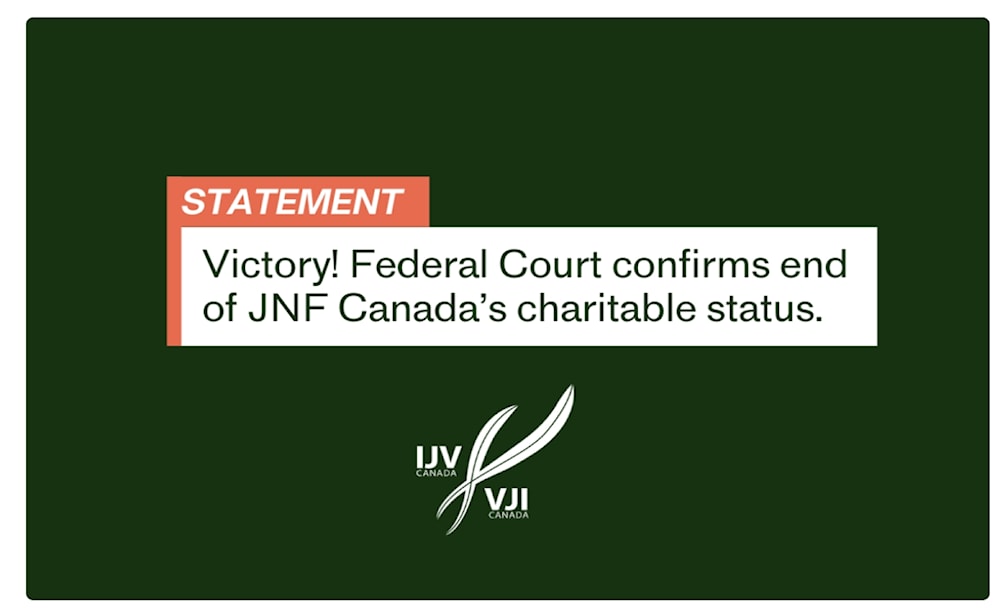
JNF Canada challenged the revocation judicially. On November 8, 2024, the Federal Court summarily dismissed the application for review, upholding the CRA's decision. Independent Jewish Voices Canada hailed this as a major victory after years of advocacy, emphasising that JNF Canada could no longer issue tax receipts and would need to wind down operations.
JNF Canada described the process as blindsiding and argued the CRA applied standards retroactively to activities accepted for decades. The organization signalled intent for further appeals while considering operational workarounds.
Connected cases: Ne’eman Foundation and the Emunim Fund (2024–2025)
In the same August 2024 action, the CRA revoked the Ne’eman Foundation's status, citing audit findings of insufficient control over funds, poor reporting, and transfers to non-charitable purposes, including some linked to military support or activities in contested areas.
After the Ne’eman revocation, The Emunim Fund emerged as a successor, registered on April 18, 2024 (initially under another name) and renamed shortly thereafter. The CRA suspended it for one year, effective September 26, 2024, barring receipt issuance and certain donations. Full revocation followed on September 20, 2025, following an audit confirming continued non-compliance.


This sequence highlighted concerns over Zionists restructuring activities to bypass prior revocations, though CRA focused strictly on compliance issues.
Additional Revocations in Late 2025
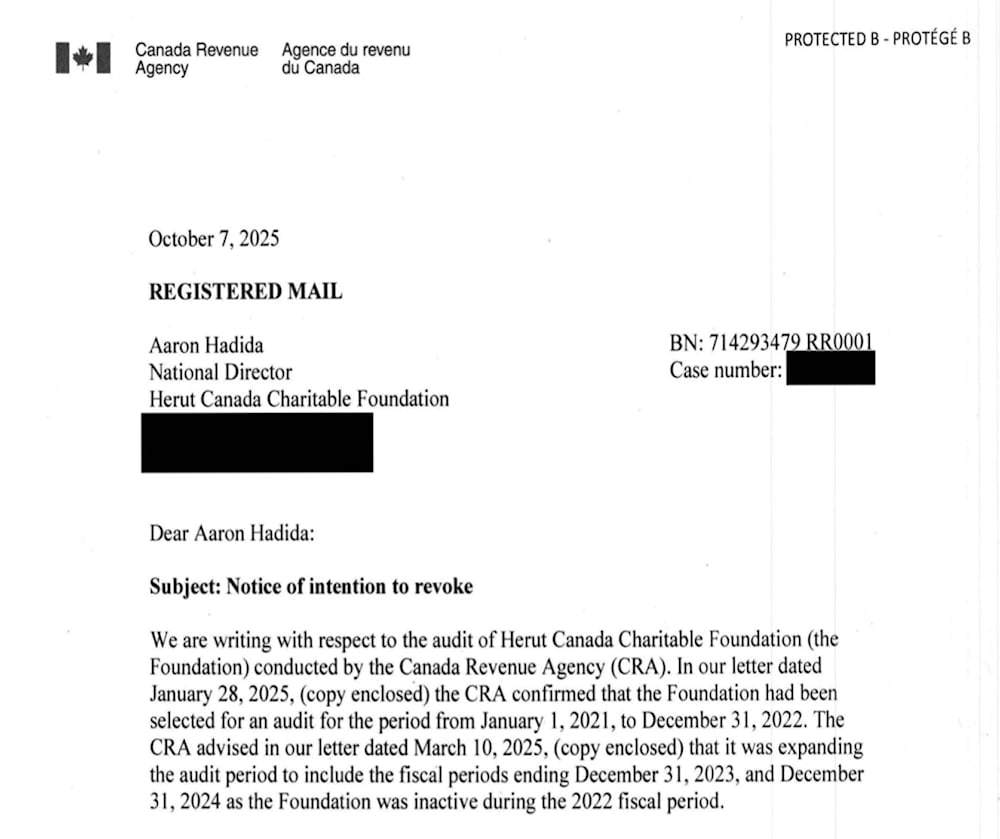
November 2025 saw more actions. The CRA revoked Herut Canada Charitable Foundation's status effective November 15, 2025, referencing breaches of Income Tax Act sections related to record-keeping and overall compliance. The group, a Revisionist Zionist extremist group, had minimal revenue but faced audit-driven revocation.
Around the same period, other organizations lost status on administrative grounds: the Canadian Foundation for Masorti Judaism (effective October 25, 2025) for failing:
“to demonstrate that it has implemented all of the agreed upon corrective measures, outlined in a compliance agreement …in 2019 following a previous audit. Specifically, the current audit found repeat non-compliance in that the Organization failed to maintain and provide adequate books and records and failed to devote resources to charitable activities carried on by the Organization itself by gifting to non-qualified donees”
Mazel Charity Fund (effective October 18, 2025), was also revoked. It had been under investigation for some time, starting with an audit in 2015 for its fiscal periods from May 1, 2011, to April 30, 2013. As with so many of these charities, it was donating to non-charitable causes and failing to maintain adequate accounts, among other crimes.
2026 Revocations: Canadian Zionist Cultural Association and Canada Charity Partners
On February 21, 2026, the CRA revoked the registrations of the Canadian Zionist Cultural Association (CZCA) and Canada Charity Partners, publishing notices in the Canada Gazette. Complaints against CZCA originated in 2021, alleging transfers of millions (at least $5.7 million between 2017 and 2023) to the Association for the Soldiers of Israel, partially funded by the Israeli Ministry of War. Such support violates CRA's explicit ban on aiding foreign militaries.
These revocations stemmed from documented evidence of large donations inconsistent with charitable rules.
Role of Campaigners
Organizations such as Independent Jewish Voices Canada and Just Peace Advocates led scrutiny through sustained strategies:
- Filing comprehensive complaints supported by financial records and project analyses.
- Launching parliamentary petitions that amassed substantial signatures to prompt CRA reviews.
- Publishing statements, collaborative reports, and monitoring successor entities for potential evasion.
- Emphasising links to military funding or non-charitable activities.
Success arose from combining persistent advocacy with the CRA's independent enforcement duty. Audits revealing verifiable breaches (deficient records, ineligible transfers, or military support bans) triggered notices, objections, and revocations. Outcomes hinged on evidence rather than advocacy pressure alone.
Patterns, implications, and historical context
From 2024 to early 2026, at least eight organizations with "Israel"-focused activities lost charitable status. CRA decisions consistently cited technical or substantive failures: poor documentation, non-exclusive charitable purposes, or prohibited military ties. Some directly involved foreign military funding; others focused on administrative lapses.
A 2025 study by Miles Howe and Paul Sylvestre examined seven revoked charities (2018–2024) with Zionist charities: Colel Chabad Lubavitch Foundation of Israel (revoked 2022), Kupas Hachesed Meoroth (2022), Chasdei Levy Yitzcok (2023), Gates of Mercy (2019), Beth Oloth Charitable Organization (2019), Ne’eman Foundation Canada (2024), and Jewish National Fund of Canada. The authors state: "Cumulatively, a rough estimate is that upwards of $1 billion CDN was handled by these revoked charities during their respective activation periods." They highlight inter-charity donations representing nearly 40 per cent of funds and argue CRA enforcement is narrow, failing to address upstream foundations, especially those Zionist family foundations which channel most of the cash to Zionist lobby and radicalisation groups.
Advocacy groups like Just Peace Advocates cite this work while claiming "over the last decade, the CRA has revoked over 30 charities that sent money to Israel in support of occupation and apartheid regime." My own research shows that from 1992 to the present at least 54 Jewish/zionist charities have been revoked by the Canada Revenue Agency, not just for failing to submit annual reports.
Affected Zionist groups and their supporters have raised concerns, claiming selective enforcement or campaign influence - making sure to flex their victimhood wherever possible. Proponents of the actions argue they demonstrate neutral application of tax law to international funding. The CRA stresses decisions derive from audit evidence, independent of external input.
These developments reveal strict limits on tax-advantaged giving in politically sensitive overseas contexts. Advocacy persists, pushing for wider examination of Canada-to-"Israel" donation pathways. As of March 2026, the cases show how documented, long-term complaints can drive enforcement when organizations cross charitable boundaries under Canadian law.
International context: Canada as a leader
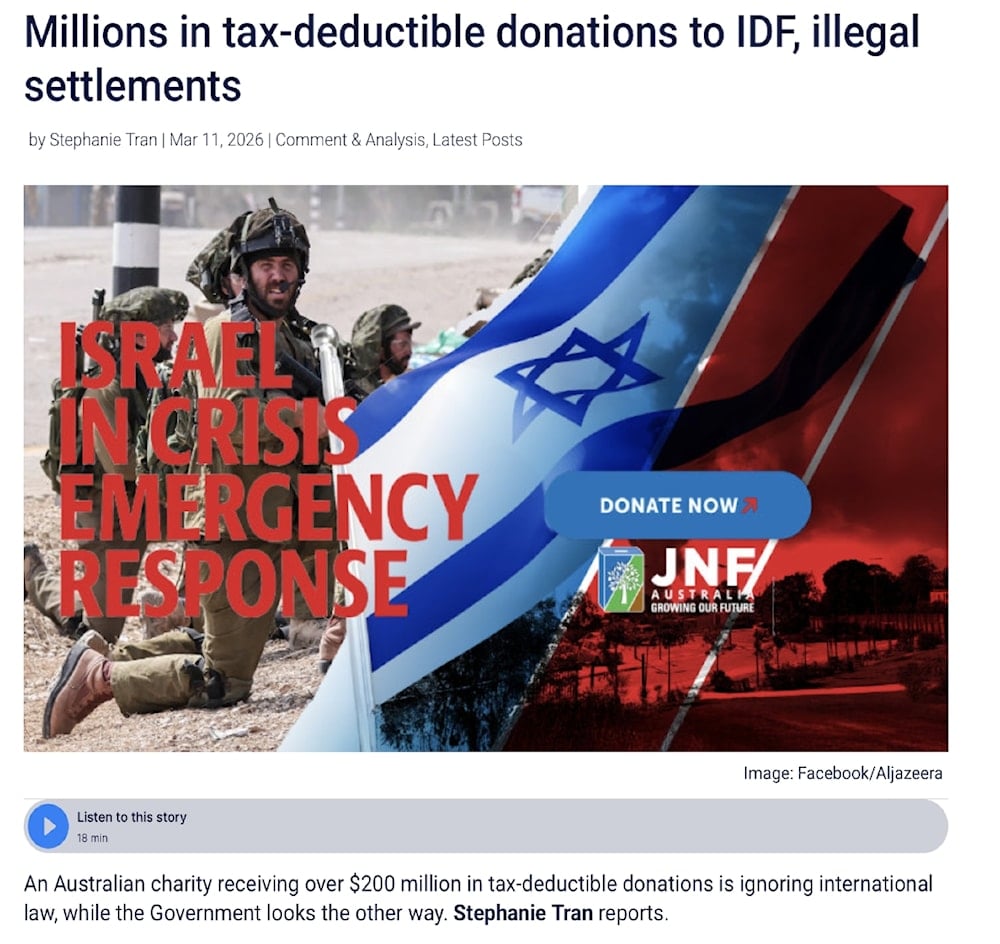
Campaigns targeting similar organizations have arisen elsewhere but produced limited results. In the United Kingdom, advocacy groups such as the International Centre of Justice for Palestinians have called on the Attorney General to revoke JNF-UK charitable status over alleged links to prohibited activities, including funding illegal Israeli settlements and military operations, with repeated complaints to the Charity Commission yielding no revocation. In Australia, investigative reporting has exposed tax-deductible donations flowing to IOF support and settlement projects without triggering revocation by the Australian Charities and Not-for-profits Commission (ACNC), despite hundreds of concerns related to the war on Gaza conflict since October 2023. In the United States and parts of Europe, complaints have focused on specific entities such as the Jewish National Fund (JNF-USA) and Friends of the IDF, with submissions alleging discrimination, support for settlements, or foreign military aid, yet the IRS and equivalent bodies have issued no comparable revocations for Israel-linked charities.
Canada appears to be a leader because the CRA has systematically audited evidence, published revocations in the Canada Gazette, secured court confirmation of its decisions, and enforced explicit prohibitions on foreign military support, delivering at least eight successful outcomes where other jurisdictions have seen campaigns stall at the complaint stage or face regulatory inertia.
Guidance for those seeking similar outcomes in the US, UK, Europe, Australia and wider
Those wishing to enact comparable decisions should first compile verifiable evidence of non-compliance, including financial transfers, project documentation, and links to prohibited activities such as foreign military aid or inadequate record-keeping. Submit formal, detailed complaints to the relevant authority — for instance, via the IRS Tax Exempt Organization Complaint Process in the United States or the Charity Commission reporting form in the United Kingdom — while supporting them with parliamentary petitions and public reports. Monitor successor entities, collaborate across groups, and maintain focus on legal rather than political arguments. As the Canadian experience demonstrates, sustained, evidence-based pressure on independent regulators can lead to enforcement of existing tax rules and the removal of charitable status where breaches are clearly established.