China-Japan conflict: Japan’s remilitarization over Taiwan
-
 Pedro Monzón Barata
- 25 Dec 2025 14:36
 13 Min Read
The structural contradiction between a military alliance with the US and commercial dependence on China is turning the Japanese archipelago into a decisive friction point in the region.
-
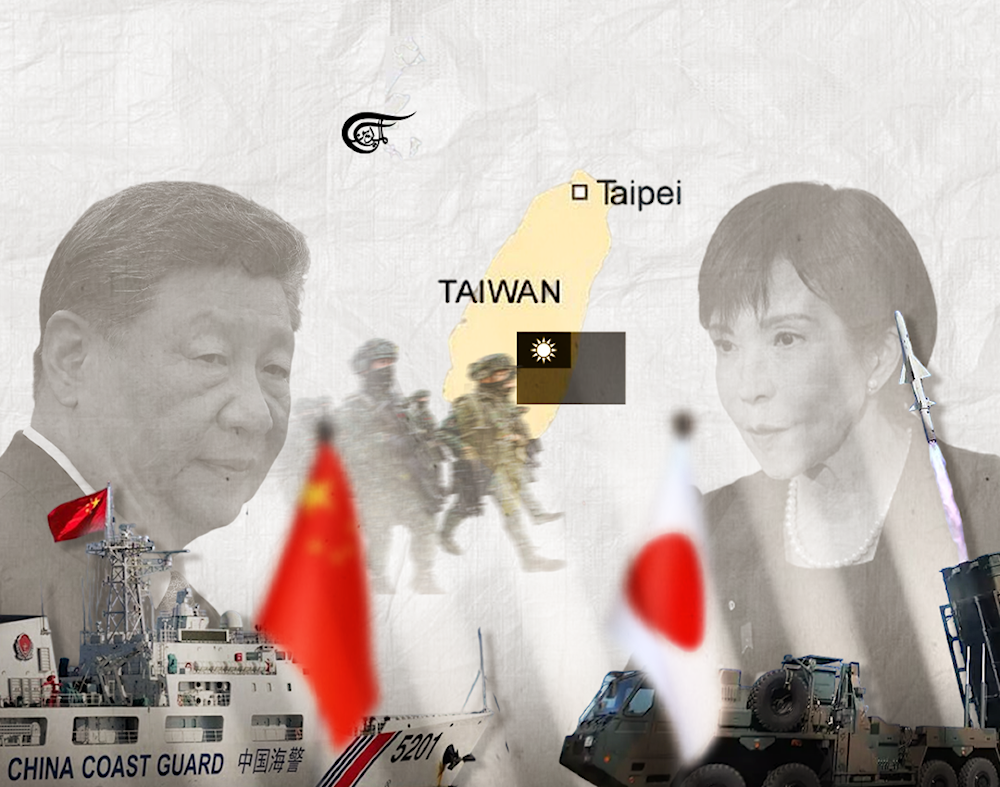
Japan’s remilitarization may spark a new “hot cold war” (Illustrated by Batoul Chamas; Al Mayadeen English)
The growing tension between China and Japan has become one of the most troubling sources of instability in the Asia-Pacific region. Unlike previous decades, when rivalry was limited to controlled diplomatic disputes or economic competition, we now witness a profound reconfiguration of their relations, marked by a new strategic axis: Taiwan. Under the leadership of Prime Minister Sanae Takaichi, a leading figure of the most conservative wing of the Liberal Democratic Party (LDP), Tokyo has embarked on an unprecedented remilitarization since 1945, closely aligned with US foreign policy under Donald Trump’s second presidential term.
Paradoxically, while Japan hardens its military posture and becomes increasingly involved in the conflict surrounding Taiwan, a Chinese province, it maintains deep economic interdependence with China, vital to its internal stability. This structural contradiction, between a military alliance with Washington and commercial dependence on Beijing, is turning the Japanese archipelago into a decisive friction point in the region, with a real risk of triggering a broader clash.
A conservative government as the breeding ground for rearmament
Ms. Sanae Takaichi’s rise to power in October 2025 was not the result of an overwhelming popular mandate but rather a fragile parliamentary realignment following the collapse of Shigeru Ishiba’s cabinet. She managed to govern through an alliance with the ultraliberal Ishin party, support from traditionalist LDP factions—inheritors of Shinzo Abe’s and Taro Aso’s legacies—and the rupture of the historic coalition with the pacifist, Buddhist Komeito party.
Although her appointment was hailed as a symbolic milestone for being the first woman to hold the office, her cabinet composition reflects key elements of a conservative agenda:
- Only three women among 19 ministers
- An equality minister critical of “radical feminism”
- Unwavering defense of male-only imperial succession
- Resistance to reforms like adopting married surnames
Although her appointment was hailed as a symbolic milestone for being the first woman to hold the office, her cabinet reflects a deeply conservative agenda: only three women in a team of 19 ministers, an Equality Minister critical of “radical feminism", unwavering defense of male-only imperial succession, and resistance to reforms such as the adoption of married surnames.
Economically, Ms. Takaichi has deepened a neoliberal agenda: social spending cuts, labor market flexibilization, and strong state backing for strategic sectors like defense and high technology. This framework has served as the basis for what the government calls the “normalization” of its security policy. In practice, however, it amounts to a deliberate erosion of the pacifist spirit of Article 9 of the Constitution, which since 1947 prohibited Japan from maintaining combat forces or resorting to war.
Reinterpreting this principle is not merely a technical adjustment; it represents an ideological shift that has transformed Japan from a defensive ally into a potential offensive actor on the regional stage, a development that evokes painful memories of the country’s tragic conduct since it embarked on its imperial expansion following the Meiji Restoration.
The 'Japanese dilemma': Between containment, dependence, and autonomy
Japan-US-China relations place Tokyo at the heart of a three-dimensional strategic dilemma.
First, the security imperative: Despite the fact that historically Japan was the aggressor country—having invaded China and inflicted grave harm upon its population—in its current policy and military strategy, Tokyo treats China as its primary threat. This perception is grounded in the territorial dispute over the Senkaku Islands (Japan) or Diaoyu Islands (China), China’s growing naval and aerial presence in the East China Sea, and, above all, the fear that a conflict over Taiwan could drag Japan into war due to its geography, the presence of US military bases on its territory, and its formal alliance with Washington. The response has been clear: a record increase in military spending—reaching 8.3 trillion yen in 2025, approaching the 2% of GDP demanded by NATO—intense cooperation with the Quad, and trilateral exercises with the US and South Korea focused on scenarios involving the blockade of the Taiwan Strait.
Second, the economic imperative: Beijing is Tokyo’s main trading partner. Sectors such as automotive, electronics, and industrial components critically depend on the Chinese market. Supply chains—especially in semiconductors, rare earths, and precision manufacturing—are so deeply intertwined that any attempt at “decoupling” would have devastating consequences. The threat of selective economic retaliation by China constitutes a real brake on blind, imperial alignment with Washington.
Third, the strategic autonomy imperative: Japan’s elite understands that its future lies in Asia. Thus, Tokyo participates in agreements like the RCEP (alongside China), seeks leadership in Southeast Asia, and maintains diplomatic channels with Beijing, even amid escalating tensions. However, this pursuit of “relative autonomy” clashes with the bloc logic imposed by traditional US policy and Trump’s previous and new National Security Strategy, which demands unequivocal loyalty—especially regarding Taiwan.
The issue of Taiwan: The catalyst of the clash
It was precisely around Taiwan that the ambiguous balance Japan had maintained for decades broke down. Traditionally, Tokyo recognized the “One China” principle and avoided direct statements on the island’s defense. But under Ms. Takaichi, this caution has been replaced by an openly interventionist stance.

On November 15, 2025, at the World Economic Forum in Tokyo, the prime minister stated that “Japan has regional responsibilities that could include supporting Taiwan in the event of aggression.” Beijing viewed this interventionist declaration as a flagrant violation of its sovereignty. Simultaneously, her government has promoted an even looser reinterpretation of Article 9, opening the door to offensive capabilities: long-range missiles, dual-use technology exports, and explicit logistical cooperation in crisis scenarios in the strait.
Japan has backed its interventionist stance on Taiwan with concrete measures:
- Donated drones to Taipei,
- Authorized the sale of strategic radars manufactured by NEC
- Coordinated with the US and Australia evacuation plans for 20,000 Japanese citizens in Taiwan, implying joint contingency planning for conflict.
Beijing recognizes in this conduct a qualitative leap: Japan is ceasing to be a passive ally and becoming a direct actor in a non-negotiable issue—the territorial integrity of Taiwan as sovereign Chinese territory, a fact historically substantiated and recognized by the international community and the United Nations itself.
China’s response: Pressure on all fronts
Understandably, China has responded swiftly and forcefully. Following Ms. Takaichi’s speech, it suspended bilateral dialogue on sensitive areas such as cybersecurity and climate change. After her symbolic visit to the Yasukuni Shrine on December 7—a site honoring Japan’s WWII dead, including convicted war criminals—Beijing activated a narrative denouncing the strengthening of dangerous “Japanese revisionism".
Militarily, China has deployed the aircraft carrier Liaoning near the Senkaku/Diaoyu Islands and simulated maritime blockade scenarios. Economically, it has promoted boycotts against brands like Toyota and Panasonic, launched media campaigns—such as a People’s Daily editorial titled “Japanese Revisionism Threatens Asian Peace Once Again”—and warned tourists about “insecurity” in Japan.
Popular demonstrations have taken place in front of the Japanese embassy in Beijing, supporting the official stance. The bilateral conflict has thus acquired a triple dimension: military, diplomatic, and economic.
The Taiwan–Senkaku Arc: The geography of rearmament
Japan’s remilitarization is geographically structured around the Taiwan–Senkaku axis. Tokyo has reinforced its capabilities in the southwestern archipelago—especially in Okinawa and the Nansei Islands (Ryukyu Islands) —ostensibly to protect both the disputed islands and maritime routes toward Taiwan. The development of anti-ship missiles, long-range air defense systems, and integration into exercises with the US and South Korea have turned Japan into an advanced pillar of America’s desperate containment policy in the Indo-Pacific.
Under its newly released National Security Strategy, the Trump administration has reinforced its regional commitment, albeit with a more selective approach. Unlike Biden-era “integrated deterrence", Trump’s strategy prioritizes the Western Hemisphere and demands that allies “pay their fair share.” This has legitimized Japanese rearmament but, seemingly, has also introduced ambiguity regarding automatic US backing in a Taiwan scenario.
At the same time, the 2025 NDAA (National Defense Authorization Act of the United States) increases military aid to Taiwan, and Washington has deployed hypersonic missiles in Guam, deepening coordination with Tokyo. The result is a triangle of pressure: the US as architect, Japan as military bastion, and Taiwan as potential flashpoint. This is no longer rhetoric: the conflict is unfolding in military drills, technology transfers, and contingency planning.
Internal tensions: Pacifism versus nationalism
This shift is not without domestic resistance. NHK and Shimbun polls show that only one-third of the population supports direct military measures related to Taiwan; a clear majority fears Japan becoming a “nuclear target” in a superpower conflict, invoking the trauma of Hiroshima and Nagasaki. Seventy-one percent want to preserve Article 9 without substantial changes.
The pacifist movement, led by organizations like the Article 9 Association, remains influential, especially among older generations. Meanwhile, the Japanese economy faces crises: inflation above 5%, rice—a staple in the Japanese diet—has doubled in price since 2021, public debt hovers around 250% of GDP, and the yen has sharply depreciated. In this context, rearmament is presented as a way to boost the military-industrial complex, benefiting conglomerates like Mitsubishi, IHI, or NEC. Anti-Chinese nationalism thus functions as a symbolic pressure valve for the contradictions of Japanese capitalism.
Strategic options and their costs
Japan now faces three paths, all with high costs:
- Full alignment with the US: guarantees military backing but exposes Tokyo to economic rupture with China and positions it on the front lines of a conflict.
- Fair accommodation with China: protects economic interdependence but erodes trust with Washington.
- Risk-management strategy (the current path): strengthens the US alliance while preserving ties with China. It avoids immediate ruptures but increases the likelihood of incidents due to misunderstandings and selective economic retaliation.
It is in this intermediate, particularly unstable, scenario that Japan finds itself today: remilitarizing around the Taiwan–Senkaku axis, aligned with Trump’s containment doctrine, yet still dependent on China as a commercial engine.
Toward a 'Hot Cold War'
The China–Japan conflict is not an isolated bilateral phenomenon but a microcosm of the emerging regional order. The US is expanding its military footprint in the Philippines, Guam, and Australia; China responds with economic coercion and active diplomacy, denouncing Japan as the destabilizing factor. The result is an environment prone to accidental or provoked incidents: dangerous encounters near Senkaku, misunderstandings during exercises near Taiwan, or escalations disrupting critical supply chains.
Conclusion: Best possible scenario
More than a strictly bilateral issue, the China–Japan conflict signals the likely fate of the entire Asia-Pacific: nations trapped between economic dependence on China and military dependence on the US—the enforcer of today’s unjust international order—and pressured to choose the imperialist camp in a world where strategic ambiguity is no longer tolerated.
In this context, the best possible scenario for ensuring stability and peace—though it may seem remote today—would be a structured competitive coexistence. This would require:
- Japan to balance its alliance with Washington without crossing Beijing’s red lines, especially regarding Taiwan;
- China to respond with goodwill to such a positive shift;
- And, above all, the United States—under Trump’s second presidency—to accept a degree of strategic autonomy for its allies, rather than imposing absolute loyalty.
Trump’s new National Security Strategy—centered on a global “reset” and more selective containment—opens a window of opportunity. If Tokyo prudently seizes it, it could avoid becoming the weakest link in the Indo-Pacific order. If not, the archipelago could transform not only into the theater of a new “hot cold war” but into its first battlefield.
Peace in the Asia-Pacific does not depend solely on arsenals, but on the ability of those actors—committed to maintaining the policy of containing China—to envision a future not doomed to repeat the grave errors of the past. In this endeavor, Japan is not merely a key actor; it is the clearest mirror of the dilemma facing the entire region in a world that is inevitably moving toward multipolarity and a more just international order.
Bibliography:
- Amin, S. (2022). The long revolution of the global South (N. S. Sylla, Ed.). Monthly Review Press.
- Borón, A. (2023). La nueva Guerra Fría: Estados Unidos, China y el orden mundial en disputa. CLACSO / Siglo XXI Editores.
- Christensen, T. J. (2015). The China challenge: Shaping the choices of a rising power. W. W. Norton & Company.
- Green, M. J. (2019). Japan’s reluctant realism: Foreign policy challenges in an era of uncertain power. Palgrave Macmillan.
- Hughes, C. W. (2022). Japan’s military modernization and the U.S.-Japan alliance in the Indo-Pacific. International Institute for Strategic Studies. https://doi.org/10.1080/00036846.2022.2058765
- Liu, B. (2021). The U.S.-Japan alliance and its impact on regional security in East Asia. International Critical Thought, 11(3), 345–360. https://doi.org/10.1080/2040088X.2021.1945821
- Ministerio de Relaciones Exteriores de la República Popular China. (2024). White paper on China’s position on the Taiwan question and the reunification of the motherland. http://www.fmprc.gov.cn
- Sousa Santos, B. de. (2025). La cruel pedagogía del imperio: Pandemia, guerra y neofascismo en el orden global. Akal / CLACSO.
- Wang, J. (2022). China and the world: The Maritime Silk Road and regional order. Social Sciences Academic Press.
- Zhang, W. (2024). The China wave: Rise of a civilizational state (2.ª ed.). China International Publishing Group.