
From Suez to Hormuz: The crisis of American hegemony after October 7
-
 Amro Allan
- 8 Oct 2026 20:15
- 4 Shares
 13 Min Read
Amro Allan draws parallels between the 1956 Suez Crisis and today’s war over the Strait of Hormuz, arguing that US military superiority can no longer guarantee political dominance in West Asia.
-

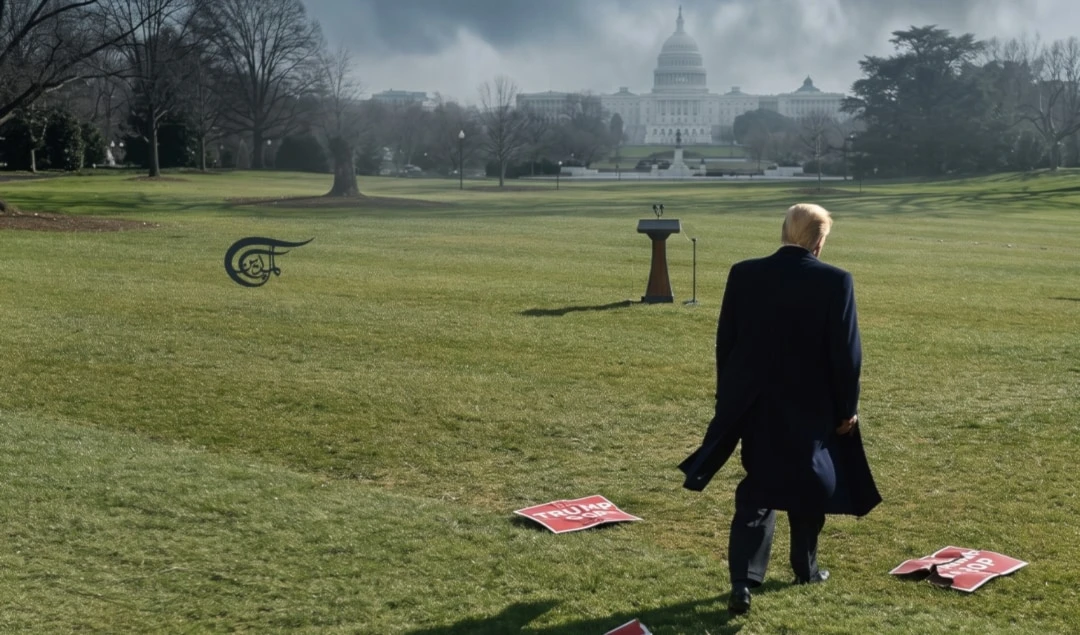
The task before the living forces of Arab and Islamic liberation is to turn the limits of hegemony into political advance before attrition consumes the possibilities that history has opened. (Al Mayadeen English; Illustrated by Zeinab el-Hajj)

A power that tears a region apart cannot claim the right to write its future.
That is perhaps the clearest political conclusion to emerge from the three years since October 7, 2023. The US-Israeli project has deployed overwhelming military force in an attempt to bring the region back under its control, inflicting destruction on a scale familiar to all. Yet it has failed to convert that destructive power into the political authority to determine the fate of the region and its peoples.
It is in this gap, between the ability to inflict losses and the ability to impose one’s will, that the crisis of American hegemony is becoming visible.
Al-Aqsa Flood, on October 7, erupted in a region where the causes of confrontation had been accumulating for years, and at a moment when the global balance of power was already shifting. Washington, meanwhile, was trying to consolidate a regional order built around the supremacy of the Israeli occupation and its deeper integration into the region, even as the United States’ ability to manage the international system unilaterally was declining.
The confrontation therefore acquired a significance far beyond Palestine. The struggle over Palestine became intertwined with the struggle over the consequences of global transformation, while the success of the American project increasingly depended on subduing forces that continued to reject its terms despite immense sacrifices.
For the forces of Arab and Islamic liberation, this moment carries a responsibility that goes beyond registering the adversary’s setbacks. American superiority no longer guarantees Washington the ability to impose whatever it wants. But that change will not automatically benefit the peoples of the region. The limits now exposed in American power must be turned into political opportunity.
A changing world
Since the end of the Cold War, the United States has acted in our region as though its supremacy entitled it to define the boundaries of the possible. It sanctioned those who rejected its conditions, determined the limits of acceptable settlements, and demanded that the holders of legitimate rights adapt themselves to whatever remained.
But the world that made such domination possible has been changing.
Costly American wars accumulated constraints on Washington’s ability to act. China rose as an economic and strategic competitor. The war in Ukraine opened a wider confrontation between Russia and the West over the shape of the international order.
The emergence of multiple centres of power widens the space available to those seeking to escape the conditions of hegemony. The dominant power becomes less able to monopolise choices, while alternative relationships, resources and political openings become more available. At the same time, those who benefit from the existing order move to prevent new balances from consolidating at their expense.
Historical opportunity therefore comes together with intensified struggle. It has to be seized politically; it cannot simply be awaited.
West Asia was already living through this contradiction before October 7. Iran’s efforts to secure its nuclear rights had reached an impasse. Western pressure on Tehran was intensifying. Confrontation with the occupation was escalating in the West Bank and Al-Quds. The Zionist entity was accelerating land seizures, imposing new facts on the ground and threatening Al-Aqsa Mosque, while continuing to threaten Lebanon and obstruct its ability to benefit fully from its resources.
Existing arrangements had proved incapable of addressing the source of the conflict. No regional order can achieve lasting stability while preserving occupation and simultaneously demanding that the people of the land surrender their right to resist subjugation.
That was why the prospects of escalation outweighed those of calm.
In my February 2023 article, “The Road to War”, I argued that limited settlements which had failed to resolve the region’s contradictions during the era of overwhelming American supremacy would prove even less capable of doing so amid growing international fluidity.
The Saudi-Iranian agreement brokered by China showed that escalation could be reduced in a specific arena. But calming one file does not resolve the crisis of the regional order as a whole. Nor does the greater room for manoeuvre enjoyed by some of Washington’s allies mean that their governments possess the political will to break free of American hegemony.
Palestine returns to the centre
In this changing world, Palestine was expected to remain trapped in an unchanging reality.
Normalisation would expand. Settlements would grow. The occupation entity would deepen its regional relationships. Palestinians, meanwhile, would be told to wait for a settlement that denied them meaningful self-determination.
The purpose of this arrangement was to remove Palestine from the region’s political calculations, transform occupation into an accepted fact, and then blame the people of the land for the instability produced by their refusal to submit.
October 7 shattered that assumption.
It returned Palestine to the centre of the struggle over the regional order and demonstrated that bypassing the Palestinian cause does not make it disappear. A project built on entrenching occupation carries within it the sources of its own instability.
As the war spread into other arenas, the test ceased to concern only the restoration of Israeli deterrence. It became a broader test of the United States’ ability to impose its rules on forces that reject them in an international environment Washington no longer controls alone.
The counteroffensive that followed was intended to close that possibility.
Gaza was devastated. Hezbollah sustained severe blows. The Axis of Resistance lost the strategic depth it had previously enjoyed in Syria. Eventually, war was waged directly against Iran.
But destruction was never the ultimate objective.
The American-Israeli project sought to turn those losses into political submission, breaking the will to resist and producing a region that could be reorganised on a durable basis, what war criminal Benjamin Netanyahu has repeatedly called a “new Middle East”.
It is here that the project has faltered.
What it succeeded in destroying did not automatically become something it could control.
Iran continues to reject the conditions imposed upon it. The forces targeted by the war remain factors in the calculations of both confrontation and settlement. The devastation of Palestine has not produced a legitimate basis for liquidating the Palestinian cause or extinguishing the rights of its people.
Liberation has not yet been achieved. But preventing liquidation preserves the possibility of continuing the struggle toward it. The objective remains the liberation of Palestine from the river to the sea and the termination of the colonial project established upon it.
Iran, the sea and the limits of coercion
The war on Iran exposed with particular clarity the limits of the American quest for decisive victory.
The project sought to deprive Iran of its capacity to retaliate, sever its ties with the forces of resistance and subordinate its political decision-making. It succeeded in damaging important Iranian capabilities, but failed to compel Tehran to accept its terms or strip it of the means to resist pressure.
As the confrontation extended to bases, interests and maritime routes through which Washington exercises its influence, the cost of protecting the US-led order itself became part of the cost of the war being fought to preserve that order.

This contradiction is especially visible at sea.
The United States presents the protection of global trade and energy flows as one of the core functions of its international leadership. When navigation is disrupted, therefore, Washington’s credibility is tested before allies and adversaries alike.
The United States has to protect and sustain an extensive network. Its adversaries need only ensure that the threat to that network persists for the cost of protection to recur.
The Red Sea offered a clear example. American bombing campaigns ultimately gave way to the May 2025 agreement, mediated by Oman between Ansar Allah and the United States, under which the two sides agreed to halt mutual targeting, including attacks on American vessels.
Washington was thus compelled to reach an understanding with the same force whose impact it had sought to eliminate through military means.
Later developments around Bab al-Mandab reopened the problem of controlling this maritime passage and again placed the Red Sea route under pressure. Efforts to find alternatives that could ease pressure on the Strait of Hormuz therefore ran into instability along the very corridor expected to absorb part of the redirected exports.
In Hormuz itself, Iran linked the cost of war against it to the security of one of the world’s most important energy arteries. As movement through the strait became increasingly dependent on exceptional routes, specific understandings and military protection, the gap widened between the mere continuation of exports and the orderly freedom of navigation Washington claims to guarantee.
One of the pillars used to justify American influence is therefore becoming a task that consumes that influence.
From Suez to Hormuz
The Suez Crisis of 1956 offers a useful historical parallel.
Britain attacked Egypt alongside France and the Israeli occupation entity in an attempt to overturn the nationalisation of the Suez Canal and subjugate Gamal Abdel Nasser’s Egypt.
The attacking powers possessed overwhelming military superiority, but military superiority did not enable them to achieve the political objective of the campaign. Nasser remained in power. The nationalisation of the canal stood. Britain was forced to withdraw.
The crisis revealed that London possessed the power required to attack but not the power required to impose the political outcome it wanted.
That is the relevance of the comparison today, despite the obvious differences between the two periods.
When a hegemonic power cannot subordinate an adversary materially weaker than itself, war can accelerate the exposure of the limits of its position. It can also lead other states to reconsider assumptions they had previously treated as settled.
Washington now faces such a test amid a wider global transition.
Competing powers are watching the resources consumed by its wars. States tied to the American order are watching the costs generated by a system that creates dangers from which it then promises to protect them.
Hegemony requires more than destructive power. It requires an order that can sustain itself.
Three possible trajectories
The interaction between this regional outcome and the wider global transition opens three broad trajectories.
The first is a renewal of American influence.
Washington still possesses formidable instruments of financial power, military supply and political leverage. It may be able to use the region’s desire to end the war to reconstruct its influence, even through a settlement narrower than its original objectives — one that preserves a central American role while reducing the costs of confrontation.
The failure to achieve complete subjugation should therefore not be confused with the disappearance of Washington’s ability to contain, adapt and recover influence.
The second possibility is the emergence of a regional balance based on negotiation.
This becomes more plausible if it is established that forces which could not be subdued cannot simply be excluded from determining the region’s future arrangements. Their ability to prevent decisive victory can then be converted into political weight, while the terms of settlement become subject to balances that restrict unilateral American control.
But such a trajectory requires political will. Occasional disagreements between regional governments and Washington do not necessarily amount to a will for independence. The space for change expands only when those forces that resisted subjugation preserve the independence of their decisions and make respect for that independence a condition of settlement.
The third possibility is prolonged attrition.
This is the scenario in which the American-Israeli project continues seeking decisive victory while opposing forces continue preventing it, without any political settlement capable of ending the cycle of war.
Under such conditions, the United States may remain unable to construct a stable regional order while retaining enough power to exhaust its adversaries and obstruct alternatives that threaten its position.
American hegemony could therefore decline at the same time as the societies of the region lose their ability to benefit from that decline.
This is perhaps the most dangerous outcome.
An order that fails to dominate the region can still continue to devastate it. The opportunities opened by the global transition can be consumed by an endless war.
The forces of Arab and Islamic liberation therefore have to connect resistance to subjugation with a political project capable of transforming the conditions that make subjugation possible, while protecting the peoples’ rights to life, sovereignty and self-determination.
It is not enough for the adversary to remain unable to impose its will if the peoples of the region remain equally unable to build their own future.
Alongside continued steadfastness and the effort to raise the cost of aggression, this requires a comprehensive political project for the region’s future, stronger coordination among the components of the Axis of Resistance, and deeper links between them.
The question after hegemony
The past three years have placed Palestine at the heart of the struggle over the consequences of global transformation.
They have shown that American-Israeli military superiority does not provide its possessors with a guaranteed ability to determine the future of the region, particularly when those under attack identify the adversary’s vulnerabilities, remain steadfast in their positions, manage their struggle effectively, and bear the sacrifices required for independence.
But the decline of hegemony will not automatically produce liberation.
The responsibility is therefore to seize the possibilities opened by this moment, preserve the independence of political decision-making, and direct the struggle toward ending occupation and dependency and restoring rights in full.
From Suez to Hormuz, the limits of hegemonic power are once again being exposed.
The task before the living forces of Arab and Islamic liberation is to turn those limits into political advance before attrition consumes the possibilities that history has opened.


