
The undeclared US-Israeli strategy against Iran, and Tehran’s counter-strategy
-
 Amro Allan
- 4 Mar 2026 14:00
- 8 Shares
 6 Min Read
Amro Allan argues the US–Israeli campaign seeks not immediate regime collapse, but to structurally weaken Iran and “prepare conditions” for its eventual overthrow. But Tehran’s counter-strategy aims to reshape deterrence and exit the war stronger, not merely intact.
-
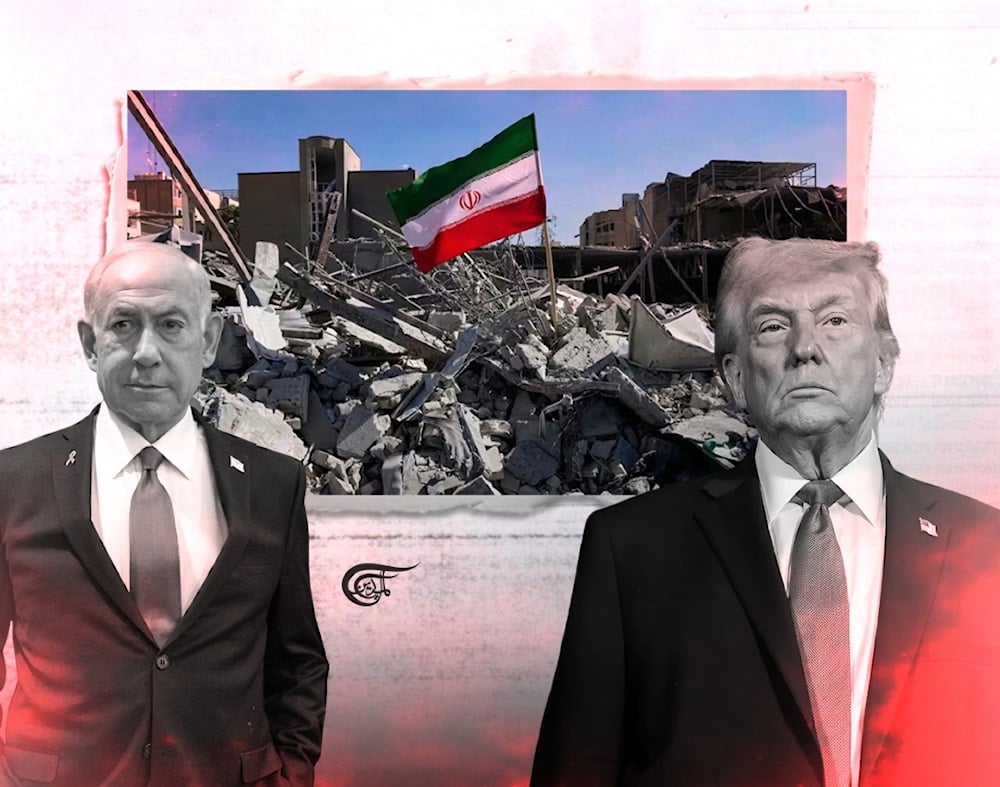
How Tehran is countering the undeclared US–Israeli strategy (Illustrated by Batoul Chamas; Al Mayadeen English)
Four days into the Zionist–American assault on the Islamic Republic (an unjust and unlawful act of aggression) and with the battlefield performance and operational constraints of both sides now more visible, it is possible to offer a more grounded assessment of the strategic logic guiding the war’s principal actors, setting aside, as far as possible, the inflated claims and rhetorical posturing that often dominate media coverage.
The character of the opening strike, culminating in the criminal targeting of Iran’s Supreme Leader, Sayyid Ali Khamenei, alongside a group of senior figures, suggests that the attacking camp entered the war with a strategy oriented towards one of two outcomes, contingent on how the early phase unfolded.
The first outcome, widely circulated in contemporary commentary, was a rapid and dramatic state breakdown triggered by the abrupt removal of Iranian decision-makers, creating a political vacuum that Western-aligned domestic networks could exploit to seize key levers of power. Whatever the intentions behind the initial strike, that scenario did not materialise in the immediate aftermath. Instead, the state’s continuity of command, institutional cohesion, and capacity to absorb shock proved more resilient than the attackers appear to have assumed.
More consequential, however, is what followed. The operational pattern after the opening strike, together with the substance of statements emerging from Washington and Tel Aviv, once one controls for inconsistencies and shifting formulations of war aims, indicates that an immediate cascading collapse was not, in the attackers’ own assessment, the most probable end state, even if it would have been the most advantageous. A realistic appraisal of Iran’s internal political landscape would also have placed limits on such expectations. The Western-affiliated groups commonly labelled by Western media as “the opposition” have, in recent episodes of domestic unrest, demonstrated limited organisational capacity and little ability to translate mobilisation into a structural breach within the state. It is therefore reasonable to conclude that planning centres on the attacking side were not relying primarily on an instant internal takeover, but on a longer campaign of pressure and erosion.
The second outcome, more consistent with the subsequent pattern of strikes, and with the campaign’s continuation, points to what appears a more plausible objective: not immediate regime collapse, but “preparing the conditions” for the eventual overthrow of the Islamic Republic over the medium or long term.
On this interpretation, the assault aims to inflict sustained damage on Iran’s military and infrastructural capabilities and then pivot to a ceasefire structured to leave Iran militarily and economically depleted and politically constrained, unable to convert endurance in war into strategic gains, whether by breaking the blockade or even meaningfully easing it. The claim here is not simply that the campaign seeks punishment, but that it seeks an end state: Iran exits the round weakened enough to be denied leverage in whatever political process follows, while the attackers retain freedom of manoeuvre for subsequent escalation.
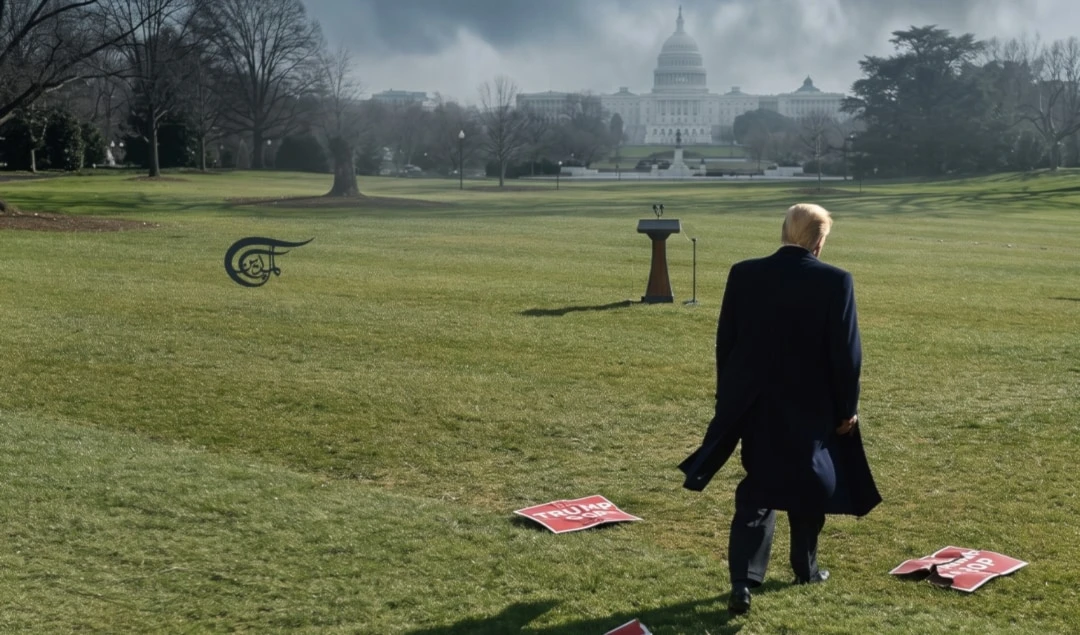

The analogue implicitly invoked by this approach is Iraq after the First Gulf War in the early 1990s: a major initial blow followed by a prolonged phase of containment, attrition, and economic pressure, during which state capacity erodes over time, thereby “preparing the conditions” for a later decisive confrontation once the full effects of the first round have accumulated. The strategic lesson for Iran, however, is that “ceasefire” in such frameworks often functions less as de-escalation than as a mechanism for locking in asymmetry and converting military damage into long-term political leverage.
Even if that is the strategic intent, it runs into two constraints operating on interlocking levels. The first is Iran’s counter-strategy as it has become visible so far, both in Iran’s own conduct and in the behaviour of allied actors within the Axis of Resistance. The second is the wider international environment, which differs materially from the late twentieth century, particularly in light of the stronger positions held today by China and Russia.
Iran’s military and political posture has thus far signalled a preference for escalation management on its own terms rather than a swift ceasefire “at any price”, a posture presented as distinct from Iran’s approach during the “12-Day War” of June 2025. The widening of the conflict’s scope by Iranian forces, the increased use of lethal force, and Tehran’s reported rejection, according to the Hebrew outlet Yedioth Ahronoth/Ynet, of an American proposal for an immediate ceasefire conveyed through a mediator said to be Italy, together provide the main indicators for this assessment. Taken at face value, these signals suggest that Tehran’s objective is not merely to avoid a “knockout” outcome in the near term, but to impose costs substantial enough to alter the political and deterrent balance that will shape the post-war environment.
In this reading, the strategic aim is to secure a more favourable regional equilibrium, one in which deterrence is reinforced and the price of future aggression is raised, rather than merely to survive the round.
This logic also clarifies the stakes as Tehran appears to define them. Tehran and allied actors seem to interpret the war’s deeper purpose as long-range: to lock Iran into a weakened position that can later be exploited politically and economically. The counter-objective, accordingly, is to ensure that the Islamic Republic (and, by extension, its regional alignment) emerges from the war in a stronger strategic position than it held on the eve of the assault. That would allow Tehran to convert battlefield outcomes into political leverage within an evolving geopolitical context, including through coordination with China and Russia, rather than accepting a rapid ceasefire that produces only a short-lived symbolic gain while leaving the underlying strategic conditions intact.
From this perspective, the war’s outcome is not merely a bilateral question between Iran and its adversaries. It is likely to shape the strategic trajectory of the Arab world and West Asia more broadly and to intersect with the wider emergence of a more multipolar international order. On that basis, regional actors face a choice: either an Israeli security order consolidates for years to come (normalising periodic unlawful force as a tool of regional governance) or a first, durable step is taken towards a more autonomous regional balance, one less vulnerable to coercion and external vetoes, an ambition that has animated the region since the Sykes–Picot settlement.
Accordingly, Arab states that have adopted neutrality, or that have materially aligned themselves with the aggression, will have to account for the strategic consequences of that positioning, regardless of how the war ends.


