
Iran’s strikes on the Gulf are not a detour; they follow the logic of the war
-
 Amro Allan
- 1 Apr 2026 11:56
- 1 Shares
 7 Min Read
Once the centre that sustains the system comes under real pressure, its regional instrument becomes more vulnerable as well. This is not a matter of rhetoric. It is a strategic sequence.
-
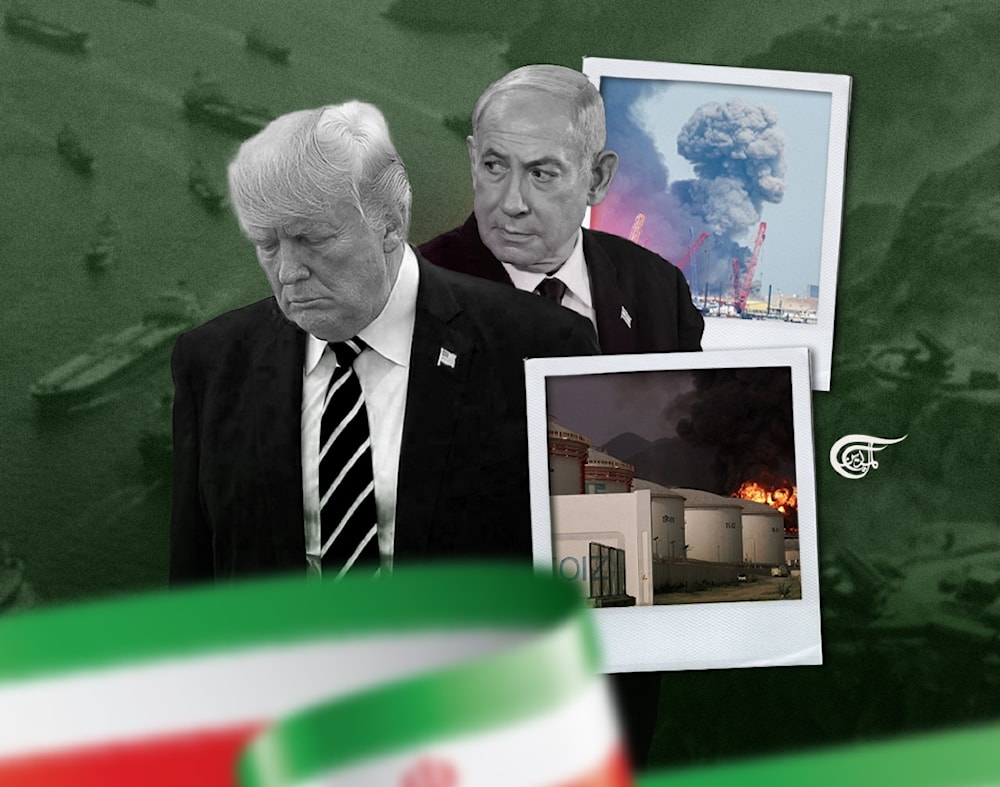
Iran’s operations target American influence across the region, not only Israeli sites (Illustrated by Zeinab al-Hajj; Al Mayadeen English)
It is easy to explain Iran’s heavier targeting of Gulf states in narrowly operational terms. Gulf-based early warning systems, radar networks, and military infrastructure can help detect, intercept, or facilitate attacks on Iran, making them obvious target in wartime.
That explanation is not wrong. But it is incomplete. It does not fully explain why this pattern of fire has emerged in the present war, nor does it capture the deeper strategic logic behind it. To understand that logic, two points need to be recognized. The first concerns the transformation "Israel" has undergone since October 7, 2023. The second concerns the wider structure of the Arab-Islamic struggle against the US-Israeli order in the region.
Since October 7, "Israel" has not fought as a "state" engaged in yet another limited round of deterrence. It has fought as a "state" that believes it is confronting an existential threat. That shift matters more than many observers are willing to admit. An adversary fighting for what it sees as its own survival does not calculate pain in the same way as one fighting for prestige, influence, or regional positioning. Its tolerance for loss expands. Damage that might once have generated an internal crisis or forced a search for de-escalation becomes easier to absorb. This has already been visible in "Israel’s" wars on Gaza and Lebanon, where levels of destruction, risk, and strategic overreach that would once have seemed politically intolerable were instead folded into a wartime logic of necessity.
This is precisely what Iran appears to understand in the current war. In this confrontation, "Israel" may in fact be more capable of absorbing direct punishment than the United States itself. "Israel", in its own self-understanding, is fighting a war of existence. The United States is not. Washington is fighting for power, posture, and strategic primacy. It is fighting to preserve hegemony, not survival.
That distinction is decisive. A state fighting for hegemony often proves less capable of enduring prolonged attrition than one fighting under the pressure of existential fear. Within the United States itself, there are influential circles that do not regard this war as an unavoidable strategic necessity. Some have even suggested that Washington was drawn more deeply into confrontation by Israeli calculations than by any urgent American national imperative. If that is the case, then the weaker link, in terms of political tolerance for sustained costs, may be Washington rather than Tel Aviv.
Even if Iran were to intensify its strikes on "Israel", that would not necessarily be the shortest route to ending the war or forcing a decisive shift in its trajectory. The more consequential route lies in targeting the real centre of gravity in the confrontation: American power itself, both militarily and strategically, and the regional architecture through which that power is projected, and this is where the Gulf enters the picture.

The issue is not simply that there are American bases in the Gulf that can be used in a war against Iran, although that alone is enough to make them militarily relevant. The deeper issue is that several Gulf states have, at a strategic level, accepted integration into the network of American power in the region. They are not merely neighbouring states unfortunate enough to find themselves near the battlefield. They are embedded, to varying degrees, in the infrastructure of US primacy: its bases, defense systems, alliances, supply chains, and command networks.
In wars of this magnitude, declared intentions matter less than actual positioning. That is the point often obscured by moralistic commentary. In a fateful confrontation, the decisive question is not whether a state presents itself as moderate, peace-seeking, or reluctant. The decisive question is where it stands within the larger structure of the conflict. Which order does it sustain? Which power does it host? Which side’s strategic depth does it protect? In such moments, the room for ambiguity narrows sharply. What remains is strategic placement.
From that perspective, striking American interests and instruments of influence in the Gulf is not an inexplicable escalation. It is a direct reading of how the war is actually organized. The matter is not only about radar, interception, or battlefield convenience. It is about the source of power in the conflict itself.
At the level of structure, the issue becomes clearer still: "Israel" cannot be defeated, or even durably weakened, without first weakening the United States, or at the very least diminishing its ability to arm, shield, replenish, and sustain "Israel". The experience of the past two years has made that plain enough. "Israel’s" regional endurance is inseparable from open-ended American support: military, political, intelligence, and diplomatic. Without that support, its capacity to sustain a prolonged war would be radically reduced.
That is why Iran’s strategy is aimed not merely at the immediate manifestations of the war, but at the power structure that makes it possible. The United States is the principal source of that power: the actor that arms, protects, and sustains the regional order within which "Israel" operates. "Israel" may be the most visible instrument of that order, but it is not its ultimate foundation. As long as Washington remains able to underwrite that system, striking "Israel" alone cannot fundamentally alter the balance. But once the centre that sustains the system comes under real pressure, its regional instrument becomes more vulnerable as well. This is not a matter of rhetoric. It is a strategic sequence imposed by the nature of the struggle itself.
For the same reason, it is not enough to condemn Iranian strikes on Gulf states as if they were simply a moral lapse or a breach of regional etiquette. Such language replaces analysis with sentiment. It asks readers to dwell on emotional discomfort while ignoring the structure that produced the battlefield in the first place.
If someone insists that Iran’s strikes on the Gulf are misguided, they should be able to offer a serious strategic reading of the war that justifies that judgment. They should explain why spaces that host, enable, or protect the projection of American military force ought to be treated as politically innocent and strategically untouchable. They should explain why a war prosecuted through a regional system should somehow be answered only at one of its visible fronts. That is not an easy case to make, because it would require denying the basic architecture of the conflict.
Iran’s strikes on the Gulf are not a diversion from the war, nor do they reflect confusion about who the enemy is. They reflect a harder conclusion: that the war on Iran is being waged through a wider American-Israeli regional order and that any response serious enough to matter must confront that order where it is operationally present and strategically vulnerable.


