
Israeli settlement expansion and the test for Europe
-
 Amro Allan
- 23 Oct 2026 14:10
- 2 Shares
 10 Min Read
Settler attacks on European diplomats expose Western governments’ failure to confront Israeli settlement expansion. Meaningful accountability requires targeting the financial and political structures enabling Palestinian dispossession.
-

Governments seeking to curb settler violence must impose costs on the project producing it and end their own contribution to its survival. (Al Mayadeen English; Illustrated by Fatima Attieh)

The settler attack on a European delegation in Taybeh, a day after the brutal assault on American photojournalist Heidi Levine in Abu Falah, exposed a reality Palestinians know all too well. Farmers leave home to tend their land without knowing whether they will return safely. What changed was the identity of some of the victims. Violence sustained by "Israel’s" settlement system had reached representatives of governments whose objections to settlement expansion far exceed their willingness to curb it. Those governments now face a direct test of their readiness to confront the project that produces this violence.
On October 16, settlers attacked Palestinian farmers harvesting olives in Abu Falah. They beat Levine despite her clearly marked press equipment, leaving her with fractures and injuries requiring hand surgery. The next day, a delegation including French, Belgian and Polish diplomats, church representatives and solidarity visitors came under attack in Taybeh. A French mayor was beaten and a Belgian vehicle damaged.
These assaults were part of wider attacks on Palestinians and their property, including the burning of vehicles in Turmus Ayya. UN figures record more than 1,600 settler attacks causing casualties or property damage across 275 Palestinian communities in the first eight months of 2026. The Israeli human rights organization Yesh Din recorded more than 170 attacks from late September to October 17. The Palestinian Health Ministry reported four Palestinians killed and more than 100 injured since the olive harvest began. The attack on diplomats offers another glimpse of what Palestinians endure.
Attacking farmers and olive trees systematically undermines Palestinian food security. When reaching a field becomes a repeated gamble with injury or death, families lose income and are driven away from their land, opening it to settler control. Herding outposts, confiscation, home demolitions, and movement restrictions reinforce this process. Attacks on journalists and solidarity visitors also reduce the international presence that offers Palestinians some protection. Together, these practices reshape the territory and its population, whether or not each assault follows a direct government order.
The relationship becomes clearer when Israeli occupation forces are present. In Abu Falah, Reuters journalists witnessed tear gas being fired towards Palestinians while settlers continued their assault, and saw an armed settler firing a weapon. The attackers cannot plausibly be separated from the system that enables them and sustains their impunity. According to Yesh Din’s data, 93.6 per cent of the investigation files it monitored concerning ideologically motivated offences by Israelis against Palestinians between 2005 and 2025 were closed without indictments.
Against that record, the arrests announced on October 19, involving ten suspects, look more like an attempt to contain diplomatic embarrassment than a departure from entrenched impunity. An arrest announcement provides little reason to revise that assessment. Accountability depends on what happens to the cases and whether the conditions enabling repeated attacks change. "Israel’s" foreign minister, Gideon Sa’ar, warned that diplomats risked attacks without prior coordination with Israeli occupation forces. The Israeli occupation forces also said the visit had not been coordinated and described such coordination as important to prevent similar incidents. Insisting on prior coordination shifts the burden of protection onto those targeted. It exposes a reality in which visiting a Palestinian farmer at an olive grove requires an escort from the occupying forces.
The assault on Europeans can also be read as intimidation and a possible response to measures some of their governments have begun taking against settlements and their support networks. It occurred amid disputes over sanctions and settlement trade, and targeted representatives of countries participating in some of those initiatives. This, at some level, reflects efforts to drive witnesses away, as well as the political impunity enjoyed by settlers and the Israeli state alike.
European sanctions imposed in May targeted organizations and individuals linked to settlement financing and displacement, including Nahala, Regavim and Amana. Coordinated measures by Western governments followed in June. In September, 12 countries announced plans to restrict trade in settlement goods or to consider such restrictions. Britain also broadened its sanctions framework in October to cover serious violations of international humanitarian law. However, announcing a trade ban does not implement it, and creating a legal instrument does not mean using it. Such distinctions should temper the enthusiasm that accompanies each Western initiative.
These steps remain far below the minimum response that continued land seizure demands. Sanctions against a handful of individuals can achieve little while financing and economic dealings with the institutions sustaining settlements continue. The dispute over Britain’s consulate in occupied al-Quds, resolved through an arrangement retaining the building as a British mission with a reduced presence, showed “Israel’s” willingness to apply diplomatic pressure against settlement-related measures. That confrontation helps explain the political setting of the recent attacks.
The E1 project east of al-Quds illustrates how settlements depend on finance and government tenders. It threatens Palestinian territorial contiguity and further isolates al-Quds from its Palestinian surroundings. Companies, banks and financiers are therefore central to the question of responsibility. Pursuing masked attackers while leaving the institutions that facilitate and profit from dispossession intact allows the machinery of land seizure to keep operating, however emphatic the condemnations.

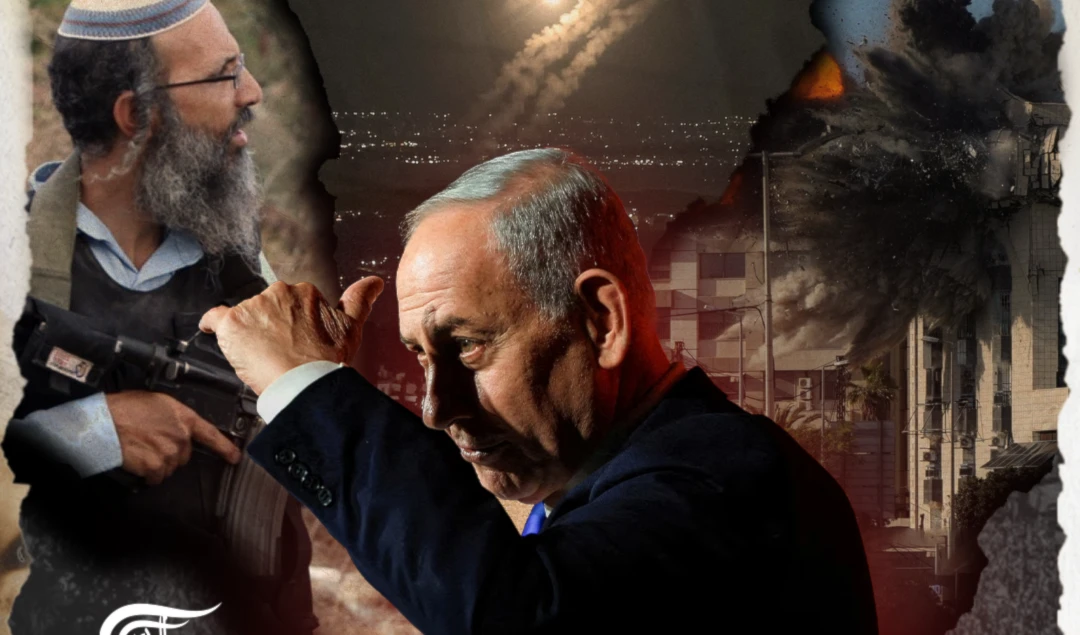
This machinery predates the current government and ministers Bezalel Smotrich and Itamar Ben-Gvir. Settlement was integral to the Zionist project before “Israel’s” establishment, and its reach expanded after the occupation of 1967 under successive governments. The record of Benjamin Netanyahu’s first administration reveals a continuity that cannot be dismissed as a sudden extremist deviation to be corrected by removing a few ministers.
His government’s 1996 guidelines described settlement in the West Bank, Gaza, the Jordan Valley, Galilee and the Naqab as "nationally" important and a fulfilment of Zionist aims. In 1997, Netanyahu advanced Allon Plus proposals to retain Greater al-Quds, the Jordan Valley, settlement blocs, strategic roads and water resources. More explicit proposals to impose what he calls “sovereignty” followed in later years. Their scope and form varied, but the persistent objective was to seize land and fragment Palestinian territory in ways that obstruct genuine Palestinian sovereignty.
“Israel’s” actions in Gaza and the West Bank should be understood within this common project, with methods adapted to each territory and the balance of power. In Gaza, widespread destruction, repeated displacement and areas controlled by Israeli occupation forces have prevented vast numbers of Palestinians from returning to their homes and land. A recent report by the Danish Refugee Council and the Palestinian Agricultural Development Association warned that the expanding area under the occupation forces’ control and protracted displacement were squeezing people into a shrinking area and preventing them from rebuilding their lives.
In the West Bank, settlements, herding outposts, checkpoints, home demolitions and repeated assaults serve the same purpose of dispossession, although the scale and tempo of force differ. They reduce the space available to Palestinians, separate their communities and turn remaining on their land into a daily struggle. The common project is evident in the direction and material effects of these policies; it does not require every operation to follow an identical blueprint. Palestinian steadfastness and resistance to displacement remain obstacles to its completion.
The logic of replacing Palestinians on their land also affects those who remained within the territories occupied in 1948, although their legal status differs from that of Palestinians in the occupied West Bank and Gaza. Citizenship has guaranteed neither national equality nor protection against discrimination affecting their towns and land. The 2018 Nation-State Law reserved national self-determination to Jews and made the development of Jewish settlement a national value that the state must promote. This constitutional priority helps explain the connection between the state’s national identity and its land policies.
Although the law contains no blanket order to expel Palestinians, its implications emerge alongside discriminatory planning, demolitions, restrictions on the growth of Arab towns and the threat of displacement facing Palestinians, particularly in the Naqab. Across these different legal settings, Jewish expansion takes precedence over the rights of the Palestinian inhabitants of the land. Defining the problem solely as expansion beyond the 1967 lines therefore leaves the wider structure of exclusion unexamined.
Western responses expose the contradiction between condemning some consequences and preserving their causes. US Ambassador Mike Huckabee described the assault on Levine as terrorism without abandoning his support for settlements. Secretary of State Marco Rubio emphasized preventing escalation, while the Trump administration had already revoked Biden-era sanctions relating to the West Bank. Reuters also reported preparations for a US statement opposing Western restrictions on settlement trade. Although the draft was never issued, its preparation underscores the limits of verbal condemnation. And the Stop the Settlements Act introduced in the House of Representatives remains a bill, not US policy.
European Union, French and Belgian statements linked the attacks to settlements, and Belgium’s foreign minister called for action against their supporters. Poland confirmed its diplomats’ safety. European leaders had condemned settlement expansion on October 15, before the assaults. These positions create scope for pressure, but do not amount to a unified Western policy or make new sanctions inevitable. Nor do official Israeli condemnations and opposition criticism, shaped partly by political and electoral calculations, demonstrate a fundamental disagreement over land seizure. Concern for “Israel’s” international standing can coexist with support for the settlement project responsible for that damage.
Palestinian official and factional responses converged on a basic point: these attacks reflect the daily Palestinian experience and the impunity settlers enjoy. Protecting Palestinian lives and land must be the starting point of any response. The safety of foreign visitors cannot become a substitute for that responsibility.
The International Court of Justice’s July 2024 advisory opinion sets out responsibilities that go well beyond protecting diplomats. It found “Israel’s” continued presence in the occupied Palestinian territory unlawful and affirmed its obligation to cease new settlement activity and evacuate all settlers from the occupied territory. Other states must neither recognize the unlawful situation nor assist in maintaining it. This makes ending economic support for the settlement system a matter of compliance with international obligations, rather than an optional expression of diplomatic displeasure. The practical test is restrictions on finance and trade, scrutiny of settlement tenders and accountability for supporting institutions, through joint European action or national measures within each state’s legal powers.
Palestinians remain the holders of these rights and the central actors defending them. Their survival cannot depend on a passing surge of European anger, nor should their resistance to occupation and dispossession be put on trial while the means of taking their land remain intact. Palestinians in Gaza, the West Bank and the territories occupied in 1948 share the same right to land, freedom and continued existence. Governments seeking to curb settler violence must impose costs on the project producing it and end their own contribution to its survival. Measures that merely contain diplomatic embarrassment when Westerners are attacked leave Palestinians facing the same system as soon as the cameras and witnesses depart.


