
EU further slashes growth forecasts as US war on Iran drives inflation
 4 Min Read
The European Commission has cut Eurozone growth forecasts to 0.9% for 2026 and raised inflation projections to 3%, as oil prices surge and supply chain disruptions from the US war on Iran batter European economies.
-
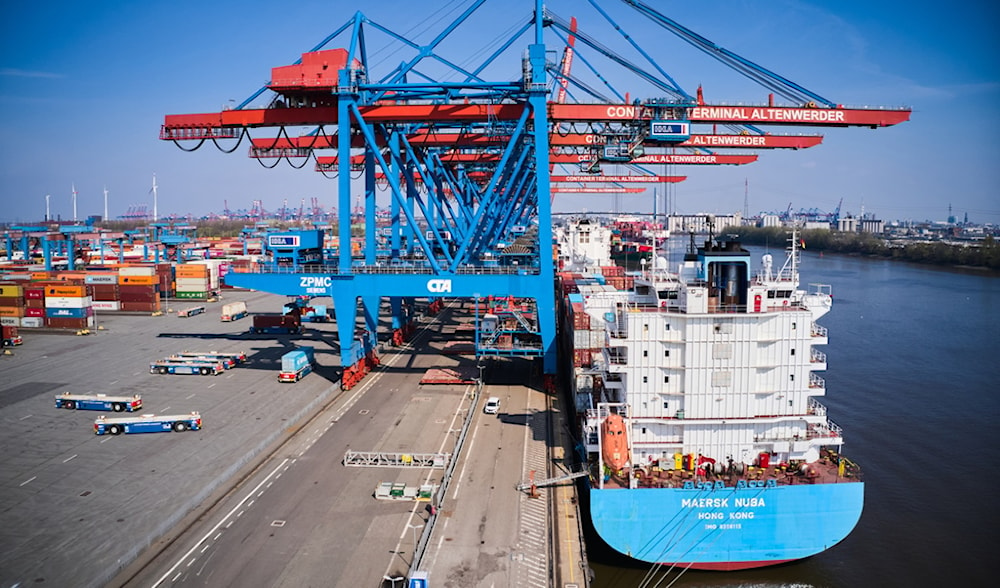
Shipping containers are stacked at the Container Terminal Altenwerder (CTA) at a port in Hamburg, Germany, Wednesday, April 15, 2026. (AP Photo/Ebrahim Noroozi)
The European Commission has sharply downgraded its economic outlook for the Eurozone, citing the surge in oil and gas prices and supply chain disruptions triggered by the US war on Iran.
The Commission now expects Eurozone growth of just 0.9 per cent in 2026, down from a November estimate of 1.2 per cent, with the projection for 2027 also trimmed from 1.4 per cent to 1.2 per cent, according to its Spring 2026 Economic Forecast.
Inflation is forecast to hit 3 per cent in the Eurozone this year, up from 2.1 per cent in 2025 and well above the European Central Bank's 2 per cent target. Across the broader EU, inflation is projected at 3.1 per cent in 2026.
"The conflict in the Middle East has triggered a major energy shock, further testing Europe as it navigates an already volatile geopolitical and trade environment," EU Economy Commissioner Valdis Dombrovskis said.
The Middle East conflict has triggered a new energy shock, with EU inflation projected to rise to 3.1% and growth set to slow to 1.1% in 2026.
— Valdis Dombrovskis (@VDombrovskis) May 21, 2026
Europe’s response must be guided by the lessons of past crises.https://t.co/JU2O6YCfpE #ECForecast pic.twitter.com/HuVLg1Xn4W
War compounds pre-existing vulnerabilities
The US war on Iran has caused oil and gas prices to surge and disrupted global supply chains, pushing up costs for European industries and households and forcing governments to increase spending to shield their economies. The blow compounds longstanding structural weaknesses in the bloc, which was already struggling with sluggish growth, US trade tariffs, and mounting competition from Chinese manufacturers.
Consumer confidence fell to a 40-month low following the outbreak of the aggression, dampening consumption and constraining business investment. Employment growth is forecast to slow from 0.5 per cent in 2025 to 0.3 per cent this year, while the long-running fall in unemployment is expected to stall, stabilising at around 6 per cent through 2027.
Individual member state outlooks have worsened across the board. Germany, the Eurozone's largest economy, is now expected to grow just 0.6 per cent this year, down from a previous forecast of 1.2 per cent. Italy's growth prospects were cut to 0.5 per cent, France's to 0.8 per cent, and Ireland is now forecast to be the only EU economy to contract outright, at -1.2 per cent.
Read more: Equinor warns Europe faces gas crisis if Hormuz closure persists
Worst-case scenario looms
Brussels has also modelled a more adverse scenario in which there is "no obvious solution in sight" for unblocking the Strait of Hormuz. Under that scenario, Dombrovskis warned, the growth forecast would be "roughly halved," and inflation pushed higher still. The ECB's own adverse scenario places oil peaking at $119 a barrel, under which growth could fall to just 0.6 per cent.
Public finances are deteriorating in parallel. The Eurozone's debt-to-GDP ratio is set to rise from 88.7 per cent in 2025 to 91.2 per cent by 2027, while the EU-wide government deficit is projected to climb from 3.1 per cent of GDP to 3.6 per cent by 2027.
The fiscal pressure is compounded by NATO's push for member states to spend 5 per cent of GDP on defence. Lithuania's Finance Minister Kristupas Vaitiekūnas revealed to the Financial Times that if the war were to escalate further, with more countries drawn in, the economic outlook could change "very
dramatically." He described the bloc's fiscal position as a political problem as much as an economic one, cautioning that high debt levels and tight fiscal positions among major economies left limited room to sustain higher defence spending over the long term.


