
France and Germany plan roadmap to address China trade deficit
 4 Min Read
Macron and Merz announce plans for a joint roadmap to tackle China's trade practices as the EU seeks a response to rising imports and a growing deficit.
-
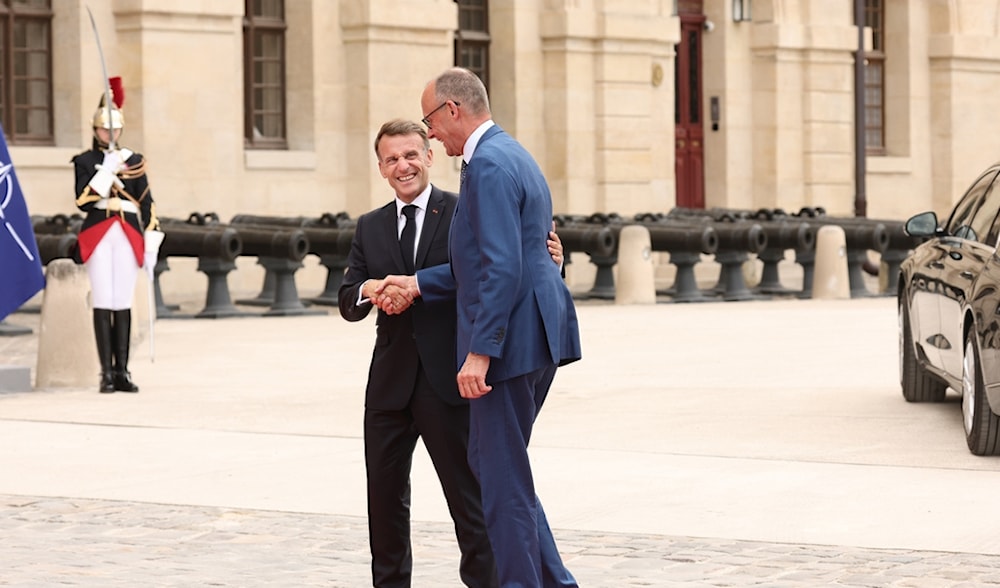
French President Emmanuel Macron, left, greets German Chancellor Friedrich Merz ahead of the Coalition of the Willing summit on security guarantees for Ukraine, at the Hotel des Invalides in Paris, July 2026. (AP)
France and Germany are preparing a joint roadmap by September to address alleged unfair Chinese trade practices, French President Emmanuel Macron said on Friday alongside German Chancellor Friedrich Merz.
The European Union has been struggling to develop a unified approach toward China's growing exports, which critics say are supported by state subsidies and an undervalued currency that makes Chinese products more competitive in global markets.
Speaking at a joint press conference with Merz near Cologne after meetings between the French and German governments, Macron said the EU was facing growing pressure from China's trade practices.
"Right now we are being shaken" by China's trade practices, Macron said. Paris and Berlin aim "to have a Franco-German roadmap on this issue by September," he said, adding that their economy, finance, and foreign ministers had been tasked with preparing the plan.
"We are going to push again very strongly to reinforce the mandate given to the European Commission to move much faster on market investigations and on these instruments to protect our industries," Macron added.
France and Germany seek stronger EU response to China
The planned roadmap comes as EU member states remain divided over how to respond to China's expanding exports and their impact on European industries.
France has long advocated for a tougher approach toward Beijing's trade practices, while Germany has traditionally taken a more cautious position due to the significant role of China in its business sector.
Macron said the EU needed stronger tools to defend European companies, citing pressure on industries including chemicals, machine tools, and automobiles.
"We want to protect our companies and our industries. We've seen it in chemicals, we see it in machine tools, in the automotive sector, and in many others," he said.
Merz also highlighted the widening trade imbalance between the EU and China, saying the growing deficit was placing pressure on European industry. "I think it goes without saying that we have to address this imbalance, because it comes at the expense of our industry."
EU trade deficit with China fuels concerns
The EU's trade deficit in goods with China reached around 360 billion euros in 2025, meaning the bloc imported significantly more from China than it exported.
The rising deficit has intensified debate within Europe over Chinese exports, industrial competition, and the need for stronger trade measures.
Macron also called for dialogue with Beijing over currency issues, urging discussions "on exchange rates and the opening of financial markets."
Addressing concerns over the valuation of China's yuan, Merz said that "if the Chinese currency is currently correctly valued, then there is no reason not to allow it to be freely convertible for trading purposes."
China, EU choose dialogue
In late June, China and the European Union agreed to enter a new round of trade consultations, signaling a shared effort to manage economic tensions through dialogue rather than allow Brussels’ growing protectionist pressure to push relations toward a trade war, The Guardian reported.
The agreement followed talks in Brussels between Chinese Commerce Minister Wang Wentao and EU Trade Commissioner Maroš Šefčovič, resulting in the first joint statement issued by the two sides in seven years. The move comes after weeks of European warnings over the bloc’s trade deficit with China, which EU officials say has reached around €360 billion annually.
For Beijing, the talks offer a chance to address disputes through established channels and prevent trade frictions from being politicized. China has repeatedly stressed that economic ties with Europe should be based on openness, mutual benefit, and respect for global supply chains, rather than accusations aimed at justifying tariffs or restrictive measures.
Read more: EU expands trade barriers targeting Chinese imports


