
EU expands trade barriers targeting Chinese imports
 4 Min Read
The European Union is preparing broader tariffs and import quotas against Chinese goods as Brussels escalates economic protection measures amid rising trade tensions with Beijing.
-
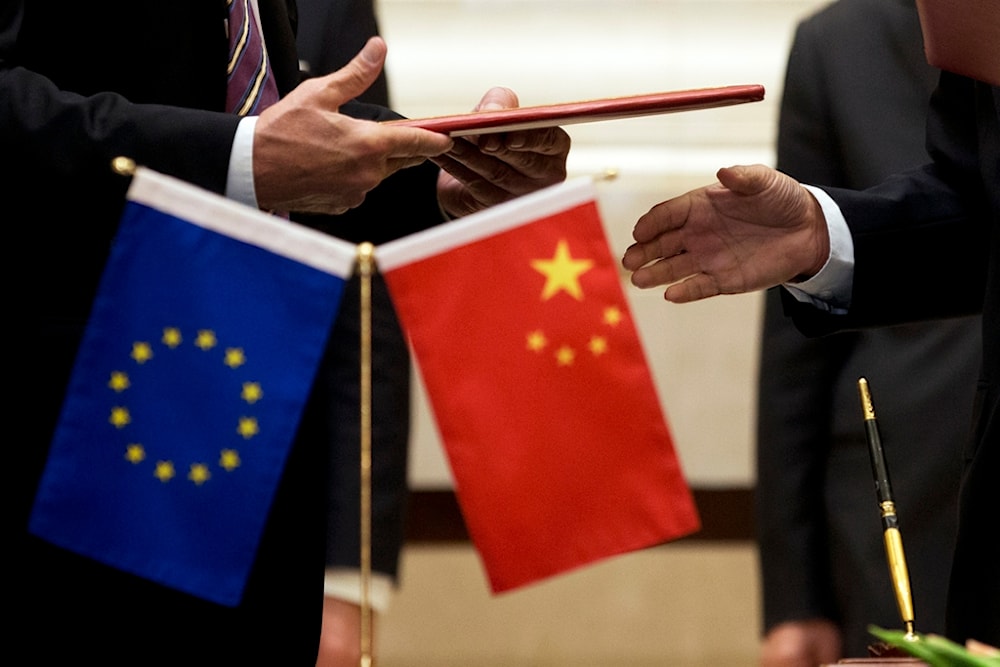
A member of the European Commission, left, prepares to exchange documents with the Chinese delegation at a signing ceremony after the 5th China-EU High Level Economic and Trade dialogue at Diaoyutai State Guest House in Beijing, on Sept. 28, 2015. (AP Photo/Andy Wong)
The European Union is preparing to significantly expand tariffs and import quotas targeting Chinese products, marking a further escalation in economic tensions between Brussels and Beijing as European officials increasingly frame Chinese industrial competition as a strategic threat, according to a report by the Financial Times.
EU Industry Commissioner Stéphane Séjourné said Brussels intends to broaden the use of trade defence mechanisms across entire industrial sectors rather than limiting measures to individual companies or specific raw materials.
In remarks to the Financial Times and other European outlets, Séjourné warned that sectors including chemicals, metals, and clean technology industries face what he described as an “existential” challenge from Chinese imports.
“We will use safeguard clauses in a more general manner on sectors and not just on businesses or particular raw materials,” Séjourné said, arguing that lengthy investigations often fail to protect industries before economic damage becomes irreversible.
The measures form part of a wider EU push to shield European markets from low-cost Chinese exports amid growing concern within Brussels over industrial competitiveness and trade imbalances.
Import quotas and tariffs at center of EU strategy
EU safeguard mechanisms impose import quotas while applying tariffs to products exceeding those limits. Brussels is now seeking to deploy these tools more systematically as part of a broader industrial protection framework.
“Our objective is not to break with China but to have a real rebalancing and real measures that allow us to do it,” Séjourné stated to the Financial Times.
According to the EU commissioner, the bloc’s daily trade deficit with China has reached approximately €1 billion, while an estimated 29 million European jobs are viewed as vulnerable to what Brussels characterizes as Chinese industrial overcapacity.
The European Commission is also examining additional mechanisms that could compel companies to diversify supply chains away from concentrated dependence on Chinese suppliers.
Read more: Why China faces limited impact from war on Iran as global risks grow
Internal divisions emerge within the EU
Despite increasing pressure for tougher economic measures, divisions remain inside the EU regarding how aggressively Brussels should confront China economically.
Séjourné acknowledged resistance from member states, including Germany and Spain, which remain cautious about escalating tensions with Beijing due to their own industrial and export interests.
“We are trying to find ways forward in the maze of discussions with member states, like Spain and Germany, who are rather reticent to give negative signals to China,” he said.
At the same time, Brussels fears that failure to adopt stronger collective trade protections could encourage individual member states to pursue unilateral economic restrictions, potentially undermining the cohesion of the EU single market itself.
“In three or four years countries will say ‘you’ve not been able to protect us so we are going to retake control over trade and put in place safeguard, protection and border control measures ourselves,’” Séjourné warned in comments to the Financial Times.
WTO limitations and growing trade fragmentation
The proposed measures also reflect growing skepticism within Europe toward existing global trade institutions, particularly the World Trade Organization (WTO), which European officials increasingly view as incapable of rapidly addressing industrial disputes and state-subsidized competition.
Séjourné argued that the WTO can no longer provide short-term solutions to mounting trade tensions.
“The WTO is no longer seen as a short-term solution but a long-term project that we must build up bit by bit,” he said, adding that EU member states have recognized “the limit of bilateral discussions.”
The European Commission is expected to discuss the proposed measures during a special meeting on China involving EU commissioners.


