
WTI falls, Brent rises while Asian markets digest Hormuz developments
 3 Min Read
South Korea's Kospi scores a record high on Tuesday while Japan and Australia fall, as oil prices diverged sharply on conflicting signals from Iran-US ceasefire talks.
-
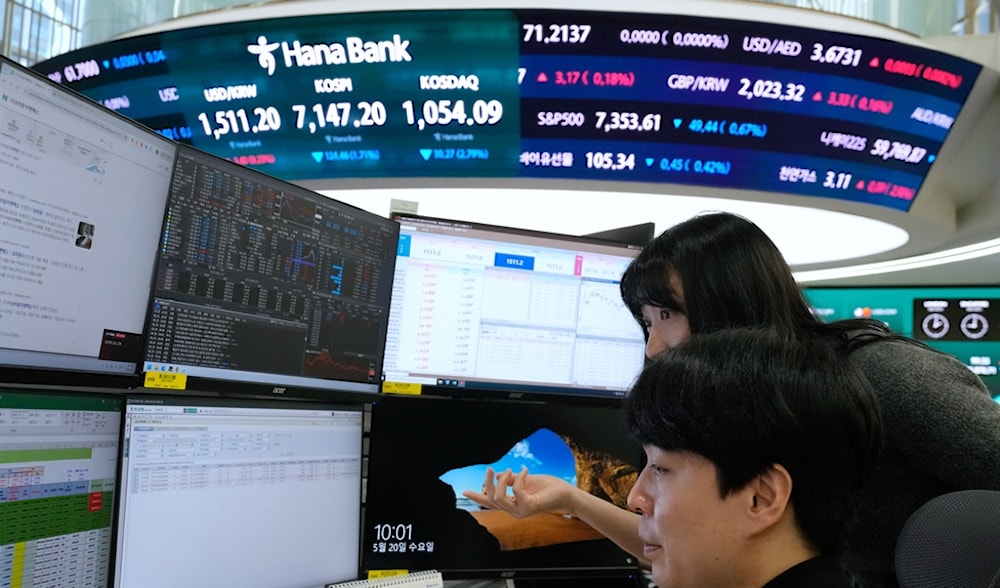
Currency traders watch monitors at the foreign exchange dealing room of the Hana Bank headquarters in Seoul, South Korea, Wednesday, May 20, 2026 (AP)
Asian equity markets and oil prices traded in opposite directions on Tuesday as investors weighed conflicting signals from Iran-US ceasefire negotiations, with South Korea surging while Japan and Australia retreated, The Wall Street Journal reported.
Conflicting signals follow US attacks on areas in southern Iran overnight, bombing what the US Central Command alleged were missile launch sites and vessels it claimed were attempting to lay naval mines.
The attacks came as Iranian negotiators were in Doha for talks aimed at ending the war. Nonetheless, US Secretary of State Marco Rubio said on Tuesday that a deal could still be reached within days.
For one, the two main global oil benchmarks diverged sharply on Tuesday. West Texas Intermediate crude, the US benchmark, fell 5.2% to $91.55 per barrel, while Brent crude, the international standard, gained 1.7% to $97.80.
Analysts attributed the gap to how each benchmark is priced. Brent reflects West Asian crude more directly, meaning any renewed threat to Hormuz shipping pushes it higher, while WTI tracks domestic US supply conditions, and American inventories have been building for several weeks.
WTI is pricing in the possibility of a deal; Brent is pricing in the reality that the strait remains mostly closed regardless of what negotiators say.
South Korea leads the region
South Korea's Kospi climbed to an all-time high of 8,094.90, buoyed by investor optimism that diplomatic progress between Washington and Tehran could reach a deal.
South Korean markets also benefited from a catch-up effect, having been closed on Monday for a public holiday and reopening with the previous session's positive news flow fully absorbed in a single move.
Foreign investors returned as net buyers of Korean stocks, with approximately 43% of the day's trading volume concentrated in chipmakers Samsung Electronics and SK Hynix, companies that stand to benefit directly from lower energy import costs and sustained global demand for semiconductors tied to the AI investment cycle.
Japan, Australia pull back
Japan's Nikkei fell 0.3%, and Australia's S&P/ASX 200 dropped 0.7%, as both economies are structurally exposed to elevated oil prices.
Japan imports the bulk of its crude from the Gulf region, leaving it particularly vulnerable to supply shocks and the inflation that comes with them.
Australia's central bank faces a similar bind, as inflation is rising on the back of energy costs while growth is slowing, making monetary policy decisions increasingly difficult.
Gold steadies, dollar holds
Spot gold dropped 0.2% to $4,559.43 an ounce as ceasefire optimism reduced demand for safe-haven assets, though prices remain near historic highs reached since the war began in late February.
The dollar fell marginally, but analysts expect further losses to be limited, pointing to ongoing AI-driven investment keeping the US economy relatively afloat.
Read more: The war on Iran is hurting the US economy more than Trump admits


