
'Secret prisons' run by UAE discovered in Hadhramaut: Yemeni gov.
 3 Min Read
A senior official in the Saudi-backed Yemeni government revealed the discovery of 'secret prisons' operated by the UAE in Hadhramaut province, vowing action against the UAE and STC forces.
-
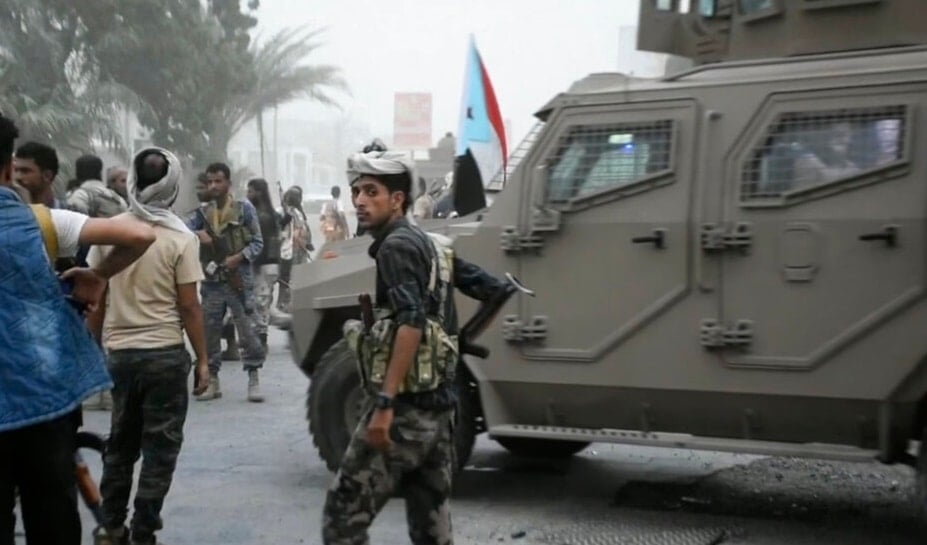
In this Friday Aug. 9, 2019 frame grab from video, Southern Transitional Council separatist fighters prepare to storm the presidential palace in the southern port city of Aden, Yemen (AP)
A senior official in the Saudi-backed Yemeni government has revealed the discovery of "secret prisons" operated by the United Arab Emirates in the eastern province of Hadhramaut.
The official, speaking to Reuters, stated that the secret detention facilities were reportedly used to detain individuals without due process. The official did not disclose further details regarding the number of facilities or the conditions of detainees.
He further declared that the government will take “all necessary measures” against both the UAE and its separatist group, the Southern Transitional Council, to “achieve justice for victims.”
UAE-KSA rift explained
This follows a sharp deterioration in relations between Riyadh and Abu Dhabi over influence in southern Yemen. Saudi officials have increasingly accused Emirati-backed factions, particularly forces aligned with the Southern Transitional Council, of advancing agendas that threaten Saudi national security, a notable rupture between two states that once jointly led the military coalition intervening in Yemen since 2015.
In December, STC-affiliated forces briefly expanded their footprint across several southern governorates, advancing toward areas Riyadh considers strategically sensitive, including zones near the Saudi border. Saudi officials later described the advance as a “red line,” warning that unchecked separatism, militia rule, or territorial fragmentation could have grave security consequences for the kingdom.
The escalation prompted Saudi airstrikes on a shipment linked to UAE-supported forces, followed by a rapid counter-deployment by Saudi-aligned units that reversed the STC’s gains. Saudi-backed “National Shield” forces subsequently announced full deployment across Aden governorate, while the Presidential Leadership Council moved to retake camps and installations previously controlled by STC-aligned units, exposing deep fractures within the coalition that has dominated Yemeni politics and security for nearly a decade.
Foreign imposition
From Sanaa’s perspective, the episode reinforces a long-standing assessment: that turmoil in the south reflects competition between foreign patrons rather than a sovereign Yemeni political process. Axis of Resistance-aligned authorities have consistently argued that both Saudi Arabia and the United Arab Emirates have violated Yemen’s sovereignty by sponsoring armed factions, managing territory, and shaping political outcomes through proxy forces, turning the country into a battleground for overlapping regional agendas rather than Yemeni self-determination.
For Sanaa, the trajectory confirms a central claim: that Yemen’s sovereignty remains constrained by foreign intervention, and that the struggle unfolding in the south is less about local choice than about a power contest between external actors, one that has now moved decisively from behind closed doors into the open.


