
261 Iran MPs strongly back negotiation team headed by Ghalibaf
 3 Min Read
261 Iranian lawmakers express support for the negotiation team, urging national unity and warning against foreign influence and disinformation campaigns.
-
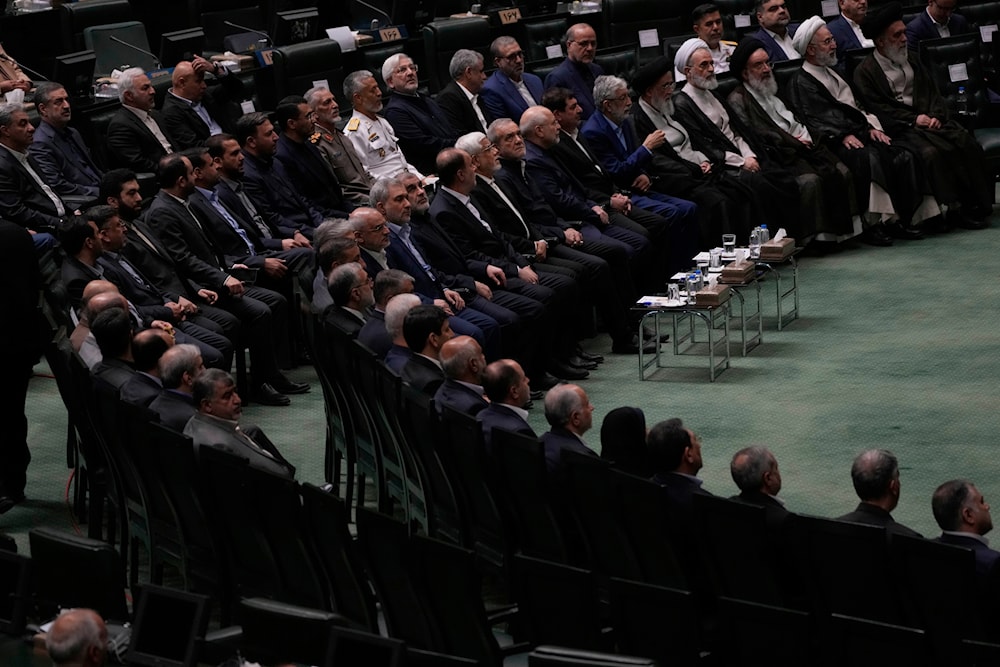
Iranian top officials attend a memorial at the parliament in Tehran, Iran, May 21, 2025 (AP)
A total of 261 members of Iran’s parliament have expressed strong support for the country’s negotiation team and called for national unity, warning against foreign attempts to undermine internal cohesion and trust in state institutions.
In a statement published on Monday, the lawmakers said decision-making in the country is being conducted under the guidance of the highest levels of leadership and with broad consensus across governing institutions.
The MPs said they fully support the negotiating delegation, stressing that it is operating in defense of national interests. They also voiced support for Parliament Speaker Mohammad Bagher Ghalibaf, who has taken on responsibility for a “new front of struggle with the enemy.”
The statement highlighted that “the hybrid operation of the American-Zionist enemy shows that the military war is entering a more complex stage involving political, economic, security, psychological, and media actions.”
The lawmakers said this reflects an attempt by adversaries to shift the nature of conflict beyond the battlefield and into broader domains aimed at influencing public perception and internal cohesion.
They added that amid the ceasefire, the United States and "Israel" are attempting to create distrust among the public and weaken confidence in official institutions to produce “miscalculation” within Iranian society and among state actors.
Disinformation campaigns being intensified to sow division
The MPs also accused foreign actors of intensifying media and information operations, stating, “The enemy seeks, through media operations and fabricated, incomplete narratives, to sow division among officials and confusion in public opinion, in order to divert attention from the main enemy and compensate for its failures in the military and political arena.”
They emphasized that such efforts are designed to exploit internal discourse and amplify contradictions in order to weaken national resolve.
Reaffirming their position, the lawmakers emphasized the centrality of national unity, especially amid past failures of external military pressure, arguing that cohesion between the public and state leadership has been decisive in resisting foreign pressure.
The statement also stressed continuity in governance and decision-making, saying that despite external pressure and internal challenges, “decision-making and decision-making processes are being carried out around the axis of the wise leadership of the Islamic Revolution with courage, prudence, and unprecedented consensus.”
Finally, the MPs urged political and social actors to avoid speculation and reliance on unverified information, warning that such narratives could serve foreign psychological warfare efforts. They expressed confidence that unity, patience, and resistance would ultimately lead to the defeat of external adversaries.


