
Exclusive | Araghchi: Iran deterrence reshapes post-war regional order
 18 Min Read
Iranian Foreign Minister Abbas Araghchi discusses Lebanon, Gulf relations, wartime preparedness, and regional security shifts in an exclusive, in-depth interview with the Chairman of Al Mayadeen Media Network, Ghassan Ben Jeddou.
-
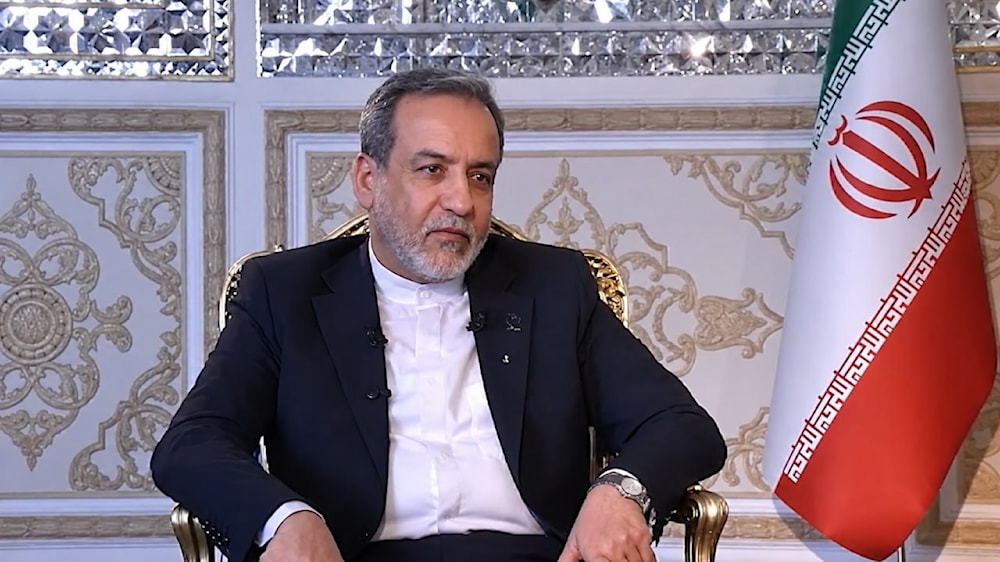
Iranian Foreign Minister Abbas Araghchi in an exclusive interview with the Chairman of Al Mayadeen Media Network, Ghassan Ben Jeddou (Al Mayadeen)
In an in-depth interview with the Chairman of the Board of Directors of Al Mayadeen Media Network, Ghassan Ben Jeddou, Araghchi addressed a wide range of issues, including developments in Lebanon, Iran’s relations with Gulf states, regional diplomacy, wartime coordination and military preparedness, as well as shifting balances of power following the war. He reiterated that Tehran’s approach is based on deterrence and strategic resilience rather than any policy of expanding the war.
End of Israeli occupation integral for Lebanon's ceasefire, reconstruction
Iranian Foreign Minister Abbas Araghchi said Iran remains committed to pursuing a ceasefire across Lebanon and the wider region, arguing that any cessation of hostilities cannot be addressed in isolation and stressing that any end to attacks must include the Lebanese front as part of a unified battlefield shaped by ongoing regional confrontations with “Israel” and the United States.
Araghchi said that ending the war in Lebanon is inseparable from ending the Israeli occupation in South Lebanon, arguing that any ceasefire must be accompanied by a full withdrawal of Israeli forces from occupied areas and a comprehensive political settlement preserving Lebanon’s territorial unity.
Responding to a question from Ben Jeddou about whether Iran would continue supporting Lebanon and assist in rebuilding areas devastated by Israeli attacks, Araghchi said ending the war requires more than a ceasefire.
According to the Iranian foreign minister, a genuine resolution must include the withdrawal of Israeli forces from occupied areas, the preservation of Lebanon's territorial integrity, and the establishment of lasting peace.
"Ending the war on Lebanon also means ending the occupation," Araghchi said, adding that any settlement must be accompanied by a complete Israeli withdrawal from Lebanese territory.
He added that reconstruction efforts would naturally follow the end of hostilities, noting that multiple countries have already expressed readiness to participate in rebuilding what was destroyed during the war.
“The issue of reconstruction will be on the agenda after the end of the war,” he said, stressing that Iran, alongside other partners, would contribute within its capabilities, while reaffirming that the Iranian government and people “will not forget their friends in Lebanon.”
Araghchi said Tehran has consistently assisted in countries affected by war or natural disasters “within the limits of its ability,” adding that Lebanon would be no exception once conditions allow.
Relations with Beirut, clarification over ambassador
Responding to questions about Iran’s diplomatic ties with Lebanon, Araghchi said he had recently met senior Lebanese officials, including the president, prime minister, speaker of parliament, and foreign minister, reiterating Iran’s intention to expand relations with the Lebanese state “in all dimensions.”
He emphasized that Iran’s support for Hezbollah remains unchanged, while stressing that Tehran views Lebanon as a whole and seeks broad engagement with its institutions across political, economic, and cultural sectors.
"Our relationship with Hezbollah and our support for Hezbollah remain steadfast, but we look at Lebanon as a whole," he said.
The foreign minister pointed to strong cultural ties between the two countries and said there is significant potential to expand economic cooperation. He added that bilateral trade remains substantial despite current regional challenges.
Addressing the controversy surrounding Iranian Ambassador Mohammad Reza Sheibani in Beirut, Araghchi suggested that the issue stemmed from a misunderstanding within Lebanon's Foreign Ministry. He said Ambassador Sheibani had been appointed with the goal of strengthening relations between the two countries across multiple fields and expressed confidence that the matter would soon be resolved.
According to Araghchi, discussions with Lebanese officials have helped contain the issue, and the ambassador will continue carrying out his duties in Beirut.
"I am confident that his legal status will be confirmed soon," Araghchi said.
Ayatollah Sayyed Ali Khamenei's martyrdom
The Iranian foreign minister revealed that he was inside the office complex of the martyred Iranian leader Ayatollah Sayyed Ali Khamenei when the attack that led to his martyrdom took place, saying the incident was one of the most difficult moments of his life.
In an exclusive interview with Al Mayadeen, Chairman of the Board Ghassan Ben Jeddou asked Iranian Foreign Minister Abbas Araghchi whether reports were true that Sayyed Khamenei had been advised to move to a highly secure location but refused.
— Al Mayadeen English (@MayadeenEnglish) June 4, 2026
Araghchi said it was reported that… pic.twitter.com/s66pC7dyCX
He said he had returned to Tehran from negotiations in Geneva and went to Sayyed Khamenei’s office on the morning of the attack to brief officials on the talks and the growing likelihood of war.
According to Araghchi, the building where he was meeting officials came under attack, with one section sustaining heavy damage while the wing in which he was located remained intact.
“I was in his office building at the moment the attack occurred,” Araghchi said.
For the first time, Iranian Foreign Minister Dr. Abbas Araghchi reveals in an interview with Al Mayadeen the harrowing details of the day the Iranian Leader, Sayyed Ali Khamenei, was martyred.
— Al Mayadeen English (@MayadeenEnglish) June 4, 2026
Araghchi recounts being inside the very same building during the targeted airstrike,… pic.twitter.com/ToJ1wZ1dnT
He said his immediate concern was not for his own safety but for the condition of Sayyed Khamenei, whom he believed was likely in his office despite the heightened military tensions and warnings of war.
“My first thought and my first concern was the condition of the Leader,” he said, adding that Sayyed Khamenei’s character made it unlikely he would seek shelter despite the threat environment.
According to Araghchi, Sayyed Khamenei had said he would remain alongside the population as long as civilians did not have equal access to secure shelters, adding that any danger faced by the people would be shared by the leadership.
Araghchi described this stance as reflecting a form of leadership “that governs hearts rather than just people,” stressing that it demonstrated closeness between the leadership and the population during times of crisis.
He said such an approach defined Sayyed Khamenei’s leadership style, portraying it as one rooted in presence among the people in both hardship and relief.
Iran turned tragedy into strength
Araghchi recalled spending the following days uncertain about Sayyed Khamenei’s fate until news of his martyrdom was confirmed, saying the loss is a wound that would never fully heal.
“This grief will never be forgotten,” he said. “It is a wound in our hearts that may never heal.”
Araghchi said the Iranian political system demonstrated resilience in its aftermath, arguing that state institutions moved quickly to ensure continuity of leadership and governance and rejecting expectations he said existed among Iran’s adversaries that the martyrdom would destabilize the country.
He said the transition to new leadership showed the strength of the Islamic Republic’s institutions and transformed what opponents saw as a moment of weakness into a source of national unity.
Araghchi added that he spent the following 40 days working from the Foreign Ministry rather than returning home, focusing on defending Iran’s position internationally and communicating the country’s resilience during the war.
He ultimately said that his martyrdom was a turning point in modern Iranian history, saying it reinforced rather than weakened Iran’s resolve.
Iran anticipated war and was fully prepared militarily
Responding to whether they were expecting a war after returning from Geneva, Araghchi said Tehran was already preparing for war before the Geneva negotiations, arguing that all indicators on the eve of the talks pointed to a high probability of escalation.
Araghchi revealed that Iranian officials had publicly and privately acknowledged this assessment, including in closed parliamentary sessions, stressing that both the government and armed forces were ready for any scenario.
While he conceded that the war included tactical surprises, Araghchi insisted Iran was not strategically caught off guard. He pointed to Iran’s rapid response after the opening strikes, saying retaliatory operations began within two hours despite the loss of senior commanders in the initial phase.
Araghchi said Iran’s military system had been carefully pre-planned, including contingency arrangements for leadership succession across multiple levels. He explained that each command position had designated replacement structures, ensuring operational continuity even in the event of targeted assassinations.
According to the foreign minister, this layered system allowed Iran to sustain its response throughout the war despite ongoing attacks on personnel and military infrastructure.
He added that Iran is now in a stronger position to confront future aggression, citing improved preparedness and battlefield resilience developed during the war.
War preparedness was directly directed by Sayyed Khamenei
Araghchi said Iran’s wartime preparations and military response strategy were directly ordered and overseen by Sayyed Khamenei, saying the framework for preparing for a prolonged war and responding militarily had been established under his guidance and implemented by the armed forces.
Iranian Foreign Minister Abbas Araghchi said in an interview with Al Mayadeen that Sayyed Ali Khamenei personally issued the orders regarding the current war on Iran.
— Al Mayadeen English (@MayadeenEnglish) June 4, 2026
"In fact, the directives came directly from him," the minister added.
Commenting on Trump's reaction,… pic.twitter.com/LlODiukHB6
Araghchi added that the speed and scale of Iran’s response surprised the United States, “Israel,” and their allies. He said it was widely unexpected that Iran could sustain resistance for around 40 days of continuous confrontation.
He stated that Iran ultimately forced its adversaries to seek negotiations and a ceasefire after failing to achieve their objectives despite military superiority.
According to Araghchi, several foreign officials told him during and after the war that Iran had demonstrated unexpected resilience and emerged stronger.
He said the war marked a strategic turning point, reshaping perceptions of Iran’s military and political strength. He also argued that it exposed limits in the US military presence in the region, saying it failed to provide security and, in some cases, became counterproductive.
Araghchi said reliance on US bases had proven ineffective, and that such installations had become liabilities rather than protective assets. According to Araghchi, the war triggered a broader reassessment of regional security frameworks, with growing discussion of a new model based on regional cooperation rather than external powers.
He added that a shift is underway toward a more autonomous Gulf security architecture.
Iran warned Gulf states over US bases and regional escalation
Araghchi said Tehran had repeatedly informed Gulf countries that any escalation involving the United States or “Israel” could lead to Iranian responses targeting US military assets in the region, while stressing Iran did not seek war.
He said this position was conveyed during multiple regional visits, where officials emphasized that Iran did not want war but would respond if imposed. He said Iran explicitly warned that US bases in regional countries could become targets if used in operations against Iran.
Araghchi disclosed that some states may not have taken these warnings seriously or believed Iran lacked the capability to act. He added that on the morning the war began, Iranian officials contacted several regional governments to reiterate that any response would include US installations.
He stressed Iran’s response would target US bases, not the territories of Gulf states, distinguishing between host countries and US forces.
Iran coordinated warnings with Gulf states
Araghchi said Tehran had informed all GCC states in advance of its position regarding retaliation during escalation with the US or “Israel,” adding that direct contacts were made with most regional capitals.
He said on the day the aggression against Iran began, Iranian officials reached out to most Gulf countries, though some calls could not be completed due to timing. He noted no formal contact with Bahrain due to a lack of diplomatic relations, although he said informal and personal contacts with Bahraini Foreign Minister Abdullatif Al Zayani had previously existed.
In an exclusive interview with Al Mayadeen, Iranian Foreign Minister Abbas Araghchi affirmed that during his tours in the Gulf region, he had already conveyed to all the countries of the region that Iran does not want war, but if war is imposed on it, then Tehran will certainly… pic.twitter.com/ni93lwmluZ
— Al Mayadeen English (@MayadeenEnglish) June 4, 2026
He added that during the war, contacts continued at varying levels, including near-regular communication with Saudi Arabia’s foreign minister.
Araghchi said Iran regretted that regional territory and airspace were used against it, insisting Tehran had repeatedly warned against such use.
Araghchi said most Gulf states had stated they would not allow use of their territory, but US forces still operated from within the region. He cited Kuwait and referred to reported incidents involving F-15 aircraft, questioning their operational presence and US-linked airspace usage which Iran has documented.
He affirmed that Iran submitted evidence to the UN Security Council detailing these violations. Araghchi stressed Iran does not seek confrontation with Gulf states and said responses were directed at US forces only.
Looking ahead, Araghchi reiterated that Iran aims to move beyond the recent escalation toward a new regional security framework, arguing that long-term stability in the region can only be achieved through cooperation among regional states rather than reliance on external military powers.
Close Iran-Oman coordination on Strait of Hormuz
On Iran's relations with the Sultanate of Oman, Araghchi said they remain “friendly and fraternal,” stressing close coordination between the two countries on the management of the Strait of Hormuz.
He said Oman was largely unaffected during the war, aside from isolated incidents, which he said resulted from error or misunderstanding.
Araghchi said Tehran and Muscat are actively consulting on maritime traffic management, noting that both are coastal states sharing responsibility over the strategic waterway.
He argued that the Strait of Hormuz is not an international waterway in the commonly used sense, but is instead divided between Iranian and Omani territorial waters, giving both countries a “natural right” to jointly administer it.
He said this framework underpins ongoing talks aimed at regulating navigation in line with international law, while noting that implementation details remain under negotiation.
Araghchi added that both sides will continue consultations with other Gulf states whose interests are tied to the strait, stressing the importance of sustained regional dialogue on maritime security.
The ultimate objective, he said, is to ensure safe and uninterrupted commercial shipping in conditions of stability and security for all parties involved.
Qatar visit aimed at advancing Iran-US talks
Araghchi said his recent visit to Doha, alongside Iranian parliament speaker Mohammad Bagher Ghalibaf, was aimed at advancing diplomatic efforts with the US and exploring financial and mediation channels.
He said Qatar remains a friendly country, but noted that the use of US military facilities and airspace in Qatar during the recent war had been raised with Qatari officials.
Araghchi said Doha has nonetheless played a constructive role, particularly in facilitating discussions on financial issues linked to previous Iran-US arrangements routed through the country.
He added that Pakistan has been the primary mediator in indirect Iran–US contacts, crediting Prime Minister Shehbaz Sharif, Army Chief Asim Munir, and Foreign Minister Ishaq Dar for sustained efforts.
While stressing Pakistan’s role as central, he said Qatar has contributed at key stages, calling its involvement “useful and constructive,” but part of a broader mediation framework that still requires consolidation into a final package. He acknowledged that past mechanisms involving Qatar had not been successful, but said recent Qatari engagement has been more constructive in supporting diplomatic and financial discussions.
Araghchi calls for stronger Saudi ties while warning over UAE ties with 'Israel'
Assessing the reality of the communication with Saudi Arabia, Araghchi said the country remains a key pillar of regional stability, stressing that sustained dialogue between Tehran and Riyadh is essential for any future Gulf security framework.
He said both countries are major regional powers capable of jointly contributing to stability and development, noting that ties have stabilized following the China-brokered restoration of relations.
Araghchi acknowledged past tensions but said current engagement is steady, pointing to frequent contacts with Saudi Foreign Minister Prince Faisal bin Farhan, whom he described as a “close friend.”
He said both sides share an understanding of the importance of constructive dialogue despite ongoing differences, expressing confidence that relations will continue to improve based on mutual goodwill.
On relations with the United Arab Emirates, Araghchi said Iran remains open to improved ties but argued that Abu Dhabi’s relations with “Israel” have complicated bilateral relations.
He said UAE cooperation with "Israel" has expanded significantly and said that Iran possesses evidence indicating the use of Emirati territory and facilities during the war, including US and Israeli operational activity.
Araghchi expressed regret that the war further strained relations with Abu Dhabi, recalling earlier constructive contacts with UAE Foreign Minister Sheikh Abdullah bin Zayed.
He said Iran and the UAE, as neighboring states, have no choice but to coexist and should restore relations based on mutual respect and shared interests, adding that external powers cannot guarantee regional stability.
He reiterated Iran’s readiness to rebuild ties with the UAE and broader Gulf states on a balanced and non-interventionist basis.
On Sayyed Mojtaba Khamenei's leadership role
Responding to questions on reports that Donald Trump claimed to have met or sought to meet the Iranian leader Sayyed Mojtaba Khamenei, the Iranian foreign minister said he had not seen the specific post referenced, noting that what he had come across suggested only that Trump was “ready for a meeting” or expressing willingness to engage.
He said such claims should be treated with caution and assessed within a realistic framework, stressing the need to remain grounded in “the real world.”
Araghchi then confirmed that Ayatollah Sayyed Mojtaba Khamenei is currently carrying out leadership responsibilities in the Islamic Republic, stressing he has a strong and decisive role in managing state affairs and overseeing key decisions.
Iranian Foreign Minister Abbas Araghchi said in an interview with Al Mayadeen that Sayyed Ali Khamenei personally issued the orders regarding the current war on Iran.
— Al Mayadeen English (@MayadeenEnglish) June 4, 2026
"In fact, the directives came directly from him," the minister added.
Commenting on Trump's reaction,… pic.twitter.com/LlODiukHB6
He said Sayyed Khamenei’s limited public visibility is due to security considerations, adding that authorities do not recommend expanding his appearances beyond the current level as a protective measure.
Araghchi stressed that communication with the leadership remains continuous, with directives issued at the highest level being transmitted promptly and implemented across state institutions without delay.
He added that there is a broad national consensus around the leadership structure, which he said has ensured full continuity of governance and prevented any disruption in state functioning.
According to him, institutional cohesion and administrative control have remained intact, with the same level of coordination and public alignment continuing under the current leadership arrangement.
Araghchi concluded by reiterating that Iran’s leadership model is rooted in stability and strategic continuity, and that Iran is a state with stable and functioning political structures, saying the United States should reassess its understanding of the Islamic Republic and engage with it as a resilient regional power operating firmly within “real-world” political realities.
“We live in a real world, and we must look at facts as they are,” he said.
Key points from the first part of the interview
In the first part of the interview with Al Mayadeen Media Network Chairman Ghassan Ben Jeddou, Iranian Foreign Minister Abbas Araghchi said the recent regional war demonstrated the effectiveness of deterrence by Iran and the Resistance Axis, arguing that planned Israeli attacks on Beirut’s southern suburbs were ultimately prevented due to coordinated warnings and readiness by Iranian armed forces and allied actors.
He said Tehran had directly communicated with US officials and regional governments, warning that any major escalation in Beirut would trigger a broader response, while emphasising that Iran does not seek war but is prepared for it if imposed. Araghchi added that indirect communication channels between Tehran and Washington remain active despite ongoing tensions.
He further argued that the war reinforced rather than weakened Iran’s position, stressing that its military infrastructure, including contingency command structures and succession planning, allowed it to maintain continuity even under targeted attacks.
Araghchi also reaffirmed Iran’s continued support for Hezbollah, saying it is a central component of Lebanon’s political and social fabric, and insisted that the Resistance remains resilient even after the martyrdom of senior leaders. He said Western expectations of collapse were proven wrong, as such movements are rooted in ideology rather than individuals.
For more details, read Part 1 of the interview here: Araghchi: Ending war on Iran requires ending it on Lebanon - Interview


