
CENTCOM chief leads oil smuggling with help of UAE: Rezaei
 4 Min Read
Iran’s Supreme National Security Council Secretary noted that valuable US assets in the UAE and around Hormuz remained outside Iran’s target list, underscoring the additional options available to Tehran.
-
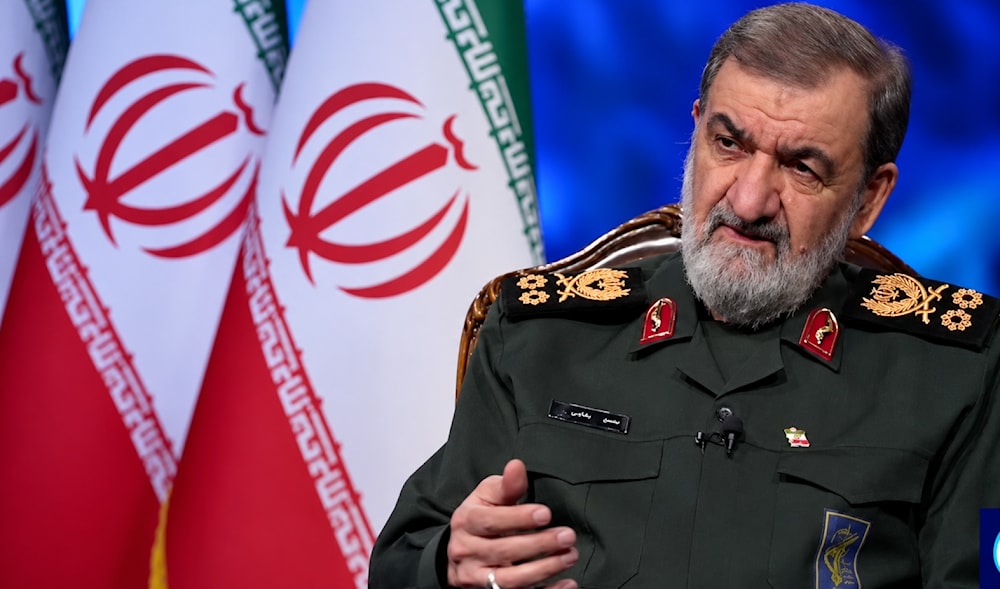
Major General Mohsen Rezaei speaks during an interview with Press TV (Press TV/Screenshot)
Iran maintains control over the Strait of Hormuz while Washington resorts to oil-smuggling operations directed by the commander of US Central Command (CENTCOM) with UAE military assistance, Iran’s Supreme National Security Council Secretary Major General Mohsen Rezaei said.
In an interview for Press TV, Rezaei challenged Washington’s repeated assertions that the Strait of Hormuz remains open, saying US President Donald Trump was relying on “criminals operating in Oman’s territorial waters” to move oil.
Washington “is engaging in smuggling,” he said, stressing that the strait “is under Iran’s control, and we manage it.”
Rezaei described operations involving five or six small vessels transferring oil to larger tankers, saying Iranian forces target five or six of these vessels every night.
His remarks came as shipping data showed vessel traffic through Hormuz had fallen to its lowest level in more than two months following an escalation in attacks on violating tankers.
Iran ready to demonstrate new capabilities
Rezaei stressed that Iran was prepared for renewed hostilities and would respond with a broader military plan and capabilities it had yet to demonstrate.
“We are fully prepared to demonstrate new capabilities if war breaks out again,” he said.
He noted that valuable US assets in the UAE and around Hormuz remained outside Iran’s target list, underscoring the additional options available to Tehran.
“America has highly valuable assets in the UAE and around the Strait of Hormuz that we have not yet included among our targets,” Rezaei said.
He warned that renewed war would expose cables, data centers, artificial intelligence facilities, and other regional sites to destruction. The cables and technology facilities in the region were worth more than $2 trillion, he added.
“If any new confrontation occurs today, we will confront the enemy with a much broader and more comprehensive plan,” he said.
US economic pressure carries consequences for Washington
Rezaei said the United States was confronting severe economic difficulties, pointing to elevated inflation and Washington’s inability to pay federal employees and military personnel.
“The person who now wants to take action against us will ultimately face a major economic defeat,” he said.
He added that Tehran was preparing economic assessments and measures to counter further hostile US actions.
“We will gradually develop forecasts and take the economic measures necessary to counter hostile US actions,” Rezaei said.
Addressing the Israeli crimes in Gaza, he described the violence as a manifestation of the Israeli regime’s weakness.
“The brutal crimes committed by the Zionist entity in Gaza demonstrate this regime’s weakness and desperation,” he said.
"They faced defeat in almost every single campaign" In an exclusive interview with Press TV, Major General Mohsen Rezaei said that Iran defeated successive enemy campaigns, took control of the Strait of Hormuz, and disrupted smuggling operations. Follow: https://t.co/oa9JV4iSOo https://t.co/qz1zEWYXN8
— Press TV 🔻 (@PressTV) October 11, 2026
Tehran’s conditions must be met before Hormuz reopens
On his part, Iranian parliamentary National Security Committee spokesperson Hassan Qashqavi separately affirmed that reopening the Strait of Hormuz was impossible before Tehran’s announced conditions were fulfilled.
Iran’s management of the waterway was growing stronger each day, he said.
Qashqavi also noted growing momentum for a review of Iran’s nuclear doctrine, with the issue gaining support among the public, experts, and officials.
Tanker explosion follows breach of navigation rules
The remarks followed the Islamic Revolution Guard Corps (IRGC) Navy’s announcement on Saturday that a supertanker carrying crude oil had struck a naval mine while attempting to bypass authorized shipping routes through Hormuz.
In a statement carried by Iran’s IRNA news agency, the IRGC Navy said the tanker suffered a “massive” explosion after departing from the permitted navigation lanes.
The vessel had switched off its navigation and positioning systems before the incident, according to the statement.
A major fire broke out aboard the tanker, with flames visible from coastal areas. The IRGC said the incident resulted from the vessel’s disregard for the navigation rules and security procedures in force in the strait.
Read more: Iran Hormuz grip exposes US power limits: Marandi, Henningsen | Excl.


