
CNBC: Amid Iran war, what to expect from the US-China summit?
 8 Min Read
CNBC reports US President Donald Trump will visit China to meet Xi Jinping for talks on trade, AI tensions, Iran developments, and rare earth leverage.
-
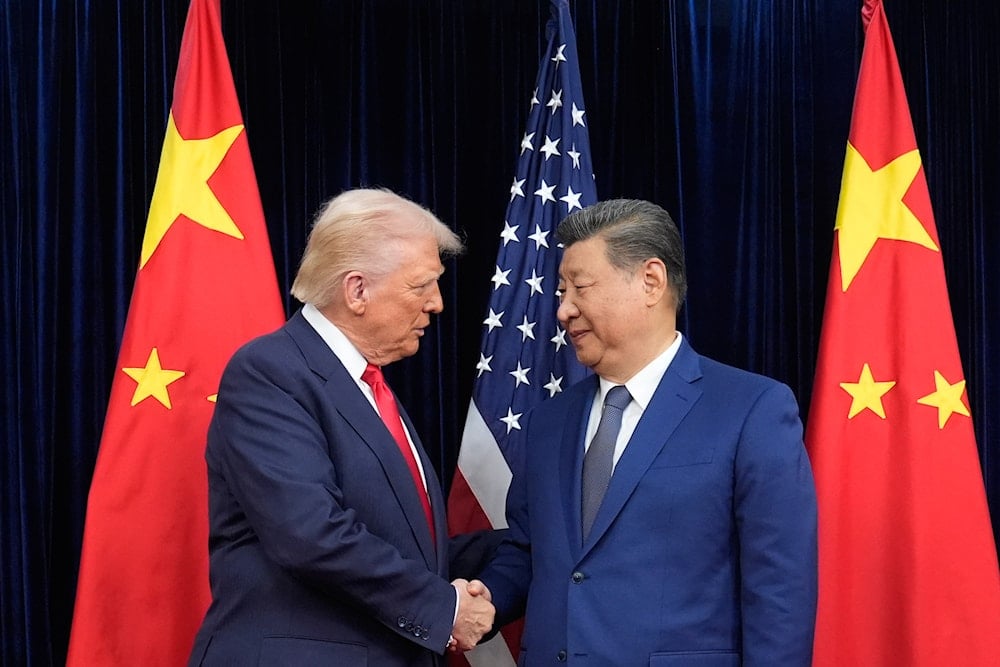
President Donald Trump, left, and Chinese President Xi Jinping, right, shake hands before their meeting at Gimhae International Airport in Busan, South Korea, Thursday, Oct. 30, 2025 (AP)
Donald Trump is heading to China on Wednesday to meet Chinese President Xi Jinping in the first visit by a US president to China in nearly a decade. The last such visit was also made by Trump during his first term in 2017.
At the time, Beijing rolled out an extraordinary welcome for Trump, which Chinese officials described as a “plus-sized state visit.” However, CNBC notes that much has changed over the past nine years. The two countries have fought a trade war, endured a global pandemic, and seen rising concerns over military activity in the region, alongside a renewed round of trade tensions.
Currently, Trump is preparing to visit Washington's principal global rival amid a different atmosphere. His visit was previously delayed after he launched the unlawful aggression against Iran, and his trip has been shortened to just two days.
Ahead of the summit, both sides escalated pressure. Washington accused Beijing of carrying out “industrial-scale” campaigns to steal US artificial intelligence technology, while China instructed companies not to comply with US sanctions on Iranian oil. Whether relations move toward cooperation or further escalation could have major implications for the global economy, CNBC said.
What to expect
Trade relations
The path toward the Xi–Trump summit was shaped during a meeting in Busan last October, when the two sides agreed to a temporary truce in the trade war launched by Trump last year, during which tariffs on Chinese goods reached as high as 145% at their peak.
China responded by restricting exports of rare earth minerals, critical components in global industrial supply chains and US military technology, leading some US factories to pause operations.
As the US administration seeks tangible gains ahead of the November midterm elections, reports indicate that the White House invited several top executives from companies such as Nvidia, Apple, and Exxon to accompany the president on his visit. Boeing CEO Kelly Ortberg and Citigroup CEO Jane Fraser have reportedly confirmed their attendance.
For its part, China is seeking to extend the current trade truce, preserve access to US technology, and ease tighter US export restrictions, using its position as a key counterpart in ongoing negotiations. CNBC expects that Beijing may also leverage the talks to secure major investments in the US economy, similar to arrangements previously reached by the Trump administration with countries such as Japan and South Korea.
Plans to establish both a trade council and an investment council may be formally announced during the meeting. However, a Reuters official noted that the mechanisms may still require further work before becoming operational.
Beijing is also leveraging high-value industrial cooperation, including ongoing discussions with Boeing over a potential agreement for around 500 Boeing 737 MAX aircraft, along with dozens of wide-body jets. Such a deal would represent China’s first major Boeing order since 2017 and a significant outcome for both sides.
Agricultural commitments form another key area of negotiation, with Washington pressing Beijing to commit to purchasing 25 million tons of soybeans annually for three years, alongside increased imports of US poultry, beef, coal, oil, and natural gas.
Beyond conventional trade and investment, China’s strongest leverage lies in its rare earth supply chains.
Analysts believe Beijing may propose a long-term, stable trade arrangement akin to a “general license” that would grant the United States access to rare earth minerals and related magnets, on the condition that they are not used for military purposes.
War on Iran reshaped summit dynamics
The US aggression against Iran has also reshaped the dynamics of the summit, consuming much of Trump's attention. Asian diplomats previously told Al Mayadeen that Beijing rejects any pressure or attempt to transform the summit into a political tool against Tehran, reaffirming China's solidarity with Iran.
The war resulted in the closure of the Strait of Hormuz, through which nearly one-fifth of global oil supplies pass. While it was expected that the Chinese economy would be threatened, Iran showed flexibility, allowing Chinese vessels to transit the waterway safely, and even conditioning the passage of other tankers on paying transit fees in Yuan.
Trump’s shifting statements, alternating between declaring the war over and threatening destruction, have also created diplomatic confusion. On Thursday, Pakistani officials again said the US and Iran were nearing a temporary agreement to halt the situation.
This week, US Treasury Secretary Scott Bessent called on China to “step up diplomatic efforts,” a move widely viewed as a request for Beijing’s help in managing a war initiated by Washington. US Trade Representative Jamieson Greer also said Trump intends to raise China’s continued purchases of Iranian energy during the summit.
China, as the largest buyer of Iranian oil, maintains a significant level of economic interdependence with Tehran, giving both sides incentives to preserve stable trade flows. At the same time, Beijing seeks to safeguard global economic stability, since a downturn that weakens international demand would also affect Chinese exports.
China views the war on Iran as a confrontation created by the United States, affirming full solidarity with Tehran.
Read more: Why China faces limited impact from war on Iran as global risks grow
The issue of Taiwan
President Xi Jinping appears increasingly focused on China's “sphere of influence,” especially in relation to Taiwan. Chinese Foreign Minister Wang Yi said this week that Taiwan represents the “greatest source of risk” in US-China relations.
The United States does not formally recognize Taiwan but supplies it with military capabilities, particularly through arms sales. In recent years, Washington has escalated military drills and sales in Taiwan, raising concerns over a potential military confrontation in the Indo-Pacific.
Trump, however, appears to hold a more flexible stance toward Taiwan than previous US presidents, reportedly viewing it more as an economic competitor, especially in semiconductors, than as a democratic ally. Reports also suggest that an $11 billion US arms package for Taiwan was temporarily suspended by the State Department ahead of the Xi–Trump summit.
Beijing, CNBC said, may seek to pressure Washington into adjusting its official language on Taiwan, including shifting from saying the United States “does not support Taiwan independence” to explicitly stating it “opposes Taiwan independence.”
Artificial intelligence race
Few issues are likely to carry as significant long-term implications as the rapid advancement of artificial intelligence led by both the United States and China, as both countries continue to push the boundaries of innovation while also engaging in discussions around safety, governance, and responsible development.
President Xi may view the summit as an important opportunity to highlight how the two leading AI powers can work together on establishing global standards, framing such cooperation as a shared contribution to the orderly and sustainable development of the field, according to The Guardian.
Trump aides have reportedly expressed concern about advanced AI models being developed in China, while also emphasizing the importance of maintaining open communication channels between the two sides to manage risks, prevent misunderstandings, and ensure stable development in the use of AI technologies.
At the same time, the United States has also pursued a range of pressure measures and restrictions aimed at limiting China’s access to advanced technologies and slowing its broader tech development trajectory, reflecting a dual-track approach of engagement alongside competitive containment.
Nuclear file
Washington has long sought to engage Beijing in discussions on nuclear weapons, while China has taken a more cautious stance, emphasizing that its strategic posture is shaped by its own national security considerations and maintaining a comparatively restrained nuclear policy.
According to a Reuters source, the Chinese government has informally indicated to the United States that it “currently sees no interest in sitting down for nuclear arms control negotiations or arrangements of this kind,” reflecting its preference for conditions it considers more balanced before entering such talks.
The most recent meeting between Trump and Xi Jinping took place in October in South Korea, where the two leaders agreed to ease tensions in a major trade dispute that had seen the United States impose tariffs worth several hundred percent on Chinese goods, while Beijing responded with the potential to restrict global supplies of rare earth minerals, an area where China plays a central role in global supply chains.
In February, the US Supreme Court ruled that Trump lacked the legal authority to impose many of the global import tariffs, though he later signaled his intention to reintroduce some of them through alternative legal mechanisms, underscoring the continued use of trade policy as a tool in managing economic competition with China.
Read more: Beijing rejects leveraging US-China summit to pressure Iran: Source


