
Cuban FM says US pressuring UN states to delay embargo talks
 3 Min Read
Cuban Foreign Minister Bruno Rodríguez says Washington is intimidating UN members to postpone discussions on the US embargo against Cuba.
-
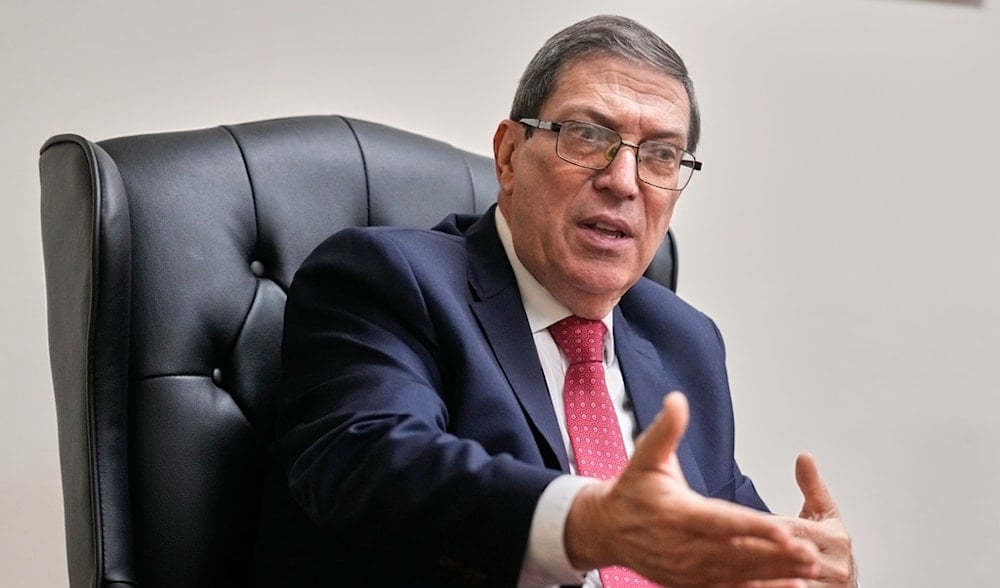
Cuba's Foreign Minister Bruno Rodriguez Parrilla speaks during an interview with The Associated Press at the Permanent Mission of Cuba to the United Nations, in New York, Tuesday, Sept. 30, 2025. (AP)
Cuban Foreign Minister Bruno Rodríguez has accused the United States of pressuring and intimidating United Nations member states in an effort to delay discussions on the US embargo against Cuba.
Speaking on Tuesday, Rodríguez said the sanctions and decades-long embargo have caused serious humanitarian consequences, including deaths inside the country.
He also rejected continued US threats against Cuba, stressing that the island hosts no foreign military bases.
“The only foreign military base on Cuban territory is the illegal Guantanamo Bay base,” Rodríguez said.
The Cuban foreign minister dismissed allegations that Havana has been involved in the war in Ukraine, categorically denying any Cuban role in the war.
Earlier, Cuba’s ambassador to the United Nations, Ernesto Soberón Guzmán, said in an interview with Al Mayadeen that Cuba is facing not merely a US embargo but a sustained “economic war” that has continued for nearly 67 years.
Guzmán said Havana remains prepared for all scenarios, whether through dialogue based on mutual respect and equality or by standing firm in the face of any aggression.
US escalates blockade: sanctions on state companies
The United States recently imposed a new round of sanctions on five major Cuban state-owned entities, escalating its long-running economic blockade as the island grapples with severe economic hardship, recurring blackouts, shortages of food and medicine, and mounting pressure on public services.
The sanctions target several companies linked to Grupo de Administración Empresarial S.A. (GAESA), a business conglomerate run by Cuba's Revolutionary Armed Forces. Washington said the measures are intended to increase pressure on Cuba's leadership and state-controlled economy.
US Secretary of State Marco Rubio accused Cuba's government of prioritizing political control over the welfare of its citizens, alleging that GAESA diverts national resources away from public needs.
Havana rejects US accusations
Cuban authorities dismissed Washington's claims, arguing that the latest sanctions deepen the humanitarian impact of the decades-long US blockade while being presented as support for the Cuban people.
Foreign Minister Bruno Rodríguez condemned the measures, saying they amount to "collective punishment" and accusing the United States of deliberately worsening living conditions on the island.
Cuba's ambassador to the United Nations, Ernesto Soberón Guzmán, also rejected the sanctions, saying they represent part of a broader US campaign of "economic war" aimed at isolating the country, discouraging foreign investment, and forcing political change through economic pressure.
Trade and investment expected to face further pressure
Among the sanctioned entities are Almacenes Universales S.A. (AUSA), Cuba's main logistics and warehousing company, Banco Financiero Internacional, a key commercial bank serving foreign investors, Rafin S.A., Geominera S.A., and Empresa Siderúrgica José Martí, the country's largest raw steel producer.
Analysts say the sanctions could further complicate trade and financial transactions by increasing the risks for foreign companies doing business with Cuba, making investment and commercial operations on the island more difficult.
The measures were announced shortly after Cuba unveiled a series of economic reforms, including plans to allow private businesses to import goods without relying on state intermediaries.
Cuba has consistently denied posing any threat to the United States and maintains that the US blockade remains the primary cause of the country's economic difficulties, including shortages of food, fuel, medicine, and other essential goods.


