
Damascus welcomes repeal of US Caesar Act
 5 Min Read
Syria's new leadership hailed Washington’s repeal of the Caesar Act, though critics argue the move reflects shifting US geopolitical interests rather than a genuine commitment to Syria's recovery.
-
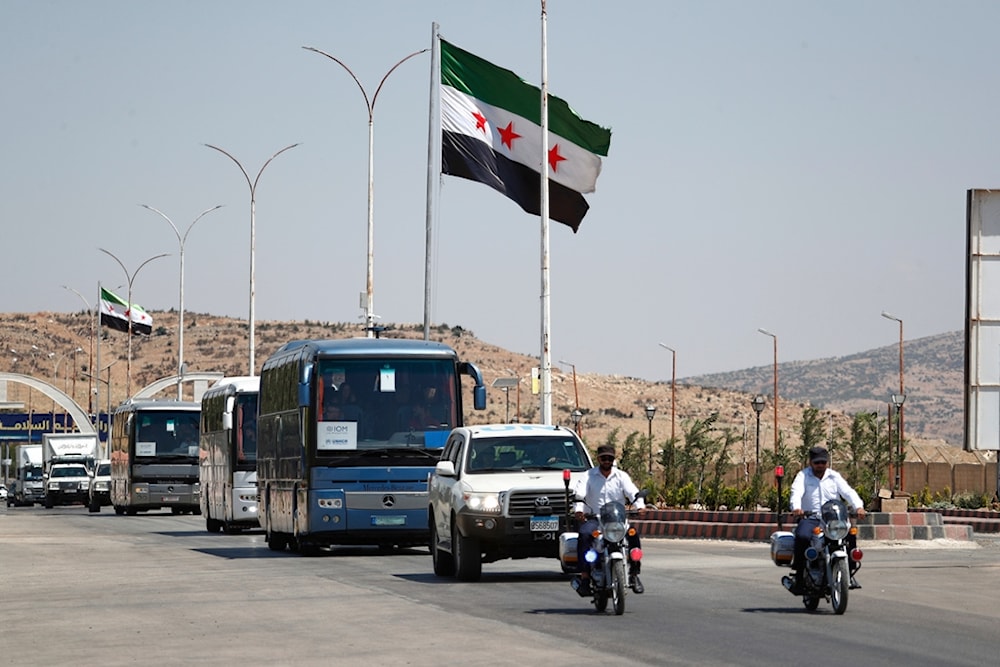
FILE - A convoy of buses carry Syrian refugees who return home from Lebanon, arrive at the Syrian border crossing point, in Jdeidet Yabous, Syria, Tuesday, July 29, 2025. (AP)
Syria’s new interim leadership on Friday celebrated what it framed as a major political breakthrough after Washington formally removed the Caesar Act from US law, ending more than a decade of sanctions that had devastated the country’s economy.
Interim President Ahmed al-Sharaa announced the development in a video address posted to his newly launched X account, calling the moment a turning point for Syria’s recovery. "Today is the first day that Syria is without sanctions, thanks to God Almighty, and then to your efforts and patience for 14 years," he told Syrians.
The shift in US policy came after Congress voted on Wednesday to permanently eliminate the measures originally enacted against former president Bashar al-Assad, who was overthrown in December of last year. The Caesar Act had cut Syria off from global financial networks and blocked nearly all forms of foreign investment.
For years, economists, humanitarian agencies, and regional governments warned that the law amounted to collective punishment that crippled national institutions and deepened civilian suffering.
Sharaa Credits Trump
Al-Sharaa, once an al-Qaeda leader before entering politics, acknowledged the role of external actors in securing the change. Offering what he described as a public gesture of gratitude, he said: "special thanks to (US) President Donald Trump... for responding to the call of the Syrian people, and to the members of Congress for recognising the sacrifices of the Syrian people".
His comments sparked criticism among Syrians who note that Washington, alongside Gulf and Turkish partners, backed the very political forces that lobbied for these sanctions in the first place, only to reverse course once the country’s leadership changed.
Although Trump had previously paused enforcement of the sanctions twice following appeals from Saudi Arabia and Turkey, both backers of Sharaa’s government, Friday’s announcement marks the first time the restrictions have been fully revoked. Syrian officials had long argued that even temporary suspensions discouraged investors who feared exposure to US legal risk, but also stressed that no genuine recovery could occur as long as foreign powers dictated the pace and terms of Syria’s economic reopening.
In an earlier statement Friday, Syria’s foreign ministry described the decision as a gateway to rebuilding the state. Calling the repeal "an entrance to the phase of reconstruction and development", the ministry urged citizens everywhere to participate in the recovery process, saying the government encourages "all Syrians in the country and abroad to contribute to national recovery efforts".
Sanctions Era Ends
The repeal follows months of pressure from regional states that warned Washington that the sanctions were obstructing not only Syria’s reconstruction but also regional stability. Gulf governments, Jordan, and Egypt repeatedly argued that prolonged collapse risked fueling renewed extremism, destabilizing border regions, and accelerating refugee outflows. UN agencies likewise reported that the sanctions had compounded humanitarian suffering, restricting access to medical equipment, spare parts, and essential materials for early-recovery projects.
US lawmakers backing the repeal argued that the Caesar Act had lost “strategic relevance” after Assad’s removal, an assessment critics say reveals the political nature of the sanctions rather than any humanitarian concern. Maintaining the law, they claimed, risked pushing Syria closer to Iran and Russia at a moment when Washington is seeking to reassert influence in the Levant. Several European governments are now independently reviewing their sanctions regimes, signaling possible Western re-engagement with Damascus after more than a decade of isolation.
Despite the repeal, analysts warn that Syria’s economic revival will be slow. Years of war, foreign-backed insurgency, capital flight, and fragmented authority across parts of the country pose major challenges. Economists note that international banks and companies will still move cautiously until Washington clarifies how other US counterterrorism and money-laundering statutes will be applied to Syrian entities, meaning the end of Caesar sanctions does not automatically translate into the end of Western economic pressure.
Postwar Pressures
The move also comes amid a fragile and heavily contested political transition. Sharaa’s interim government faces pressure to restore basic services, rein in armed groups that helped bring it to power, and address reports of abuses against minorities during the transition period. Critics argue that Western powers are using the promise of reconstruction funding as leverage to shape Syria’s internal political direction, reflecting patterns seen in earlier US interventions across the region.
Regional markets, however, reacted positively to the repeal, with Syrian-linked stocks in Amman and Dubai edging upward on expectations of renewed trade. Business associations in Lebanon and Iraq also welcomed the decision, anticipating the reopening of supply chains and labor corridors that had collapsed under the sanctions regime, though many remain cautious, noting that Syria’s recovery will depend on whether foreign powers allow the country to rebuild on its own terms rather than through externally imposed conditions.
Read more: UK sanctions Syrian figures over civilian violence


